




Terracon Moves to Larger GVW Trucks
The 1,400-vehicle nationwide fleet lowered its total cost of ownership, increased safety, improved load capacity, and boosted driver morale after moving from smaller trucks up to ½-ton pickups.

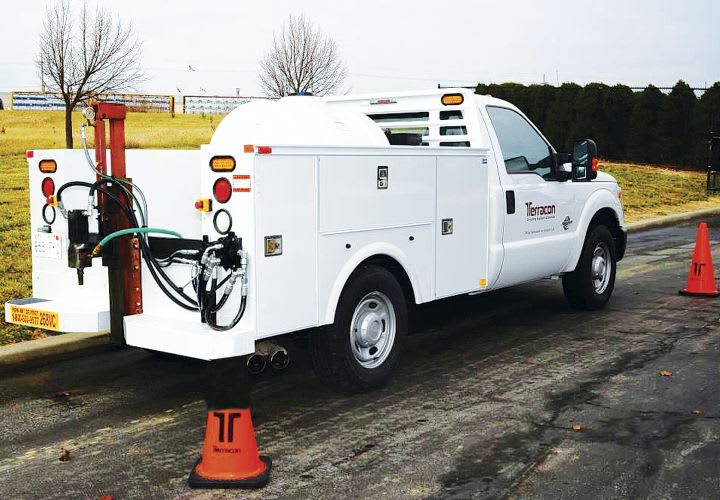
Terracon's fleet consists of approximately 1,400 ½- and 1-ton pickups, 60 vans and SUVs, 82 semi-tractors, and 87 drill rigs.
Photo: Terracon
Safety concerns continue to challenge fleet operations of all sizes. On average, 21 percent of fleet vehicles are involved in some form of crash each year, according to data from several accident management companies. Today, more fleet managers are turning to safer vehicles in an effort to help increase driver safety and mitigate rising accident costs.
Consulting engineering firm Terracon, based in Olathe, Kan., made such a change when it implemented an initiative to switch from smaller, light-duty trucks to a ½-ton pickup fleet for greater load capacity and increased safety.
Terracon was initially founded in 1965 and has evolved into a successful multi-discipline firm specializing in environmental, facilities, geotechnical, and materials engineering consulting. With more than 3,000 employees in 140 offices across 40 states, the company also partners with its U.S. clients to serve their international needs.
The company provides services on thousands of projects each year. And, according to Ginny Liddle, CAFM, buyer II for Terracon, the fleet plays a large part in the company delivering exceptional customer service.
"By being responsive, resourceful, and reliable, we strive to exceed our clients' expectations for service, solutions, quality, and speed of delivery," she explained. "Based on a deep understanding of our clients' needs, Terracon's commitment is centered on these key objectives."
Safety Evaluation Leads to Important Discoveries
Terracon's fleet consists of approximately:
1,400 ½- and 1-ton pickups.
60 vans and SUVs.
82 semi-tractors.
87 drill rigs.
Because fleet drivers include consulting engineers and scientists, employees need a variety of vehicles to work on construction sites, make land and building inspections, and perform land and water drilling for foundation recommendations. The company's replacement guideline falls at four years/110,000 miles.
In 2007, the company's fleet management evaluated its trucks for productivity and safety. And, in examining its accidents for the previous two years, the fleet team realized that it had many rollovers in smaller trucks, while noting only one in a ½-ton pickup and one in a van.
Another discovery encompassed repair history. When fleet management examined the repair history, it found vehicles were going through brakes quicker and the number of suspension problems was increasing at an unexpected rate.
"In 2008, after working with our leasing company doing a total cost of ownership (TCO) analysis comparing small trucks and ½-tons, we found it would actually be a cost savings by transitioning to just the ½-ton truck," Liddle said. "The safety factor in a larger truck would increase as well."
The fleet currently uses the Ford F-150 and chose this model based on hard data.
"We were running a few Rams and F-150s at that time, and we received the best rebates from Ford and Chrysler," Liddle said. "With the data our leasing company had on all the trucks, we compared the ½-ton trucks and smaller trucks for total cost of ownership and found that the Ford F-150 would give us our best results."
Initiative Results in Significant Operational Benefits
The switch from small trucks to ½-ton pickups resulted in significant savings for Terracon. In fact, the company lowered its TCO, increased safety, improved load capacity, and even increased driver morale.
The ½-ton trucks were made safer as a result of their improved capacity and ability to make the job more efficient.
"We did not need to overload them to get the job completed," Liddle said.
The fleet team also put safety nets on all the truck beds to ensure that equipment, samples, etc., did not fall out of the truck for increased public safety.
In fact, since the company's study showing 11 rollovers in 2006-2007, only three rollovers have occurred in the remaining small trucks in service, and none in the ½-ton pickups.
Driver productivity also increased, because each new vehicle could hold more samples and equipment. And, downtime decreased since less maintenance was required. The fleet had fewer trips to the shop for brakes and suspension issues, and tires have lasted longer.
"Our drivers applauded the change as they were given a more functional, safer, efficient tool to complete their work," Liddle stated.
Completing the Conversion Process
Terracon has been replacing the smaller trucks since 2008 and have less than 100 units left. While the recession slowed the replacement schedule, Liddle expects the entire conversion to be completed soon.
"Our move to larger vehicles would not have been possible without support from upper management," she said. "Terracon's senior management is very good at evaluating current and future business trends and adapting our strategic plan accordingly."
The company has also increased its safety department from two people to five people. And, as its fleet grew, the company's senior management recognized the need to increase its safety role with employees, so that all employees live in an incident- and injury-free culture and arrive home safely every day.
Moving forward, Terracon's fleet department will continue to evaluate vehicles to ensure they supply employees with the correct vehicle for the job and continue to upgrade safety features.
"This year, we will add the backup camera to our 2014 models to assist in backing safely," she concluded.
Originally posted on Work Truck Online
More Operations

Avis Budget Group Deploys Neology Toll Management Technology Across Major Brands
Neology’s neoFleet platform will manage toll transactions and toll-authority operations for vehicles across Avis, Budget, Payless, Budget Truck and Zipcar.
Read More →
Fleet Personal-Use Charges Edge Higher in 2026
Nearly eight in 10 surveyed fleets allow personal use of company vehicles, while just over half of respondents report charging employees for the privilege.
Read More →
The Future of Fleet + What’s Changing Right Now | AF News Recap
Could developments overseas offer a preview of what’s coming for U.S. fleets? This week, we’re looking at the future of AI, autonomy, and electrification, plus Ford Pro’s new certified pre-owned program, smarter vehicle offboarding, and a new way for fleets to manage toll expenses.
Read More →
How to Handle Vehicle Offboarding
What do fleet managers need to do when a driver leaves?
Read More →
Fleet Manager’s Ultimate Playbook: Navigating the New Standard in OEM Connectivity
Rising operating costs, driver safety concerns, and unplanned downtime are putting unprecedented pressure on modern fleets. Discover how fleet managers use embedded OEM connectivity and real-time vehicle data to cut TCO, prevent downtime, and protect drivers without aftermarket telematics hardware.
Read More →
U.S. Bank Adds Verra Mobility Toll Management to Voyager Fleet Platform
The integration allows U.S. Bank Voyager fleet customers to manage toll payments and violations alongside fuel, EV charging and maintenance expenses.
Read More →
ADAS Prevents Crashes. But Repairs Cost More | AF News Recap
ADAS-equipped vehicles may crash less often, but they can cost more when they do. This week, we’re breaking down what that tradeoff means for fleets, plus Subaru’s first Forester Wilderness Hybrid, Nissan’s new e-POWER Rogue, and why Calstart has become Catalyst Mobility.
Read More →
Moventum Fleet Management Names Mark Iorillo Head of Sales
Iorillo brings nearly 20 years of fleet management and sales experience to the role, including previous positions at Element Fleet Management, CEI, Donlen and Ryder.
Read More →
Fleet Has a Talent Pipeline Problem. What Comes Next? | AF News Recap
Where will fleet’s next generation of leaders come from? This week, we’re looking at the industry’s talent pipeline, what certification can add to a fleet career, how to build an award-worthy track record, and the return of Automotive Fleet’s Personal Use Survey.
Read More →
Smith System Launches Driver Risk Management Program
Fleets have more driver data than ever, but identifying risky behavior doesn't necessarily correct it. Smith System's new Driver Risk Management program combines monitoring, training, and follow-up coaching to help fleets connect risk signals with driver intervention.
Read More →