




Surviving Against All Odds
But while its outer trappings convey the power of an indestructible institution, the police car itself is simply another fleet vehicle - one, in fact, that probably takes more abuse than any other. Used in endless stop-and-go driving, it must perform at a moment's notice in high-speed pursuit, can be rammed by other cars or shot at while officers crouch behind it.
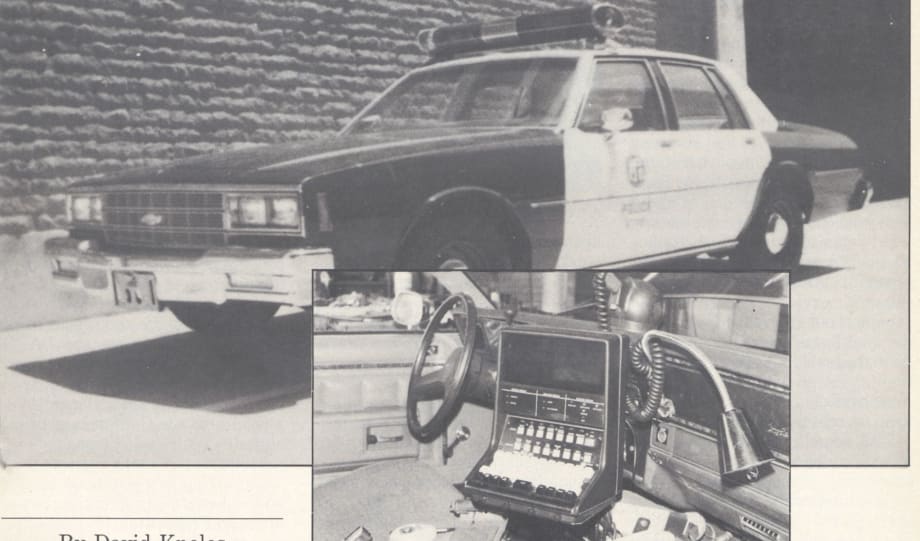
No car on the road is as quickly recognized; its flashing lights and black-and-white coloring are symbols of authority. But while its outer trappings convey the power of an indestructible institution, the police car itself is simply another fleet vehicle - one, in fact, that probably takes more abuse than any other. Used in endless stop-and-go driving, it must perform at a moment's notice in high-speed pursuit, can be rammed by other cars or shot at while officers crouch behind it.
A police fleet is one of the most difficult to administer. Aside from the obvious maintenance problems arising from the constant vehicle abuse, police fleet administrators are restricted as to what models they can buy, and their replacement and acquisition policies are often hampered by politics.
Nowhere is this more the case than in Los Angeles. The Los Angeles Police Department owns and operates one of the largest police-car fleets in the country. Charged with protecting 2,966,800 people in the 465-square-mile area within the city boundaries, the LAPD currently operates over 3,000 vehicles, including cars, vans, motorcycles, buses, and three-wheel parking-control vehicles. Of that total, 2,150 are cars. According to Don Brittingham, LAPD director of police transportation, a small percentage are unmarked cars used by special police divisions such as detectives or narcotics. But the majority are black-and-whites. About 80 of these are used for full-time traffic enforcement. The rest are used for patrol and are on the road 24 hours a day, seven days a week.
It would be impossible to adequately cover a sprawling area such as Los Angeles from one centralized location, so the LAPD splits its operations among four geographic divisions: downtown or metropolitan areas, beach areas to the west, valley areas beyond the Santa Monica Mountains to the north, and the San Pedro/harbor area, an isolated area about 35 miles to the south. According to Brittingham, there are 19 separate locations or precincts within these four geographic areas where police cars are stationed. "We do it this way," Brittingham says, "so we can have the patrol cars available where and when they are needed."
This method of dispersal also aids in problems such garaging space and maintenance delays. Each precinct garage contains its own maintenance shop and fueling station, and each is administrated by its own separate fleet manager. "Each of our latest-type garages, at Wilshire, Pacific, Devonshire, and Southwest stations, has three drive-through bays providing six work stalls," Brittingham says. Three of the work stalls have twin-post hoists. There is also a drive-through car wash area with a vacuum cleaning system, hand washing, and a drive-through rinse spray. A storage area for motorcycles is at one end, and the office, parts room, locker room, and showers are at the other. Each garage has three mechanics and a senior-mechanic garage-supervisor, who works closely with the police supervisor and personnel to meet changing priorities. "Each of the garages services, maintains, and repairs about 100 vehicles, so the individual fleets are small enough to be manageable," Brittingham comments. "And with the basic PM decentralized, minor repairs present no real problem."
Fuel, something that creates both a cost and accounting problem for many fleet managers, is provided from underground storage tanks at each of the 19 garages. "That's about the only way we can handle it, since we go through about 4 million gallons of gasoline a year," Brittingham says. "Patrol cars are out around the clock, and they need fuel 24 hours a day. We stock an adequate supply at each facility; we have people manning the pumps during the day, and the officers themselves pump gas during the night. Officers also carry credit cards to buy fuel if they need it in the field, but this is only done in an emergency."
Brittingham acquires fuel through a fuel broker, who delivers it on a weekly or bi-weekly basis as needed. "The broker finds the best prices for us dependent on current petroleum costs, which means our cost fluctuates slightly from time to time. Based on what he considers to be the best price, he might deliver any one of the major brands to us," Brittingham says.
Only fueling and preventive maintenance such as oil changes, tune-ups, and alignments are done at the station garages. Major repair work, including engine overhauls, engine replacements, transmission work, front-end replacement, and collision-damage repairs, is done at one of two centers in the downtown area.
These centers are also where newly-acquired cars are prepped for police work. "We install radios, sirens, and rotating-light bars on the new cars from the factory," Brittingham says. Here a new piece of police equipment, the MDT, is also installed. "Each black-and-white carries a mobile digital terminal (MDT)," he says, "that provides remote, on-line, computer access to DMV and criminal justice files, preventing the delays of voice communication in determining the status of traffic offenders or criminal suspects. Officers normally receive their calls on the computer screen instead of through voice communication, which eats up available air time. The police dispatchers type the information into their consoles without transmitting the information, then use the transmit key, which sends the complete message in a split second. The patrol officer has a standard keyboard and several programmed function keys which let him immediately transmit his status. The system also tells the dispatcher what unit is transmitting."
With minimal garaging, maintenance, and fueling problems, management of the LAPD fleet sounds as smooth-running as a brand-new V8 engine. But this is only half the management picture; other aspects would give most fleet administrators nightmares.
Major problems lie in the areas of vehicle service life and replacement cycling. At one time, the LAPD adhered to a policy of vehicle service life and replacement similar to NAFA fleet averages. But in 1978, a change in the California political climate rendered those policies meaningless. A rising concern over skyrocketing property taxes heralded the Jarvis-Gann Initiative, better know as Proposition 13. Passed by an overwhelming majority of California voters, Proposition 13 limited property taxes to 1 percent of assessed value. While property owners were elated, property-tax-revenue-dependent city and county governments plunged into an economic tailspin. As a result, the LAPD soon found itself under the blade of budget cuts. "Something had to go," Brittingham remembers, "and we couldn't freeze hiring. So after Proposition 13, we didn't get any new cars; it's as simple as that."
Prior to 1978, police cars were kept for about three years or 60,000 miles - 70,000 miles for unmarked cars. But after the money for new-car acquisition evaporated, policies had to be re-thought. And the answer was simple: Keep the old cars as long as possible. "In 1978, we extended the expected life of our cars from 60,000 miles to a maximum of 140,000 miles before replacement," Brittingham says. "But only a few black-and-whites got up that high. We'd blow them up or wreck them first. Fortunately we had a good fleet and a good PM program at the time Proposition 13 hit, so we were able to survive pretty well."
With budget restraints loosening, Brittingham says the replacement policy has been revised to 90,000 miles. He wants to bring replacement policies even closer to what they were in '78 but says: "It's not something you can do all at once. We're phasing new acquisition and replacement policies in a little at a time, based mostly on what money the city has at any one time. This is still somewhat dependent on what happens in Sacramento, since the state still determines to a great extent what money the city has to spend. This year, we have 500 cars on order, which is about all we can process through our radio shop at one time anyway."
New cars are ordered through a bidding process. "We bid through various dealers for the best price," Brittingham says. "The dealers don't physically handle the vehicles, though. They just handle the new-purchase paperwork." He adds that police cars are modified versions of existing domestic models that are not available to the general car-buying public. "For one thing," he says, "a police-car engine is special; it is larger than an engine you could buy in a conventional car. You used to be able to equip a police car with a 350 cubic-inch engine, but that was discontinued. A 318 is about the biggest you can get now."
The problem of downsizing is something else that plagues Brittingham. The current LAPD fleet is predominantly made up of 1978, intermediate-size, 116-inch wheelbase, Plymouth Furies. Brittingham bemoans the fact that although the nameplate was retained, the Fury was downsized, rendering it almost useless as a police car. Although some law enforcement agencies in California, such as the Highway Patrol, can use smaller cars like the Chevrolet Camaro and Ford Mustang, the LAPD cannot. The smaller cars, Brittingham says, are used mostly for high-speed pursuit on the open highways and are not big enough for inner-city patrol duties. He says only full-size cars will meet these needs. One reason for this is that a small car does not have the back-seat capacity to transport suspects in relative comfort; another reason is that a smaller-wheelbase car does not have the front-seat interior space needed to hold two officers and their necessary equipment. "There isn't a lot of room for two officers, the MDT, radio equipment, shotgun, spotlight, and everything else," Brittingham says. "Only two police-car models have the necessary width at the beltline to do this, and they are the Chevrolet Impala and the Ford LTD Crown Victoria." In '82, the department chose Impalas, he says; this year it ordered Crown Vics.
But if lack of model selection isn't enough of a problem, acquisition is further hampered by availability. Brittingham says that only about 50,000 police cars are made each year and, because of this, there is only a narrow time-window during which police cars can be ordered, usually between December and March. The LAPD is not, however, restricted by strict California emission standards. Brittingham says the force was exempted from California emissions standards in 1981. "That doesn't mean our cars don't require smog control devices," he says. "In our best years we only bought 10 percent of the police cars made, so it was just un-economical for Detroit to make so few cars."
When cars are ordered, attention is paid to interior options. "The police car is the officer's office and home for eight hours a day," Brittingham says. "So we try to make it as comfortable and safe as possible. We use fabric upholstery instead of vinyl for comfort and coolness, even though it might not wear as well. We use all-vinyl rear seats, which do wear well with prisoners and can be easily cleaned."
Disposal of off-line police cars is a much simpler process. Used cars are assigned for sale through a centralized city salvage department, and are then sold at public auction. "They haven't brought in very much, though," Brittingham comments. "About the most we get for a used black-and-white police car is $350, although the unmarked cars used to bring in a little more. The fact is, cars are worn out by the time we dispose of them. We have learned something from all this, however. We can run cars longer than we did prior to '78. Since there are fixed costs involved in putting a police car on the road, such as equipment installation, it can be economical to keep them beyond the 100,000 mile mark even if there is very little resale value left in them when we are done."
Limited availability, limited model selection, and fluctuating yearly budgets are frustrating, but good management, good PM programs, and plain ingenuity have allowed the LAPD to weather the bad times.
More Operations

Avis Budget Group Deploys Neology Toll Management Technology Across Major Brands
Neology’s neoFleet platform will manage toll transactions and toll-authority operations for vehicles across Avis, Budget, Payless, Budget Truck and Zipcar.
Read More →
Fleet Personal-Use Charges Edge Higher in 2026
Nearly eight in 10 surveyed fleets allow personal use of company vehicles, while just over half of respondents report charging employees for the privilege.
Read More →
The Future of Fleet + What’s Changing Right Now | AF News Recap
Could developments overseas offer a preview of what’s coming for U.S. fleets? This week, we’re looking at the future of AI, autonomy, and electrification, plus Ford Pro’s new certified pre-owned program, smarter vehicle offboarding, and a new way for fleets to manage toll expenses.
Read More →
How to Handle Vehicle Offboarding
What do fleet managers need to do when a driver leaves?
Read More →
Fleet Manager’s Ultimate Playbook: Navigating the New Standard in OEM Connectivity
Rising operating costs, driver safety concerns, and unplanned downtime are putting unprecedented pressure on modern fleets. Discover how fleet managers use embedded OEM connectivity and real-time vehicle data to cut TCO, prevent downtime, and protect drivers without aftermarket telematics hardware.
Read More →
U.S. Bank Adds Verra Mobility Toll Management to Voyager Fleet Platform
The integration allows U.S. Bank Voyager fleet customers to manage toll payments and violations alongside fuel, EV charging and maintenance expenses.
Read More →
ADAS Prevents Crashes. But Repairs Cost More | AF News Recap
ADAS-equipped vehicles may crash less often, but they can cost more when they do. This week, we’re breaking down what that tradeoff means for fleets, plus Subaru’s first Forester Wilderness Hybrid, Nissan’s new e-POWER Rogue, and why Calstart has become Catalyst Mobility.
Read More →
Moventum Fleet Management Names Mark Iorillo Head of Sales
Iorillo brings nearly 20 years of fleet management and sales experience to the role, including previous positions at Element Fleet Management, CEI, Donlen and Ryder.
Read More →
Fleet Has a Talent Pipeline Problem. What Comes Next? | AF News Recap
Where will fleet’s next generation of leaders come from? This week, we’re looking at the industry’s talent pipeline, what certification can add to a fleet career, how to build an award-worthy track record, and the return of Automotive Fleet’s Personal Use Survey.
Read More →
Smith System Launches Driver Risk Management Program
Fleets have more driver data than ever, but identifying risky behavior doesn't necessarily correct it. Smith System's new Driver Risk Management program combines monitoring, training, and follow-up coaching to help fleets connect risk signals with driver intervention.
Read More →