


At a Glance
The strategies of E3 are useful ideas that fleets can use as a concept for employee to rally around. They focus on:
Efficiency
Effectiveness
Enthusiasm
 MENU
MENU SEARCH
Fleets should turn to an “E3” strategy, which means being efficient, enthusiastic, and effective to accomplish company goals.
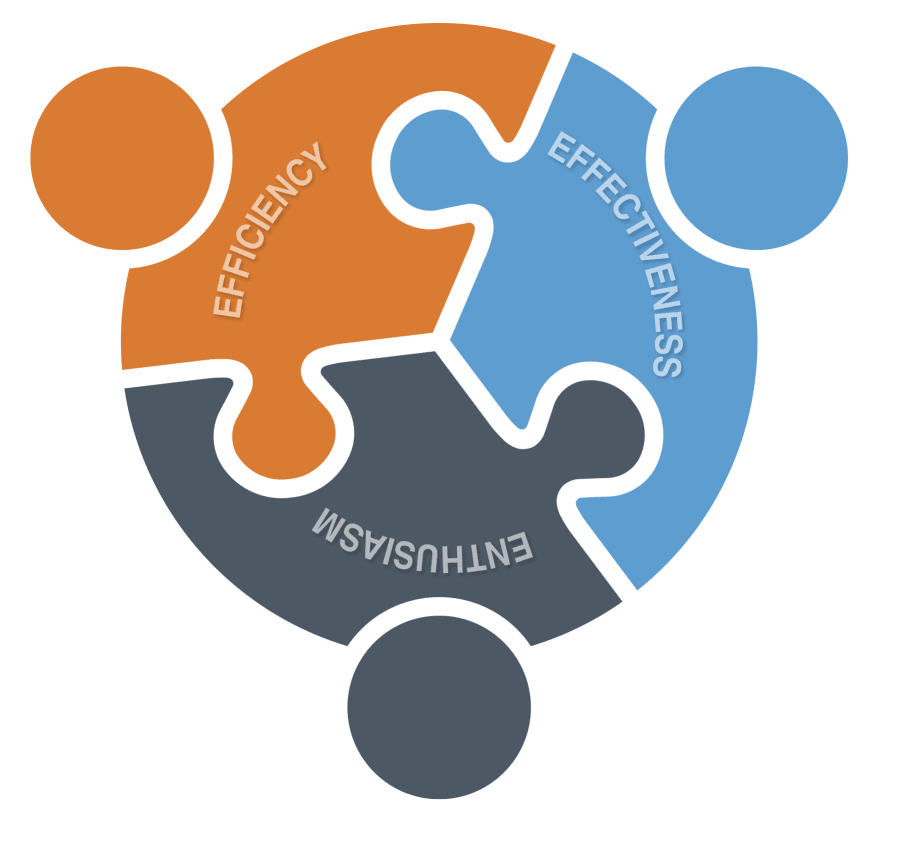
Graphic courtesy of Getty images.
Graphic courtesy of Getty images.
In this age of fast-paced technological advancements, fleets are desperately trying to engage and train employees to embrace change, remain focused, maintain optimal productivity, and stay motivated to sustain their performance at a high level.
The strategies which are employed, and often simultaneously pursued, can become diluted and less than effective. These include employee participation in mission and vision creation to obtain buy-in, management led self-assessments, focus on performance metrics, one-on-one dialogue session, and off-site events that create environments for team interaction/bonding. These various approaches can have a positive impact on a fleet operation; individually and as a team.
However, when employees of organizations or teams are individually interviewed, they usually don’t share the same opinion of what is impactful to them and their recollection of the latest vision and mission statements get lost in the fast-paced shuffle. Quite often it is the simple slogans or quotes that many employees personally adopt that have the most meaning and which can commonly be found at the bottom of an employee’s e-mail signature line. All of them have some personal impact, but none have an across the board connection to organizations or teams.
This is where the practices of E3 come into play. What is E3? It is merely a simple approach to engaging employees to rally around a memorable and impactful saying that can be applied to virtually any undertaking in both a business and personal environment. E3 can become the lighthouse for deploying organizations and teams to achieve tasks and objectives that support the vision and mission of any venture.
The E3 strategy consists of three simple, yet meaningful words. They are efficiency, effectiveness, and enthusiasm. These three words can be considered the “triangle offense” of any successful business, enterprise, or personal endeavor. When clearly understood, and practiced, they can easily be implemented and lead to the achievement of ultimate success, either personally or in a business environment.
Efficiency is one of two continuous improvement principles that has a limited shelf life resulting from new ideas, change in conditions, and constant evolution of technology and the human understanding of how to leverage current technology. Process improvement principles and philosophies such as Total Quality Management (TQM), and Lean Six Sigma have been around for decades. The methods of teaching and adopting these various approaches themselves have had to evolve along with the advent of technology to remain effective and efficient in helping organizations remain on the continuous improvement path.
Efficiency is the act of completing a task in a minimum amount of time that accomplishes 100% of the specific task. An example of this would be to drive from point A to point B to make a sale in the least amount of time to complete the sale. However, efficiency, alone is not enough to achieve and sustain full value.
So, what is needed to sustain full value? It is effectiveness which is the second of those key continuous improvement principles which require a closed loop feedback system which allows for the measurement of outcomes (metrics) to determine if the desired results are being achieved.
Effectiveness is the act of accomplishing a specific task, or set of tasks, that achieves 100% of intended overall objective. An example of this by comparison would be to drive to the right location to make a sale that makes the most net profit. This too requires the appropriate key metrics to measure success.
Enthusiasm is the engine that provides positive energy to complete a task, or achieve a goal, efficiently and effectively. This element creates momentum that is infectious to others especially in a team environment. This belief compelled Walter Chrysler, founder of Chrysler Corp., to proclaim that “enthusiasm is the key to success.” Without it, we are merely going through the motions and depriving ourselves of a deeper fulfillment when accomplishing tasks or goal.
Enthusiasm is a modeled behavior that when consistently demonstrated by leadership in a business environment, or people as part of a lifestyle, can have significant influence on others. “We engage in emotional contagion,” says Sigal Barsade, a Wharton management professor, who studies the influence of emotions on the workplace. “Emotions travel from person to person like a virus.”
Barsade is the co-author of a new paper titled, “Why Does Affect Matter in Organizations?” (“Affect” is another word for “emotion” in organizational behavior studies.) The answer: Employees’ moods, emotions, and overall dispositions have an impact on job performance, decision making, creativity, turnover, teamwork, negotiations, and leadership.
People who approach all that they do with enthusiasm achieve measurably better results when compared to people who perform tasks with apathy, or worse, negativity.
Without efficiency and effectiveness, a performed task or set of tasks may not result in a maximum outcome. They should not be considered mutually exclusive but rather must be pursued simultaneously if optimum success is to be achieved. Thus, the combination of efficiency, effectiveness, and enthusiasm can result in a team of people achieving success will beyond the individual sum of its parts.

Where will fleet’s next generation of leaders come from? This week, we’re looking at the industry’s talent pipeline, what certification can add to a fleet career, how to build an award-worthy track record, and the return of Automotive Fleet’s Personal Use Survey.
Read More →
Fleets have more driver data than ever, but identifying risky behavior doesn't necessarily correct it. Smith System's new Driver Risk Management program combines monitoring, training, and follow-up coaching to help fleets connect risk signals with driver intervention.
Read More →
Less than two weeks left! Commercial and corporate fleet managers are invited to share how their organizations handle company vehicle personal-use policies, charges, and driver eligibility.
Read More →
Can better prompts make AI more useful for fleet managers? This week, we’re breaking down smarter fleet analysis, an AI-assisted experiment that turned safety training into music, and what happened to fuel prices in August.
Read More →
Include these six elements in your fleet prompts to generate more relevant analysis and accurate answers.
Read More →
This edition of the Fleet Meets series features one of the industry's best leaders driving multi-market and national operations.
Read More →
Research highlights a growing need for proactive management strategies to address rising costs in fleet operations effectively.
Read More →
Tracking fleet metrics is only useful when the data leads to better decisions. This guide helps fleet leaders assess cost, utilization, and downtime more accurately, identify performance gaps, and prioritize the actions that can improve operational results.
Read More →
Fleet compliance isn't just about having policies — it's about consistently enforcing them. This practical guide reveals six hidden compliance risks common in public sector and shared fleet operations and outlines proven strategies to improve visibility, accountability, and audit readiness
Read More →
Does data alone drive results in operations?
Read More →