




Steps for Reducing Preventable Accidents
Accident management costs are consistently increasing year-over-year. Several experts shared their recommendations and steps to reducing preventable accidents.

Accident management costs are consistently increasing year-over-year. Several experts shared their recommendations and steps to reducing preventable accidents.
There are five basic safety steps to reduce preventable accidents:
1. Collect motor vehicle reports on all job applicants and existing fleet drivers to prevent the hiring of problem drivers and help identify high-risk drivers who require extra attention, such as remedial training.
2. Keep current files on driver behavior, and include as many data points as possible. In addition to motor vehicle violations, include accident history, traffic camera violations, and public driver re-porting data.
3. Set up a system where every driving event is equally applied to a driver’s risk summary, any-where it happens. Create a for-mula for identifying different risk levels based on each driver’s cumulative performance.
4. Make it easy for drivers and their managers to know the risks they present to fleet, what can make increase or decrease risk, and what the consequences are.
5. Take action for poor driving as soon as possible after drivers pass into a higher risk level, and reward drivers for good driving performance.
It is imperative fleet managers monitor drivers through a driver records program,” noted Eliot Bensel, director, vehicle accident services and risk safety for PHH. “Also, choosing the right safety program is critical. Clients should always seek the consultation and advice of qualified safety training providers to ensure positive results.”
According to Bob Martines, president and CEO for Corporate Claims Management, driver training is the best combatant to accident prevention.
With all of its benefits, technology can have its downsides. “If drivers be-come too dependent on rear sensors, back-up cameras, or automatic braking, driving skills will deteriorate over time,” according to Martines. “I am willing to bet most drivers with back-up sensors in their vehicles do not turn completely around to look behind their vehicle or just glance into the side view or rear view mirrors because they have become ‘programmed’ to rely on the back-up sensor. What happens if the sensor fails? Every licensed driver needs to have reminders that their driving skills must always be fine-tuned just in case a mechanical failure occurs.
Fleet Response recommends identifying issues and addressing them with a comprehensive approach that includes reviewing policy, reviewing trends, and creating a safety program that includes sending a message to drivers that safety is important, training drivers and identifying drivers that need attention.
More Safety

Does Your Fleet's Culture Encourage Distracted Driving?
What happens when the people responsible for enforcing safety rules are the ones setting the wrong example? The answer may reveal why some of the biggest risks to fleet drivers have little to do with what's written in the employee handbook.
Read More →
Fleet Manager’s Ultimate Playbook: Navigating the New Standard in OEM Connectivity
Rising operating costs, driver safety concerns, and unplanned downtime are putting unprecedented pressure on modern fleets. Discover how fleet managers use embedded OEM connectivity and real-time vehicle data to cut TCO, prevent downtime, and protect drivers without aftermarket telematics hardware.
Read More →
From Driver Well-Being to EV Charging | AF News Recap
Mental health belongs in the fleet safety conversation. This week, we’re looking at five ways fleets can support employee well-being before a crisis, plus Holman’s expansion in Mexico, new one-day Fleet Forward passes, and why EV charging demand is outpacing infrastructure growth.
Read More →
Nexar-Nauto Merger Aims to Give Fleets Better Safety Intelligence Through Larger Driving Dataset
Stefan Heck tells Automotive Fleet that combining more than 10 billion miles of driving history with Nexar's AI models will give fleets deeper insights into driver risk and roadway conditions than either company could provide independently.
Read More →
Don't Wait for a Crisis: 5 Ways to Build Mental Health Into Your Fleet Safety Program
For Suicide Prevention Month, fleet and safety leaders have an opportunity to put mental health where it belongs: at the center of workplace safety.
Read More →
How Camera Data Can Strengthen a Fleet’s Insurance Renewal
Insights from a commercial insurance carrier and a broker show how fleets can turn video telematic data, driver coaching, and improved claims results into a stronger case at insurance renewal.
Read More →
The Safest Fleets Aren’t the Ones with the Most Technology
You’ve made the telematics investment. Here’s how to capture the other half of its value and build the safest fleet on the road.
Read More →
Hidden in Plain Sight: Fleet Compliance Risks
Fleet compliance isn't just about having policies — it's about consistently enforcing them. This practical guide reveals six hidden compliance risks common in public sector and shared fleet operations and outlines proven strategies to improve visibility, accountability, and audit readiness
Read More →
NETS Sets 2026 Fleet Safety Benchmark Conference for Indianapolis
The Sept. 15–17 program will feature fleet benchmarking data, case studies, emerging technologies, and implementation strategies while running alongside the NSC Safety Congress & Expo.
Read More →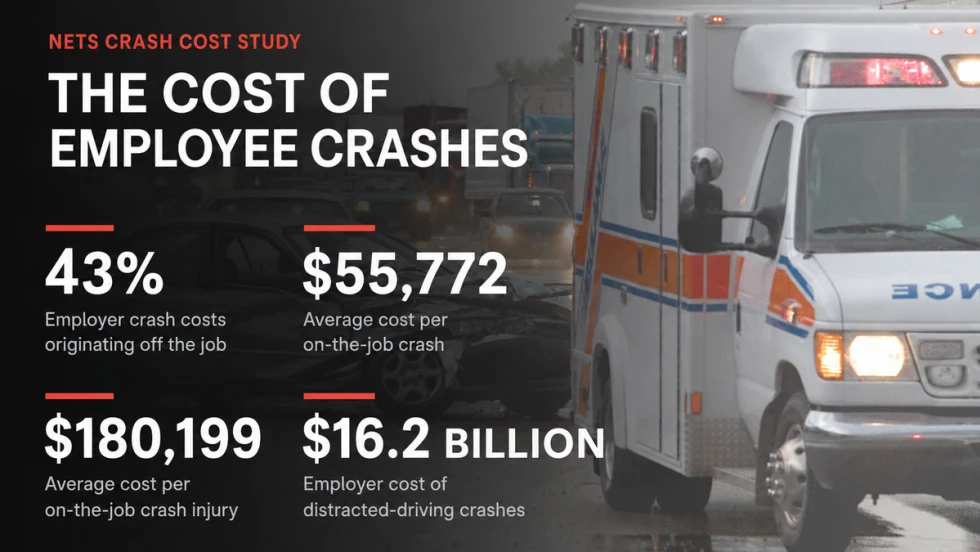
Off-the-Job Crashes Account for 43% of Employers’ $61.7 Billion Crash Burden
NETS quantifies costs dispersed across fleet, risk, HR, and other departments while providing new per-crash benchmarks for employers.
Read More →