




Siemens Takes Fleet Detail to a New Level
Using new Web-based tools, Siemens North America can pinpoint where and why costs have changed over time. The tools also allow the company to calculate future budget needs using prior-year and year-to-date data.
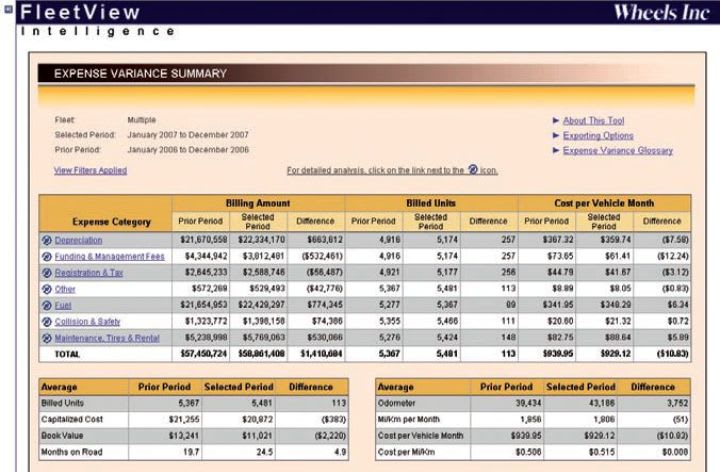
With the Expense Variance tool, Jim McCarthy at Siemens can drill down into seven categories of fleet expense to analyze and track budget data.
Data integrity. It’s becoming more important to fleet managers in these challenging economic times.
When you oversee 16,540 vehicles for the entire Siemens North America operation, a miscalculation in the fleet budget can mean millions of dollars. The company’s upper management not only wants to know how costs have changed over specific periods of time, but also in what areas they changed and why.
In the past, the Siemens fleet department’s budget process was an almost completely manual task.
"There wasn’t a lot of data integrity involved," says Jim McCarthy, director of vehicle management services for Siemens. "The cost projection tool Wheels developed changed that tremendously."
Fleet management company Wheels, Inc. recently rolled out two Web-based business intelligence tools to assist fleet managers in managing budgets. Expense Variance allows fleet managers to drill into seven different fleet expense categories to pinpoint where and why costs have changed over time. With Cost Projection, users plug in various estimates for factors affecting fleet costs, such as fleet size, capitalized cost, and fuel prices, to calculate future budget needs using prior-year and year-to-date data.
McCarthy oversees a shared services operation covering vehicles for 18 Siemens clients and three non-Siemens clients. "Before, we just used a lot of hunches and gut feelings and historical extrapolations," McCarthy says. Now, the cost projection tool allows his department to insert specific parameters for individual operating companies and develop a per-operation company budget. In the past, one fleet budget covered all of Siemens. The company has been using the Expense Variance tool extensively for about three quarters.
Expense Variance has freed up previously unavailable time for McCarthy and his department and improved data integrity for analysis. Expense Variance allows for applications and filters such as organization structure, period, year, and vehicle make and model.
The user enters the desired parameters, and Expense Variance automatically prepares the fleet’s defined timeframe with the exact prior period. The initial analysis screen "provides an overall financial view as well as a cost-per-vehicle view so you’re able to get the big picture while at the same time understanding the inherent relevance of a per-vehicle picture," McCarthy says.
[PAGEBREAK]
On-screen comparisons are segmented by primary cost drivers, such as depreciation, fuel, maintenance, registration, and funding. Other information includes number of billed units, capital average, capitalized cost, book value, and average months in service. "You’re able to get a down-and-dirty look at exactly how the fleet has progressed from one period to the next," McCarthy says.
"Much of our past budgeting process was based on assumption, and it was based on the Siemens fleet in its entirety. We left it up to the operating companies to fine-tune the numbers based on their mix because we did not have time to weave through all the data and do it on a specific operating company level," McCarthy says. "However, the integrity of those budgets probably was not that good."
The Expense Variance fuel section provides a wealth of important information. Once fleet parameters are entered with the tool, a fleet manager can drill down to fuel and the screen displays fuel variance and fuel spend tabs.
"Both tabs provide a wealth of fuel-related information," McCarthy says. The variance tab addresses the number of vehicles currently in the fuel program, fuel card utilization percentage, number of gallons used per month per vehicle, and fuel price comparison by type of fuel. The fuel spend tab provides spending information broken down into areas such as product, fuel brand, and vehicle model and application.
The data "is tremendously more detailed than we’ve been able to pull out before," says McCarthy.
For example, a fleet manager can drill down to an actual vehicle level to obtain fuel information about Dodge Chargers, for example, including such data as the mpg of an individual Charger in the fleet, where most of the fuel is purchased, premium versus regular fuel total, ethanol consumption, and fuel price.
"It’s just a tremendous tool, and everything I’m talking about is a comparison, not just data — data compared the prior period," McCarthy says. "So it’s definitely helped us get a handle and be more consultative in our efforts with our clients."
A budget forecasting tool, Cost Projection considers major factors that drive fleet costs, including number of vehicles in the fleet, average cost of the new vehicles, number of disposals, the gain or sale on disposal, interest rates, fuel prices, and miles per gallon, plus other major drivers that impact fleet expenses.
While the Cost Projection tool is still new to his fleet, McCarthy says it will be valuable.
"The Cost Projection tool is going to allow us to do a much better job in aligning ourselves per operating company with exactly what their needs are going to be, what their costs are going to be based on specific vehicle mix, based on specific replacement parameters, and the amount of vehicles being ordered," McCarthy says.
More Operations

Avis Budget Group Deploys Neology Toll Management Technology Across Major Brands
Neology’s neoFleet platform will manage toll transactions and toll-authority operations for vehicles across Avis, Budget, Payless, Budget Truck and Zipcar.
Read More →
Fleet Personal-Use Charges Edge Higher in 2026
Nearly eight in 10 surveyed fleets allow personal use of company vehicles, while just over half of respondents report charging employees for the privilege.
Read More →
The Future of Fleet + What’s Changing Right Now | AF News Recap
Could developments overseas offer a preview of what’s coming for U.S. fleets? This week, we’re looking at the future of AI, autonomy, and electrification, plus Ford Pro’s new certified pre-owned program, smarter vehicle offboarding, and a new way for fleets to manage toll expenses.
Read More →
How to Handle Vehicle Offboarding
What do fleet managers need to do when a driver leaves?
Read More →
Fleet Manager’s Ultimate Playbook: Navigating the New Standard in OEM Connectivity
Rising operating costs, driver safety concerns, and unplanned downtime are putting unprecedented pressure on modern fleets. Discover how fleet managers use embedded OEM connectivity and real-time vehicle data to cut TCO, prevent downtime, and protect drivers without aftermarket telematics hardware.
Read More →
U.S. Bank Adds Verra Mobility Toll Management to Voyager Fleet Platform
The integration allows U.S. Bank Voyager fleet customers to manage toll payments and violations alongside fuel, EV charging and maintenance expenses.
Read More →
ADAS Prevents Crashes. But Repairs Cost More | AF News Recap
ADAS-equipped vehicles may crash less often, but they can cost more when they do. This week, we’re breaking down what that tradeoff means for fleets, plus Subaru’s first Forester Wilderness Hybrid, Nissan’s new e-POWER Rogue, and why Calstart has become Catalyst Mobility.
Read More →
Moventum Fleet Management Names Mark Iorillo Head of Sales
Iorillo brings nearly 20 years of fleet management and sales experience to the role, including previous positions at Element Fleet Management, CEI, Donlen and Ryder.
Read More →
Fleet Has a Talent Pipeline Problem. What Comes Next? | AF News Recap
Where will fleet’s next generation of leaders come from? This week, we’re looking at the industry’s talent pipeline, what certification can add to a fleet career, how to build an award-worthy track record, and the return of Automotive Fleet’s Personal Use Survey.
Read More →
Smith System Launches Driver Risk Management Program
Fleets have more driver data than ever, but identifying risky behavior doesn't necessarily correct it. Smith System's new Driver Risk Management program combines monitoring, training, and follow-up coaching to help fleets connect risk signals with driver intervention.
Read More →