



At a Glance
The decision to repair or replace a damaged vehicle comes down to several factors:
Safety.
Company image.
Employee morale.
Financial impact to the fleet and the company.
 MENU
 SEARCH
After an accident or major equipment failure, fleet managers often have to make a hard decision to either repair or replace the damaged vehicle. There is no right or wrong answer, but fleets need to keep safety and the bottom line in sight.
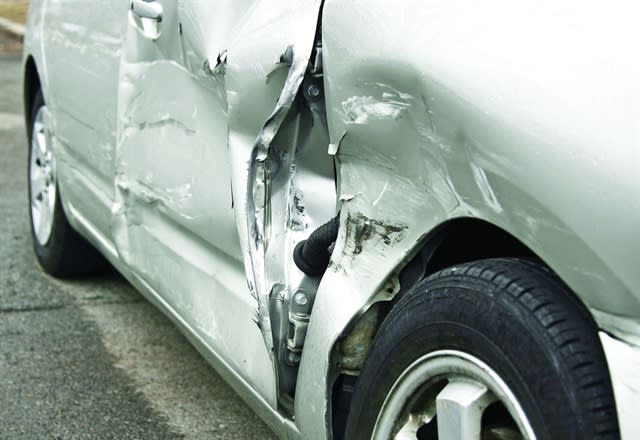
Image courtesy of iStockphoto.com.
Most fleets — no matter the size or type of vehicles — have clear replacement policies for vehicles operating under normal conditions.
But, there are times when the unexpected can turn these policies upside down, causing not only operational headaches, and presenting the fleet manager with the difficult decision to repair or replace the vehicle.
While both a catastrophic equipment failure, e.g., a powertrain failure, and a crash can cause operational problems for a fleet, the former is often a result of preventable factors, such as lack of good maintenance, driver abuse, or simply age or mileage, according to Joe Korn, senior analyst, Strategic Consulting at ARI.
While the result — equipment failure — is the same no matter the cause, resolving it might not be clear cut.
“With the exception of extreme age/mileage, fleets will often repair the vehicle to get it operational and back on the road again to perform its intended job function,” Korn said. “Often these units are lower in age and mileage and still have some remaining service life and /or a large balance of principal to be paid down.”
Physical damage most typically occurs due a collision and, since the severity can’t be predicted, fleet managers have to assess a number of factors when making the call to repair or replace the vehicle.
“Since not all accidents are the same, the damage associated with each vehicle will also be different. Some of the things we consider when reviewing these claims are: safety, cost and availability of a replacement vehicle, vehicle downtime, upfitting requirements, and resale value,” Korn said.
Policies covering damage to a vehicle need to include language to address driver responsibility, according to Ted Lewin, senior manager, risk management for Wheels Inc.
“Fleets should have a policy that holds the driver responsible for damage in the following circumstances: In the event of negligence, if an unauthorized driver, who is driving with the employee’s permission, is involved in a collision.”
Lewin noted that a number of Wheels’ clients have employees pay a deductible, which often ranges from $250 to $500, and is paid by the employee regardless of whether he or she or an authorized driver is at fault. Risk points are assigned to the driver no matter who was driving.
For Mondelez International’s fleet, the repair/replace policy is dictated by the market value of the vehicle.
“We’re focused on the total cost of ownership, and the repair decisions do affect the total cost of ownership,” said John Dmochowsky, senior global fleet manager for Mondelez International. “We also have an understanding of the vehicles that are coming down the pipeline and, when we get close to the order dates, we have to consider that as well.”
Conversely, Sprint has adopted a more fluid approach to repairing and replacing vehicles.
“The economy changes, the need for vehicles changes, its fluid — so we don’t have a set policy,” said Bret Watson, CAFM, national fleet manager for Sprint.
Sprint uses Fleet Response to handle its repair needs. Stuart Braun, adjusting and maintenance manager for Fleet Response, works closely with Watson on the decision to repair, not repair, or make a partial repair.
“The resale market and needs of the business changes constantly, and every repair/not repair decision is strategically thought out predicated on the current number of surplus vehicles, subrogration potential, and the salvage vehicle market,” Braun said. “I know when he has a surplus of vehicles, or if it’s a subrogation claim and if we have collection potential with confirmed insurance coverage from the third party. Part of the equation is how much is the repair and how much would the loss on sale be if we do not repair the vehicle? Do we want to repair it, what’s our cost recovery, can we cost recover it at the resale?”
When making the decision to repair or replace a vehicle a number of factors have to be considered, including safety, appearance, employee morale, and financial impact to the fleet.
Jeff Whiteside, senior director, Repair Services & Vendor Relations at Wheels noted that most insurance companies will write off a vehicle as a total loss when the repair amount exceeds 70%-75% of the value of the vehicle, the percentage of accidents that reach this threshold has been increasing due to the increasing expense of vehicle technology, such as air bags, cameras, and other types of sensors.
Watson of Sprint said he has authorized for repairs was over 50% of the vehicle’s value, but his typical limits are stricter than those for retail insurance. Typically, he will not repair a vehicle with more than 50% damage.
“I use what Sprint pays for the car as my benchmark,” he said. “I’m gauging what I pay for it. If I get to 50% or more of what I pay for it, I’ll probably not repair it.”
Braun of Fleet Response noted that fleets should “never put more than 75% of wholesale into a vehicle repair. That’s a good way to mitigate any loss and any exposure or liability.”
Again, reflecting the fluidity of Sprint’s repair and replacement strategy, Watson considers other factors outside cost when making repair decisions.
“I monitor my vehicles that are going out of service. So, if I have a vehicle with $10,000 worth of damage, the No. 1 question I’m going to ask is if I put $10,000 into it, how much am I going to get back at resale? The No. 2 question is what is salvage bringing? We look at the cost of repair, we look at the salvage value, and we will look at those two numbers to determine if we want to fix the vehicle or not. Part of the decision depends on how many surplus cars I have.”
Timing is a factor in Watson’s considerations.
“If the wreck is coming at a time when we’re coming off an order cycle and I have 300 cars in the remarketing process, it’s usually better to churn the car than to repair it,” he said. “You always come out financially ahead. I’ll lose less money if I salvage-sell the car than repair it. So, that’s why I can’t just tell Fleet Response, 75% of that or 50% of this. We simply don’t work that way.”
The type of accident also factors into Watson’s decision making.
“If it’s a hard frontal hit with air bags deployed one should consider if the repaired car will be as good as new in the event of a second crash,” Watson said. “This should be the most important consideration behind the financial impact of repairing the car.
The top consideration fleet managers must measure when making the repair/replace decision is safety.
“In major collisions, the structural integrity of a vehicle can be compromised and although today’s repair technology can often aid in restoring a vehicle to its prior condition, the cost to do so could be prohibitive. In these situations, clients often total the vehicle and look for a replacement,” said Korn of ARI. “Air bag deployment can have a similar effect as structural damage in that, depending on the make, model and number of air bags that have deployed, the cost to repair a vehicle, even with a lighter hit, can often be substantial and may be cost prohibitive.”
Safety trumps all considerations for Dmochowsky of Mondelez International.
“The one thing we are very focused on is the safety of our individual drivers and it is the main focus when it comes to repairing damaged vehicles,” he said. “If it’s a safety repair, it’s either going to be repaired or terminated. The decision is made with the interest of safety being our highest priority, and the last thing is total cost of ownership.”
Watson echoed Dmochowsky on the subject of safety.
“I’d rather total the car out if there’s a safety concern, and our philosophy at Sprint is if there’s any question about the repair just terminate the car and get a new one,” he said.
If there are no safety concerns then the fleet manager needs to consider the appearance of the vehicle and the effect of driving a damaged vehicle will have on employee morale.
“In terms of appearance, how visible is the damage? Will the vehicle be seen by customers in a way that could impact your image or branding?” said Whiteside. “In terms of employee morale, how do your drivers feel about driving a damaged vehicle? Is there a morale issue you need to consider?”
Korn added that vehicle type may play a role in determining whether a vehicle should be repaired or replaced. This is particularly the case with vocational vehicles.
“Vocational vehicles require a slightly different approach when it comes to major physical damage,” Korn said. “Unlike passenger vehicles, vocational applications tend to have varying levels of upfit. In some cases, it may be necessary to repair a unit with major physical damage depending on how extensive — and expensive — the upfit is. In these cases, a replacement vehicle may not be easily obtainable, and could take several weeks to build and deliver a new unit, further increasing the amount of down time for the unit.”
Dmochowsky takes rental costs associated with the repair into account in his TCO equations.
“You’re still paying the fixed cost, the depreciation of the car that is being repaired, and then take into account the other cost,” he said. “We try to utilize our unassigned vehicles, provided that they’re in the geography that’s close to the shop.”
Downtime is another factor Dmochowsky considers.
“We definitely monitor the downtime on our repairs and we will either utilize an existing unassigned vehicle that’s not assigned to that driver while they’re waiting for that car, and if one is not available, we’ll look at obtaining a rental,” he said.
Whiteside noted that the bottom line is the final consideration.
“If none of the other factors are a consideration then it really comes down to a financial decision,” he said. “If the difference between the value of the vehicle fixed and the value of the vehicle not repaired is more than the repair amount, including rental and all miscellaneous items, then repairing the vehicle should be considered.”

As fleet costs and insurance pressures rise, fleet managers are taking a closer look at which employees need company-provided vehicles and when a reimbursement program may make more sense.

The second annual program will award 15 scholarships totaling $35,000 to support ASE certification, testing fees, and equipment costs.

In this opening keynote of the 2026 Fleet Forward Conference, John Rossant, founder of CoMotion, How can fleet managers navigate a never-ending, changing industry landscape?

This week, we're breaking down which industries have the highest rates, how Jamie McKay manages 2,400 vehicles, what's happening with the 2027 fleet awards, and why software-defined vehicles could introduce new costs.

Fleet managers continue to rely on FMCs for essential services but are taking a closer look at where working directly with suppliers can improve efficiency and responsiveness.

Meet Erin Gilchrist, the inaugural Mike Antich Spirit of Fleet Award winner, as she shares insights on leadership, mentorship, the power of industry connections, and why people remain at the heart of fleet's future.

How do you keep 2,400 vehicles running across 37 states? Fleet Visionary Award winner Jamie McKay shares how collaboration, flexibility, and a few simple strategies help her tackle fleet management challenges at Aptive Pest Control.

Fleet operating costs have risen more than 20% since 2020, raising a key question: When does extending a vehicle's service life stop making financial sense?

This opening keynote session at the Fleet Forward Conference highlights the future of autonomous driving for fleets.

A stolen catalytic converter can cost fleets far more in downtime and lost productivity than in repairs. A total-cost-of-risk approach can help fleet managers quantify their exposure and prioritize theft prevention.