




Related: ARI Touts Driver Safety Program
Red Hawk Fire & Security Bolsters its Safety Program
Driver training modules and a scorecard program helped curb the fleet’s safety concerns.

Andy Lundin・Former Senior Editor
3 min to read
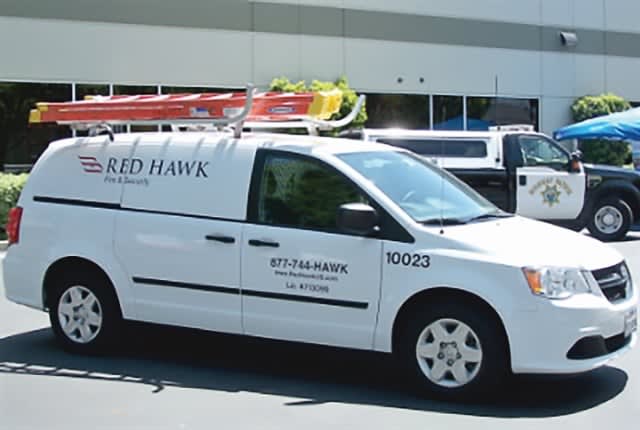
Photo of Red Hawk Fire & Security fleet vehicle courtesy of ARI.
A few years ago, Red Hawk Fire & Security’s fleet realized it had an issue: there were too many preventable accidents taking place. Because of this, the company set out with the goal of establishing new driver policies and safety training for its drivers to remediate the issue.
So in 2014, the company reached out to ARI to help provide them with a solution. The fleet management company was able to offer a remedy via its safety modules and driver scorecard program. Because of this Red Hawk recently reported that many of its issues had dissipated and that it had also discovered additional benefits the company didn’t expect to garner as a result of the partnership.
The Safety Benefits
ARI’s tools were able to reduce Red Hawk’s rate of accidents. This was due to the fact that ARI’s tools were able to offer a more proactive safety methodology than what the company was utilizing before.
“We were looking for something to carry on a message to the drivers, because sending out emails or sitting them down and saying ‘watch your speed,’ or ‘drive safely, don’t tailgate’ doesn’t really register with drivers,” said Blair Schober, Red Hawk Fire & Security, U.S. Fleet manager.
To achieve safety benefits, Red Hawk implemented a two pronged approach to its driver safety policy.
First, the company required drivers to complete five mandatory safety modules that were designed with the help of ARI. The modules focused on subjects ranging from understanding crash avoidance to overall fleet policies. The type, and amount, of modules that Red Hawk provides for its drivers may vary depending on the driver.
“The safety modules are offered in a library, where you can choose a module that you want to assign for a driver. There’s also a customizable feature, which was nice,” said Schober. “We did create and customize our own module with ARI to encompass our fleet policy.”
Once Red Hawk established the modules it wanted for its fleet, ARI helped incorporate them into the safety policy, which was sent electronically to its employees. The drivers review this and agree to its rules. This in turn would not only reduce accidents but also help curb concerns related to liability.
“That allows us to hold them accountable and it’s an easy place to reference the employee’s agreement with the module,” said Schober.
The other approach that Red Hawk went about to handle poor driving behavior was to identify and correct poor driving behavior even before an accident ever occurred. Part of this was due to the fact that ARI’s driver scorecard allowed Red Hawk to identify and categorize drivers who may be exhibiting poor driving behavior.
When ARI’s driver scorecard identifies poor driving habits via telematics data, the fleet administrator is alerted and the driver is assigned training to correct their behavior and to help them learn proper, safe driving techniques.
“ARI has a good scorecard system, it integrates with telematics based upon the readings. It includes accidents that have taken place, the ‘how’s my driving’ phone calls, telematics behavior, and motor vehicle records,” said Schober.
This also helped the fleet decide what modules to assign its drivers.
Liability Benefits
With the employee having signed off on the policy, the fleet could concern themselves less about being held liable in a claim.
Indeed, Red Hawk has seen their liability costs cut by more than $1 million. This is a result of the decrease in the number of preventable accidents as well as a decrease in the cost per incident when they do occur.
“I didn’t expect us to save as much as we did. And being able to save as much as we did really opened our eyes, not only of myself as being directly involved in fleet and overseeing the claims, but also senior management,” said Schober.
Subscribe to Our Newsletter
More Operations
Here's When You Should Make an Exception to Fleet Policy
Fleet policies are designed to create consistency, but not every driver or situation fits neatly within standard rules.
Read More →
AI-Native or AI-Acquired: What Should Fleet Managers Look for in an AI Platform?
Six questions can help fleet managers look beyond AI marketing claims to evaluate integration, data access, and real-world operational performance.
Read More →
Sponsored•October 14, 2026
A buyer's guide to fleet management software in 2027
Buying fleet management software in 2027 means looking beyond features and price. As fleet operations, technology and expectations evolve, this guide explores what today’s fleet professionals should consider when choosing a system that can deliver value now and adapt to what comes next.
Read More →

What Will Shape the Next Era of Fleet Management?
EVs, AI, and autonomous vehicles are reshaping fleet management. Discover what’s ahead—and how fleet leaders can prepare for the next era.
Read More →
How Fleets Can Recruit and Train Veterans for Technician Roles
Here's how the technician shortage has affected uptime for fleets, and what to do about it.
Read More →
Avis Budget Group Deploys Neology Toll Management Technology Across Major Brands
Neology’s neoFleet platform will manage toll transactions and toll-authority operations for vehicles across Avis, Budget, Payless, Budget Truck and Zipcar.
Read More →
Fleet Personal-Use Charges Edge Higher in 2026
Nearly eight in 10 surveyed fleets allow personal use of company vehicles, while just over half of respondents report charging employees for the privilege.
Read More →
The Future of Fleet + What’s Changing Right Now | AF News Recap
Could developments overseas offer a preview of what’s coming for U.S. fleets? This week, we’re looking at the future of AI, autonomy, and electrification, plus Ford Pro’s new certified pre-owned program, smarter vehicle offboarding, and a new way for fleets to manage toll expenses.
Read More →
How to Handle Vehicle Offboarding
What do fleet managers need to do when a driver leaves?
Read More →
Sponsored•October 1, 2026
Fleet Manager’s Ultimate Playbook: Navigating the New Standard in OEM Connectivity
Rising operating costs, driver safety concerns, and unplanned downtime are putting unprecedented pressure on modern fleets. Discover how fleet managers use embedded OEM connectivity and real-time vehicle data to cut TCO, prevent downtime, and protect drivers without aftermarket telematics hardware.
Read More →