





Related Reading: Winter Emergency Kit: 5 Essential Tips to Keep You Safe this Winter
Record-Breaking Christmas Travel Brings Added Road Risks
AAA projects over 122 million holiday travelers, making winter driving safety and trip planning critical nationwide.
December 16, 2025
Credit: Automotive Fleet
3 min to read
Christmas is fast approaching, and it is shaping up to be a record-breaking holiday travel period.
Let’s get right into it.
Year-End Travel
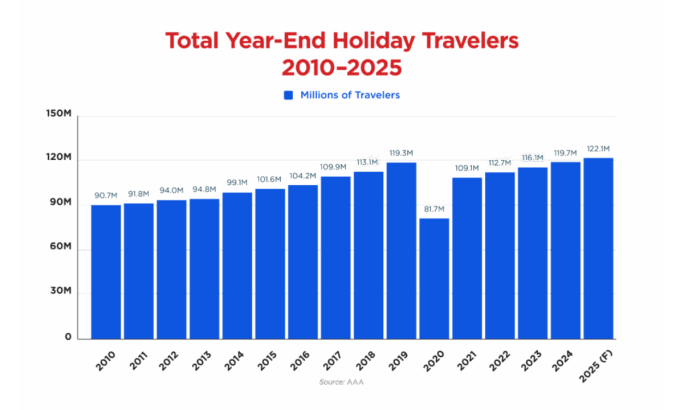
AAA estimated that 122.4 million Americans will travel at least 50 miles from their homes this holiday season, between December 20 and January 1.
This is a 2.2% increase from 119.7 million during the same period last year.
Most of these people are expected to travel by car, the second most by air, and the rest by other modes such as train, bus, or cruise.
“Year-end travel is a mix of family road trips, friend getaways, and tropical vacations,” said Stacey Barber, Vice President of AAA Travel. “Holiday celebrations look different for everyone, but a common thread is the desire to travel, whether it’s returning to your hometown or exploring new destinations.”
Credit: AAA
Winter Driving
The holiday season brings family, hearty meals, and a good helping of winter weather, all of which can affect driving.
To stay safe while driving this winter, the Occupational Safety and Health Administration (OSHA) and the National Highway Traffic Safety Administration (NHTSA) say you need to remember the three P’s: PREPARE for the trip, PROTECT yourself, and PREVENT crashes on the road.
To prepare:
Maintain Your Car: Check the battery, check your tires, check windshield wipers, keep your windows clear, and make sure your vehicle's fluids are all topped off (no-freeze windshield fluid, antifreeze, oil, etc.)
Make Sure You Bring: A flashlight, jumper cables, abrasive material in case you get stuck on ice (sand, kitty litter, even floor mats), shovel, snow brush and ice scraper, warning devices (like flares), and blankets. For long trips, make sure you have some food and water, any necessary medication, and cell phone chargers.
Stopped or Stalled: Stay in your car! Put on your hazard lights, place bright markers on the antenna or windows, and shine a light into the dome. If you run your car, clear the exhaust pipe and run it only long enough to keep it warm.
Plan Your route: Allow plenty of time (check the weather and leave early if necessary), be familiar with the route, and let others know your expected arrival time.
To protect yourself:
Buckle up and use child safety seats properly.
Never place a rear-facing infant seat in front of an air bag.
Children 12 and under are much safer in the back seat.
To prevent crashes:
Drugs and alcohol never mix with driving; do not use any substance and drive.
Slow down and increase distances between cars.
Keep your eyes open for pedestrians walking in the road.
Get plenty of rest before the trip, stop at least every three hours, and rotate drivers if possible.
If you are planning to drink, designate a sober driver.
Especially important for fleet drivers operating in winter weather is knowing your vehicle, and there is no better way to learn than by driving.
Practice. Cold. Weather. Driving. In. Your. Vehicle.
During daylight, rehearse maneuvers slowly on ice or snow in an empty lot, such as steering into a skid.
Know what your brakes will do: stomp on antilock brakes, pump on non-antilock brakes. Stopping distances are longer on water-covered ice and ice.
Don’t idle for a long time with the windows up or in an enclosed space.
Near or Far
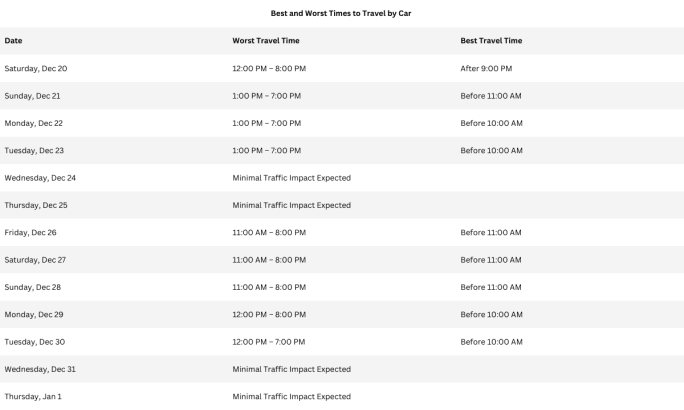
Whether you are staying local or going cross-country, road conditions can change on a whim. Stay updated on the weather and traffic events, and be patient. The holidays affect traffic nationwide, not just in cold-weather states.
Credit: AAA
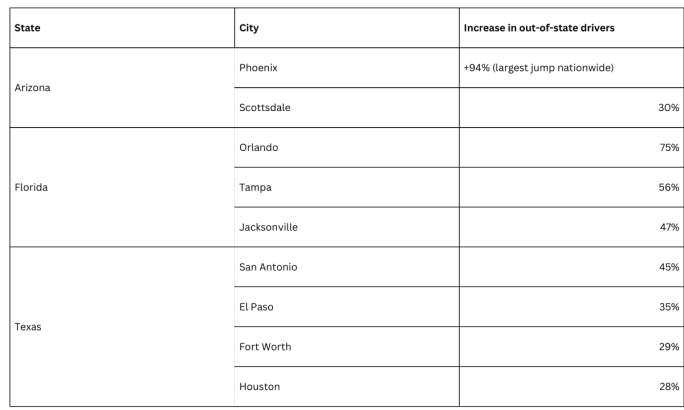
An increase in out-of-state drivers leads to longer travel times and potential detours, even on your local roads.
Cities with the biggest surge of out-of-state drivers, according to Allstate:
Source: Allstate
Holiday travel is not only busier but also riskier. According to data collected by Allstate, holiday periods see a spike in roadside assistance events, with the busiest day being December 26th and the longest tow distances on Christmas Day.
Topics:Safety
Subscribe to Our Newsletter
More Safety
IIHS Crash Avoidance Tests Reveal Safety Gaps in Cargo Vans and Work Trucks
New crash-avoidance ratings from the Insurance Institute for Highway Safety reveal inconsistent performance among commercial vehicles, with several popular cargo vans and heavy-duty pickups struggling to avoid collisions with other vehicles and pedestrians.
Read More →
What’s Next for Fleet? Safety, AI & Industry Recognition | AF News Recap
Could your company's culture be encouraging distracted driving? This week, we're exploring how workplace expectations affect driver safety, what AI, EVs, and autonomous vehicles could mean for the future of fleet management, and how fleet professionals can strengthen their award nominations.
Read More →
Does Your Fleet's Culture Encourage Distracted Driving?
What happens when the people responsible for enforcing safety rules are the ones setting the wrong example? The answer may reveal why some of the biggest risks to fleet drivers have little to do with what's written in the employee handbook.
Read More →
Sponsored•October 1, 2026
Fleet Manager’s Ultimate Playbook: Navigating the New Standard in OEM Connectivity
Rising operating costs, driver safety concerns, and unplanned downtime are putting unprecedented pressure on modern fleets. Discover how fleet managers use embedded OEM connectivity and real-time vehicle data to cut TCO, prevent downtime, and protect drivers without aftermarket telematics hardware.
Read More →
From Driver Well-Being to EV Charging | AF News Recap
Mental health belongs in the fleet safety conversation. This week, we’re looking at five ways fleets can support employee well-being before a crisis, plus Holman’s expansion in Mexico, new one-day Fleet Forward passes, and why EV charging demand is outpacing infrastructure growth.
Read More →
Nexar-Nauto Merger Aims to Give Fleets Better Safety Intelligence Through Larger Driving Dataset
Stefan Heck tells Automotive Fleet that combining more than 10 billion miles of driving history with Nexar's AI models will give fleets deeper insights into driver risk and roadway conditions than either company could provide independently.
Read More →
Don't Wait for a Crisis: 5 Ways to Build Mental Health Into Your Fleet Safety Program
For Suicide Prevention Month, fleet and safety leaders have an opportunity to put mental health where it belongs: at the center of workplace safety.
Read More →
How Camera Data Can Strengthen a Fleet’s Insurance Renewal
Insights from a commercial insurance carrier and a broker show how fleets can turn video telematic data, driver coaching, and improved claims results into a stronger case at insurance renewal.
Read More →
The Safest Fleets Aren’t the Ones with the Most Technology
You’ve made the telematics investment. Here’s how to capture the other half of its value and build the safest fleet on the road.
Read More →
Sponsored•August 7, 2026
Hidden in Plain Sight: Fleet Compliance Risks
Fleet compliance isn't just about having policies — it's about consistently enforcing them. This practical guide reveals six hidden compliance risks common in public sector and shared fleet operations and outlines proven strategies to improve visibility, accountability, and audit readiness
Read More →