




Problems, Policies Of Company-Provided Cars Aired In Survey
Query covers vehicle assignment and personal-use chargebacks.
Switched from mileage
reimbursement to providing
Getting personnel from point A to point B in an automobile is the fleet administrator's primary task. Often, fleet administrators look at that function from the role of being a provider of transportation. The details of putting that person, usually a salesman, on the road are becoming increasingly complex for everyone involved, including the salesman, fleet administrator and company president. In an exclusive sales-car survey, Sales & Marketing Management magazine pointed out some of these problems and came up with many insights into the process of providing transportation for sales personnel. Some of the major findings listed in the magazine include:
Sixty six-percent of the companies responding provide cars for at least some of their sales personnel.
The main reasons for providing cars are their value as a recruiting tool and their use as a non-taxable form of compensation.
Sales executives help select the make or model of the car in over 62-percent of companies that provide cars. Moreover, salespeople have some influence 57.2-percent of the time, usually by selecting among designated models.
Companies allot cars to sale-people according to their position in the company.
Virtually all companies that provide cars permit personal use, and there is generally some form of payment required.
Less than half (46.4-percent) of those companies requiring salespeople to provide their own cars pay a flat mileage rate for business use. Those paying a flat rate pay 15 to 17 cents per mile.
In addition to soliciting responses from 1,000 Sales & Marketing Management subscribers (of which 383 questionnaires were returned from 369 companies), S&MM also drew on the expertise of several pros in the fleet and leasing industry.
They included John Rowley, major leasing and fleet accounts manager for Lincoln-Mercury; Tom Hutchins, vice president of sales and marketing for Rollins Auto Leasing; Keith Henry, Buick's national fleet sales director; Don Albers, Oldsmobile's eastern fleet manager; Barry Stevens, vice president, field relations of Runzheimer & Co.'s Transportation Division; Roy Houston, Chrysler's manager of dealer leasing and rental; Jim Frank, executive vice president of Wheels, Inc., and George Frink, Chevrolet's director of fleet sales.
As indicated in S&MM's first table, a majority of companies recognize the value of a company car as a recruiting tool. "It's extremely important when you're hiring young salespeople, perhaps right out of college," John Rowley told S&MM. "Very often, they're not able to afford one, so an offer of a car is very attractive."
The second highest scoring reason for giving company cars, according to the survey, was that it's a nontaxable form of compensation, although most fleet-car marketers prefer to play down that aspect, S&MM said.
"For most salespeople, a car is a tool they need to do the job." Tom Hutchins of Rollins said. "You don't ask a secretary to bring a typewriter to work, and most companies don't ask salespeople to provide their own cars."
Placing third and fourth on the list of reasons to supply company cars were the fact that it was that industry's practice to provide cars (49.8-percent) and that it was important to the company's image to provide cars (39.5-percent).
The survey also confirmed the practice of sales and marketing executives selecting basic types and models of vehicles and then having the drivers choose their car from that list.
"We seldom see a company pick out one car and tell all its sales people that's what they'll be driving this year," Keith Henry, from Buick, told S&MM. "What we usually aim for is to be one of four or five cars on the list from which salespeople choose."
S&MM reported that the list is made up of more intermediate-sized or compact cars each year, as opposed to full-sized vehicles that were the standard for fleets several years ago. Specialty cars are also coming into their own, as more of these types of vehicles are appearing on selector lists. Lincoln Mercury's Rowley reported that sporty cars, such as the Cougar XR-7, are used on more sales calls. Diesels are also being used by some fleets since Oldsmobile introduced the first U.S. diesel car year.
"The original cost of a diesel-powered car is higher," Oldsmobile's Don Albers told S&MM. "For a Cutlass Supreme, for example, it's an extra $700-750. But on some of the cars we've tracked, total running costs are 2.8 cents per mile versus 4.3 to 4.7 cents per mile for a comparable car with standard engine. So the diesel may turn out to be an economical buy for high-mileage drivers."
A mild surprise for some in the survey is that a majority of the respondants (57.2-percent) indicated no to the question, "Are some salespeople provided with better cars than others?", while 41.6-percent admitted to the practice.
"I'm surprised the number is so low," Buick's Henry said. "There are very few companies we deal with that don't put the salesperson in one type of car, the sales manager in a better one, and so on."
Roy Houston, from Chrysler, indicated that sometimes the opposite is true. He told the magazine that "there are some companies in which a new salesperson with a territory in Wyoming or the Dakotas gets a big car, while the top salesman working an urban territory gets a small one."
Although only 41.6-percent indicated that they give some sales personnel better cars than others, of that number 62.4-percent reported that they assign better cars on the basis of the person's position. The next highest was 7.9-percent who would give a better car if the sames person wanted to pay the difference in price, while their achievement, demands of territory and length of service each came in at five-percent.
Almost all the companies queried (91.8-percent said they allowed personal use of company autos by the sales personnel. Most indicated they require a chargeback for that use and according to S&MM, although a flat mileage rate is the most popular method, only about one-third of the respondents use it, while various combination plans are employed by others. The typical chargeback is $25 to $50 per month, but some feel this may not be enough as the Internal Revenue Service (IRS) becomes concerned with this activity.
"Many companies find themselves in trouble when the IRS comes in for an audit because their chargebacks are too low," Barry Stevens of Runzheimer told S&MM. "We studied a 1978 four-door sedan that was driven 25,000 miles for personal use. The total operating and fixed costs for the year were $4,490, of which $1,213 was attributable to personal use. Through strict interpretation of IRS regulations, we helped the employer establish a chargeback of nine cents for each personal mile, plus $63 per month, which eliminated the fringe benefit value to the employee." The survey also noted that while companies are paying close attention to chargebacks, lease terms of company car also coming under scrutiny. The standard, two-year, 50,000-mile lease is beginning to lose popularity as longer lease terms become more common. Chrysler's Houston predicts that most leases will be stretched to 36 months and even as long as 42 or 48 months in some cases. "People are running cars longer and finding that holds down the cost per mile."
However, Jim Frank of Wheels, Inc., told S&MM that some of his clients are trading cars sooner, as often as every year. "If salespeople put on 30,000 to 35,000 miles a year, it doesn't make sense to hold a car for two or three years," he said, "because there will be almost no resale value. And companies also have to consider the competitive situation. If there's a great demand for salespeople in industry, changing cars every year will be much better for morale than holding on and keeping them in older cars. Every sales executive should be flexible and consider his own sales car situation."
Company car policy has been fairly stable, the survey reported. A total of 88.6-percent reported that they have not switched in their policy of providing company cars or reimbursing personnel using their own vehicles. Of those that did switch, 7.3-percent went from mileage reimbursements to providing vehicles, while 4.1-percent reverted from giving personnel cars to reimbursing them for use of their personal vehicles.
"By the early 1970s, most companies had already decided which way they wanted to go," Chevrolet's George Frink reported. "We haven't seen much movement. Similarly, the ratio of leased cars to company-owned cars has stabilized, with about 75-percent of fleet cars now under lease."
The survey concluded that company cars may not become a reality for all salespersons. Of those companies that do not provide company cars, 60.7-percent indicated that it was financially undesirable for the company to do so, while the next highest percentage (46.4) felt that administering a fleet was too time-consuming. A number (12.9-percent) indicated that the salespeople preferred their own autos, while 10-percent noted that the turnover in the sales force is too great to justify giving them cars.
"Turnover is a factor, too," Rollin's Hutchins echoed. "If a company has a policy of evaluating new salespeople for six months, then letting half of them go, it's not likely to want to get stuck with a lot of leased cars."
The survey also reported that at companies where sales personnel provide their own transportation, fewer than half pay straight mileage allowances. Most that do pay the flat rate, pay between 15 and 17 cents per mile. The 17-cent figure is generally the maximum allowed by the IRS before they begin to consider the allowance a covert form of tax-free compensation. S&MM reported that the IRS has recently begun to consider proposals to use different maximum allowances for small, medium and large cars.
Such rules and regulations, along with the myriad of leases available to companies, the shrinking size of the American auto, rising fuel and operating costs coupled with the specter of an energy shortage, makes company car policy a complex, challenging facet of doing business.
Why does your company provide cars for salespeople?
Company car serves as a recruiting tool | 61.7% |
It’s a nontaxable form of compensation | 59.3% |
Our industry’s practice is to provide cars | 49.8% |
We consider a company car important to our image. | 39.5% |
There’s less downtime for repairs than with salesmen-owned cars. | 15.6% |
It costs less to provide cars. | 7.4% |
We have better control over salespeople’s transportation. | 3.3% |
Cars are in better condition. | 2.1% |
Total above exceeds 100% because some respondents gave multiple answers.
TABLE 3: Do your salespeople influence the type of car they're furnished?
YES | 57.2% |
NO | 40.3% |
NO ANSWER | 2.5% |
If yes, what form does that influence take?
Selecting among designated models. | 80.6% |
Selecting within a price range. | 24.5% |
Other | 4.3% |
TABLE 4 - Are some salespeople provided with better cars than others?
YES | 41.6% |
NO | 57.2% |
NO ANSWER | 1.2% |
If yes, onwhat basis?
Their position. | 62.4% |
If they want to pay the difference in price. . | 7.9% |
Their achievement | 5.0% |
Demands of the territory | 5.0% |
Length of service | 5.0% |
Incentive or contest reward | 3.0% |
Other | 4.0% |
No Answer | 8.9% |
TABLE 5 Does your company permit personal use of the cars it provides salespeople?
YES | 91.8% |
NO | 6.6% |
NO ANSWER | 1.6% |
If personal use is permitted, how do the salespeople reimburse the company? | |
flat mileage rate | 34.1% |
pay for gas and oil | 16.6% |
flat monthly rate | 15.7% |
mileage rate plus | 1.8% |
limited use allowance | 1.8% |
other plans | 10.3% |
no reimbursement required | 13.5% |
No answer | 13.0% |
TABLE 6 Within the last five years, has your company changed its policy on providing company cars?
Switched from mileage reimbursement to providing company cars. | 7.3% |
Switched from company cars to mileage reimbursement. | 4.1% |
Have not switched. | 88.6% |
TABLE 7 - If your company doesn't provide cars for salespeople, why not?
Financially undesirable | 60.7% |
Administering a fleet is too time consuming | 46.4% |
Salespeople preer their own cars. | 12.9% |
Too much turnover in sales force. | 10.0% |
Salespeople are independent reps. | 5.7% |
Salespepole are on a commission basis. | 5.0% |
Most sales travel is by air. | 4.3% |
TABLE 8 - If your salespeople provide their own cars, how do you reimburse them for business use?
flat mileage rate | 46.4% |
no reimbursement | 15.7% |
mileage plus | 10.7% |
monthlyu allowance plus gas and oil | 9.3% |
flat monthly rate | 7.1% |
Runzheimer plan | 2.9% |
annual allowance | 2.1% |
other | 2.9% |
no answer | 7.9% |
If you pay a flat reimbursement rate, what is it?
under 12 cents per mile | 9.2% |
12 cents | 6.2% |
13 cents | 0.0% |
14 cents | 10.8% |
15 cents | 52.3% |
16 cents | 4.6% |
17 cents | 27.7% |
Total exceeds 100% because some respondents gave multiple answers.
Note for all tables: Survey results are based on a mailing to 1,000 S&MM subscribers. By the cut-off date, 383 questionnaires were received from 369 companies (14 returned both the company-car and the salesperson-owned-car questionnaires). Of those who responded, 243 provide cars to at least some of their salespeople.
More Operations
Managing Fleet Costs in an Era of Permanent Volatility
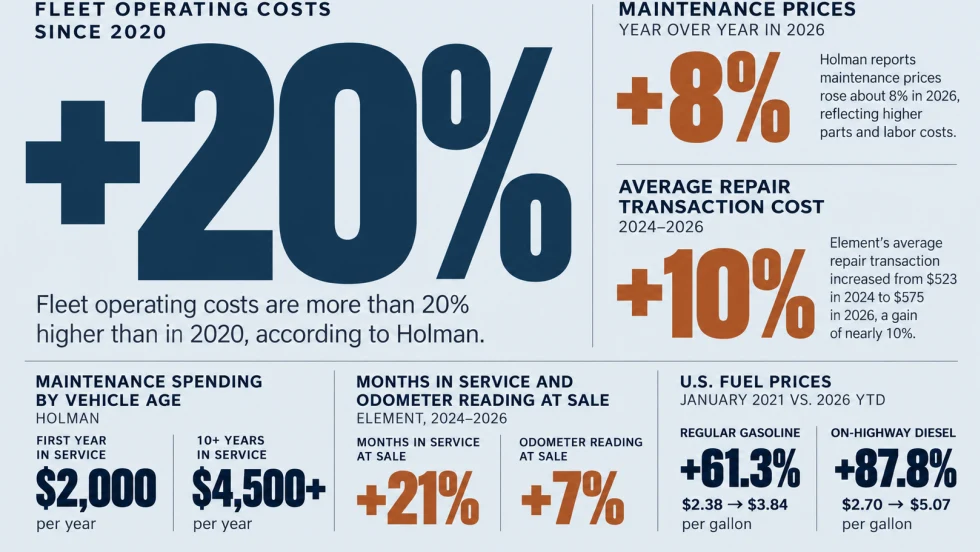
Fleet operating costs have risen more than 20% since 2020, raising a key question: When does extending a vehicle's service life stop making financial sense?
Read More →
The Next Evolution of Fleet Management: Autonomous Operations
This opening keynote session at the Fleet Forward Conference highlights the future of autonomous driving for fleets.
Read More →
How to Reduce the Total Cost of Risk From Catalytic Converter Theft
A stolen catalytic converter can cost fleets far more in downtime and lost productivity than in repairs. A total-cost-of-risk approach can help fleet managers quantify their exposure and prioritize theft prevention.
Read More →

Personal-Use Charges Rise as Vehicle Values Fall | AF News Recap
Personal-use charges are climbing, wholesale used-vehicle values are declining, and commercial fleet sales growth is slowing. This week, we're breaking down the latest fleet data, plus how Element Fleet Management is helping Waymo prepare for its first Canadian robotaxi market.
Read More →
Here's When You Should Make an Exception to Fleet Policy
Fleet policies are designed to create consistency, but not every driver or situation fits neatly within standard rules.
Read More →
AI-Native or AI-Acquired: What Should Fleet Managers Look for in an AI Platform?
Six questions can help fleet managers look beyond AI marketing claims to evaluate integration, data access, and real-world operational performance.
Read More →
A buyer's guide to fleet management software in 2027
Buying fleet management software in 2027 means looking beyond features and price. As fleet operations, technology and expectations evolve, this guide explores what today’s fleet professionals should consider when choosing a system that can deliver value now and adapt to what comes next.
Read More →
What Will Shape the Next Era of Fleet Management?
EVs, AI, and autonomous vehicles are reshaping fleet management. Discover what’s ahead—and how fleet leaders can prepare for the next era.
Read More →
How Fleets Can Recruit and Train Veterans for Technician Roles
Here's how the technician shortage has affected uptime for fleets, and what to do about it.
Read More →
Avis Budget Group Deploys Neology Toll Management Technology Across Major Brands
Neology’s neoFleet platform will manage toll transactions and toll-authority operations for vehicles across Avis, Budget, Payless, Budget Truck and Zipcar.
Read More →