




PG&E Recognized at Blue Sky
The California gas and electric utility was honored for greening its fleet, which includes the use of alternative fuels to reduce greenhouse gas emissions.
Pacific Gas and Electric Company (PG&E), one of the largest investor-owned utilities in the country, was a finalist for the 2008 CALSTART Blue Sky Award ultimately presented to industrial manufacturer Eaton Corporation at a ceremony luncheon in Los Angeles in June.
The aptly-named Blue Sky Award is presented to formally recognize and reward outstanding contributions not only to develop clean vehicles and technologies, but also to actively bring them to the marketplace. Prospective recipients can be manufacturers, developers, or users of advanced transportation technologies or services. The award is specifically designed to recognize leadership and innovation in technology for clean sustainable transportation, as well as a significant commitment to its use.
Making the Cut
PG&E was selected as a finalist for implementing fleet-greening initiatives, including the use of natural gas, biodiesel, and high-efficiency vehicles to increase fuel efficiency. “PG&E will be looking at a ‘blended’ technology portfolio where each application is matched with the appropriate technology that best meets the application needs,” says Dave Meisel, the company’s director of transportation services.
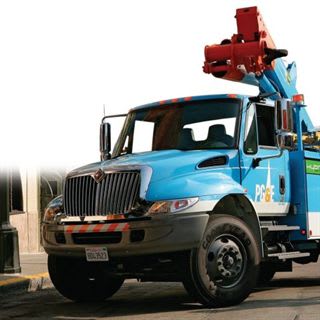
PG&E, which provides electric and natural gas service to approximately 15 million people throughout 70,000 square miles in northern and central California, developed and implemented the following initiatives to address rising fuel costs, tougher environmental regulations, demanding legislation, and a growing concern over greenhouse gas emissions:
Top-down management commitment to greening its fleet. PG&E chairman, CEO, and President Peter Darbee recognized greening the company’s fleet was critical to the organization’s long-term success. “There are two components to that — the cost piece and the technology piece,” Meisel notes. “First, since we spend a lot of money on fuel, there’s a real opportunity for us to reduce costs. Second, if technology allows us to move away from fossil fuel and toward electric vehicles, that’s an opportunity for us to improve air quality and global warming. So greening our fleet adds consistency to our business, enables us to ultimately reduce emissions, and at the same time allows us to save money.”
Building an extensive alternative-fuel program. Natural gas, either in compressed (CNG) or liquefied (LNG) form, is PG&E’s primary alternative fuel. In fact, the company operates the largest natural gas vehicle utility fleet in the country. Of its more than 1,150 vehicles, 132 are Class 7 medium- and heavy-duty trucks, 11 fueled by LNG.
PG&E has taken a leadership role in developing a natural gas-powered Class 7 truck. To support its natural gas vehicles, PG&E engineered and installed a natural gas fueling infrastructure that includes 39 CNG and two LNG stations, most of which are also available to the public. In 2007, the utility saved about $1.4 million by virtue of its natural gas usage.
Using biodiesel to add a “renewable” fuel component to its fleet. PG&E originally chose biodiesel as a way to augment the National Energy Policy Act (EPAct) of 1992 requirements. But while moving forward with greening its fleet, the company recognized biodiesel was a great way to bring a renewable fuel into play. For most of 2007, the company used biodiesel (B-20) in approximately 900 vehicles at 23 PG&E fueling sites. Near the end of the year, PG&E increased the biodiesel level to B-40 to determine any operating issues associated with that level. PG&E has since returned to B-20. In 2008, the company set a goal to use 300,000 gallons of biodiesel.
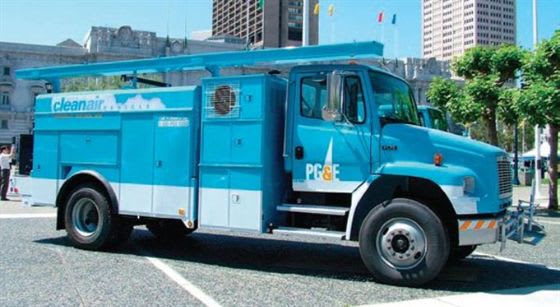
Commitment to evaluate and add emerging technologies to increase fuel efficiency and lower overall noise and air emissions. PG&E, one of 14 fleets chosen nationally to assess a “first of its kind” hybrid-electric vehicle service truck from Eaton/International, also partnered with the Electric Power Research Institute to “hybridize” its Ford F-550 Super Duty trouble truck. In 2007, the company purchased two Peterbilt hybrid bucket trucks.
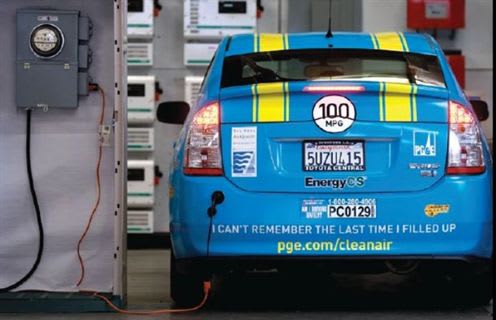
PG&E is also at the forefront of plug-in hybrid development and is working with OEMs to bring plug-in technology to medium- and heavy-duty trucks. Over the past decade, PG&E has received electric vehicles from several OEMs and strengthened strategic partnerships in the hydrogen industry.
Reducing overall emissions from its existing fleet base. PG&E employs two strategies to reduce its fleet base emission levels. First, existing diesel units are retrofitted with particulate traps. The first 100 units were completed in 2007 and 95 had a particulate matter (PM) reduction level of 25-50 percent. The second strategy is a systematic replacement of older units with cleaner technologies. In 2007, approximately 1,800 older units (10 years old on average) were replaced with newer, cleaner-burning technologies.
Reduction of emissions and costs through the use of retreaded tires. PG&E recently signed a contract with a tire provider that includes retreaded tire product lines. Plans are under way to increase use of the product line to lower purchase costs while protecting the environment. For each retreaded tire the company buys, approximately 15 gallons of crude oil are saved, compared to the oil required to manufacture a new tire. If PG&E could retread all 20,000 tires it purchases annually, the utility would reduce its crude oil consumption by more than 300,000 gallons per year.
Efforts Paid Off
The results of PG&E’s efforts to reduce its environmental footprint are significant. Over the past 10 years, the company has displaced more than 4.1 million gallons of diesel and gasoline with natural gas in its fleet. In 2007 alone, PG&E used the following quantities of alternative fuel:
Biodiesel: 180,000 gallons.
CNG: 771,200 gasoline gallon equivalents (GGE).
LNG: 17,800 diesel gallon equivalents.
Ethanol: 304,900 gallons through the use of ethanol added to California’s gasoline.
Hydrogen: 480 GGE.
Over the past decade, PG&E’s usage of biofuel in the company’s fleet avoided roughly 495 tons of CO2 emissions, while its use of natural gas has prevented more than 7,000 tons of CO2 emissions (tank to wheel). In 2007, natural gas avoided approximately 2,412 tons of greenhouse gas emission (GHG), 6 tons of NOx, and almost a half-ton of PM (full well-to-wheel). The full “well-to-wheel” analysis takes into account energy use and emissions at every stage of the process, from the moment the fuel is produced at the well to the moment the vehicle wheels move.
While PG&E was honored to be selected a Blue Sky Award finalist, the ultimate winner is the environment. “It’s great to see many major companies all doing the right things for the environment. And that’s what’s most important — recognition for making environmentally sensitive business decisions,” Meisel says.
More Green Fleet

Inspiration Mobility Acquires Key Electrada Assets
Inspiration Mobility Group has acquired select assets of Electrada, adding the fleet electrification provider's team, technology, and charging infrastructure development capabilities to its energy management business.
Read More →
Turning Connected Vehicle Data Into Decisions That Matter
Fleet leaders have more data than ever, but turning that data into clear, actionable decisions remains a challenge. This white paper shows how leading organizations are using connected vehicle data to improve safety, reduce costs, and optimize fleet performance. Learn how to turn insight into action across your fleet.
Read More →
Are You Tracking Your Fleet's True Total Cost of Ownership?
Bobit Business Media surveyed 190 fleet professionals and found that while most fleets are tracking costs, fragmented systems and data gaps are keeping true TCO visibility out of reach. With rising pressure to control spend in an increasingly volatile environment, the gap between what fleets think they know and what the data actually shows is wider than you might expect. See how your peers are managing costs today and where the industry still has room to improve.
Read More →
Hybrids: Electrification Without the Challenges
For fleet managers, fuel is one of the biggest line items in the budget — and it's one hybrids can shrink without changing how your people work. Download the eBook to see the numbers, understand the technology, and get a step-by-step guide to making the switch.
Read More →
Startup ZMD Motors Developing Electric Conversion for Ram 5500 Work Trucks
Detroit-based company says it has begun early development of a system to convert internal combustion Ram 5500 chassis-cab trucks to electric power.
Read More →
U.S. EV Adoption Is Climbing, but Commercial and Passenger Markets Diverge
New industry group data revealed that light-duty electric vehicle sales are hitting record market share and volumes, while commercial EV volume dipped. What’s driving the fluctuations?
Read More →
How To Upfit Electric Work Trucks and Vans
The biggest challenge lies in balancing additional equipment and accessories with EV battery capacity and range.
Read More →
How Fleets Can Adjust Approaches To EV Adoption
With the expiration of federal incentives, EV success now hinges less on government policy and more on discounts, battery tech progress, increased range, and broader infrastructure.
Read More →
Despite World Troubles, Forward Thinking Guides Fleets
Fleet operators shared their challenges during an annual conference that embraced the latest advances across all aspects of running private- and public-sector vehicles.
Read More →
GM Energy Details Partnerships and Targets for Public Charging Build-Out
EVgo, Pilot, ChargePoint and IONNA named; goal is 35k GM-invested DC stalls by 2030, with customer-experience upgrades at sites.
Read More →