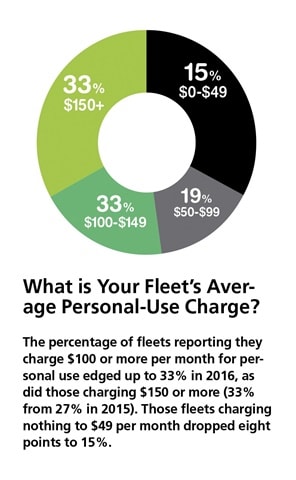
Fleets’ average monthly personal-use charges increased in 2016 by $4 to $132. Over the past five years, personal-use charges have increased $16 per month from $112.
Ad Loading...
Fleets reporting that they are charging more than $150 per month increased to 33% from 27% in 2015 and those reporting charging nothing to $49 decreased to 15% from 23% in 2015, according to the fleet managers taking part in Automotive Fleet’s annual personal-use survey for 2016.
Ad Loading...
Comparing the Numbers
While some fleet managers reported that they had made few changes to the way they are handling personal use, the numbers point to changes — some tellingly significant, and some incremental — that point to a landscape that is transforming.
For instance, 76% of fleets report allowing employees to drive their company-provided vehicle whenever they like. This is down just 3% from 2015, but down 7% from 2014 when it was at a reported high of 83%. Fleets reporting that they only allow a vehicle to be driven for personal use during non-business hours increased from 2015; 2% of respondents reported that this was the case with their companies’ fleets.
A more significant change is the reported factor governing the assignment of company-provided vehicles. In 2015, 70% of respondents indicated job function as the top reason employees received a vehicle. Still the top reason in 2016, the job function category jumped a whopping 13 points to 83%. Several of the respondents indicated that they didn’t have an executive fleet program.
At a Glance
Some of the key takeaways from Automotive Fleet’s annual personal-use survey include:
Average monthly personal-use charges are up $4 in 2016.
More fleets are excluding non-employees from company vehicles.
The majority of fleets are continuing to allow personal use at any time.
Perhaps reflecting the increased emphasis on safety and concerns about liability, the percentage of fleets reporting that they don’t allow anyone other than the employee to drive a company vehicle climbed.
Of the fleet managers responding to the 2016 personal use survey, 43% no longer allow anyone other than the employee to drive a company vehicle for personal reasons, up from 28% in 2015.
Ad Loading...
For fleets that reported doing “true-ups” or personal-use reconciliations, the majority (61%) still report doing so annually, down from 70% in the 2015 survey results.
The way in which fleets report they are determining personal-use charges showed some of the most dramatic changes with using a pro-rated annual lease value overtaking both using an industry average of competitive benchmarks and calculating the cost to the company as the most common way to determine a personal-use charge. Using a commuting charge only ticked up substantially over the 2015 survey. Substantially fewer fleets responding to the 2016 survey reported including a fuel benefit down from 18% in 2015.The percentage of fleets taking part in the 2016 personal-use survey that reported never doing a true-up and those that do it either more frequently or “as needed” edged up from 12% for the former and 5% for the latter to 13% for both. Those fleets reporting that they do a quarterly true-up increased the most, also to 13% from 5% in the 2015 survey.
Data courtesy of AF research department
Facing Challenges
While the results of Automotive Fleet’s annual personal-use survey give a good snapshot of how fleet managers are handling personal use in their fleets, and how personal use is changing and evolving, the numbers are only part of the story.
Several fleet manager respondents weighed in on some of the biggest challenges they are facing in handling the personal use of fleet vehicles and how they are attempting to solve some of these challenges.
Among the biggest challenges fleet managers reported in managing personal use was attempting to increase the amount being charged to improve operational efficiencies for the company.
Ad Loading...
“We have presented programs to increase driver fringe contribution to $100 per month to capture an additional $135,000-plus to cover the operational and fuel costs of personal use,” reported one fleet manager who asked to remain anonymous. “The program was presented at each of the last four executive board meetings and has yet to pass.”
It’s not only senior executives who have put up road blocks for fleet managers looking to increase personal-use charges.
“We have explored raising our personal-use program fees to capture more of the operational costs of the vehicle with no success/backing from HR,” reported another fleet manager who asked to remain anonymous.
Other fleet managers have found ways around this resistance.
“We are trying to implement a personal-use charge with much resistance. Most vehicles are sales cars. We do assess a 10% minimum personal use for fringe reporting,” said another anonymous fleet manager.
Ad Loading...
Data courtesy of AF research department
While some fleet managers are facing active resistance when trying to make changes, others are hitting potholes on the way to efficiency for other, more practical, reasons.
“I am looking for an app that will allow the drivers to record personal and business use in a very clean and non-tedious way,” said a fleet manager who asked that his comments be kept anonymous. “After working with my tax group, I am about to roll out a paper that defines three types of drivers as defined by the IRS. We have calculated an average daily commute for the no office driver (i.e., a sales rep whose first call one day could be 10 miles away and the next day be 50 miles away). An average commute mile based on internal account data will make it much cleaner for sales reps to record commute miles.”
While there are certainly changes and challenges for how the fleets handle personal use, it is clear that personal use remains a firmly entrenched part of the way many fleets handle their operations.
Buying fleet management software in 2027 means looking beyond features and price. As fleet operations, technology and expectations evolve, this guide explores what today’s fleet professionals should consider when choosing a system that can deliver value now and adapt to what comes next.
Neology’s neoFleet platform will manage toll transactions and toll-authority operations for vehicles across Avis, Budget, Payless, Budget Truck and Zipcar.
Nearly eight in 10 surveyed fleets allow personal use of company vehicles, while just over half of respondents report charging employees for the privilege.
Could developments overseas offer a preview of what’s coming for U.S. fleets? This week, we’re looking at the future of AI, autonomy, and electrification, plus Ford Pro’s new certified pre-owned program, smarter vehicle offboarding, and a new way for fleets to manage toll expenses.
Rising operating costs, driver safety concerns, and unplanned downtime are putting unprecedented pressure on modern fleets. Discover how fleet managers use embedded OEM connectivity and real-time vehicle data to cut TCO, prevent downtime, and protect drivers without aftermarket telematics hardware.
ADAS-equipped vehicles may crash less often, but they can cost more when they do. This week, we’re breaking down what that tradeoff means for fleets, plus Subaru’s first Forester Wilderness Hybrid, Nissan’s new e-POWER Rogue, and why Calstart has become Catalyst Mobility.