




Panasonic Switch to Audi Sales Fleet Pays Off
A little more than three years after adding Audi vehicles to its sales fleet, Panasonic is reaping the benefits of that decision.

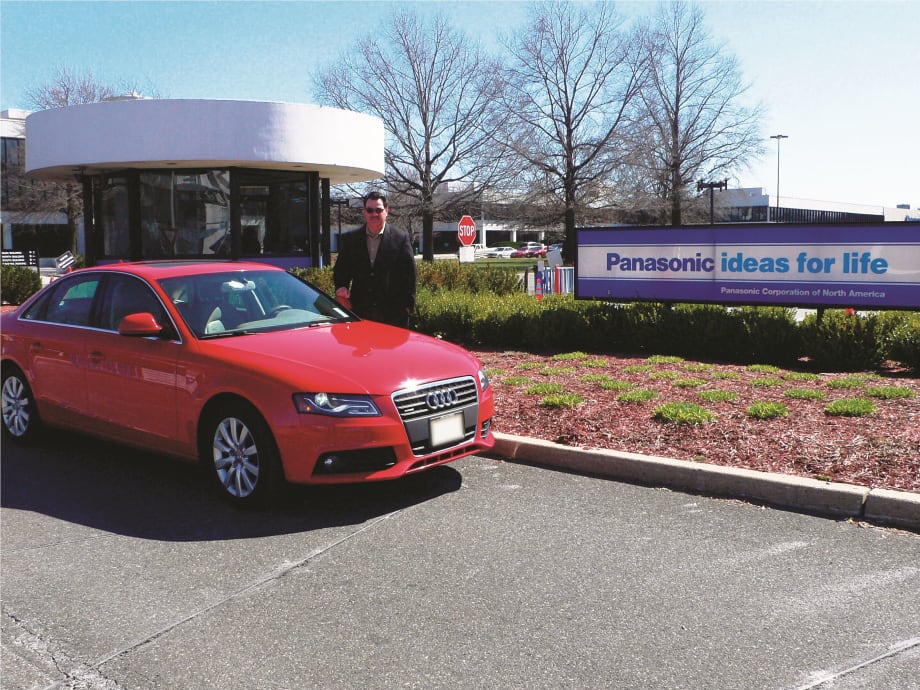
Frank Memolo, fleet manager and 25-year employee of Panasonic Corporation of North America, began adding Audi models to the company sales fleet in 2007. Not only has doing so helped boost employee morale and motivated drivers to take more ownership of their company-provided vehicles, it has also provided strong resale value in the wholesale market.
Frank Memolo, fleet manager and 25-year employee of Panasonic Corporation of North America, began adding Audi models to the company sales fleet in 2007. Not only has doing so helped boost employee morale and motivated drivers to take more ownership of their company-provided vehicles, it has also provided strong resale value in the wholesale market.
At A Glance
Panasonic's addition of Audi models to its sales fleet has resulted in several benefits, including:
● Increased employee morale.
● Strong resale value.
● More ownership and better care of vehicles.
● Better overall TCO from a company standpoint.
Ask any sales rep what his favorite perks of the job are, and the use of a company-provided vehicle is bound to make that list. Not only must the vehicle be one that entices the employee driving it enough so that he or she really values and takes care of it, but it also needs to promote a good overall image of the company, have the ability to perform the job, and of course, fall within the fleet budget. Makes sense - but still challenging nonetheless.
For Frank Memolo, fleet manager and 25-year employee of Panasonic Corporation of North America based in Secaucus, N.J., finding the right vehicles to meet all these requirements was a task he set out to accomplish back in 2007 when he added Audi models to his 740-unit sales fleet, about 100 of which are executive vehicles. Now, more than three years later, Memolo is starting to see the benefits of that decision.
Searching for Some Excitement
In 2007, Panasonic, which had gone through some downsizing, was looking to boost employee morale.
"I was given the task of finding out what we could give back to the employees - how we could motivate the sales force and create a little excitement in the company car program, something a little different than what we had been doing. That's when we started looking at different vehicles that were out there," Memolo recalled.
At the time, Memolo said Audi had just started the fleet program and he had met with them a few months earlier to scope out possible vehicles for executives. He and his team at the time started running some numbers on possible costing for sales programs and began ordering 2007 models in the spring.
"To try and create some excitement, we said, 'Let's try and use the [Audi] A4.' We presented it to upper management, they liked it, and we ran with it," he explained.
From the motivational standpoint, Memolo said drivers were shocked when the initial program rolled out. "The first word that came out of four of the first five people's mouths [to whom] I mentioned it was 'wow.' And the person who didn't say wow was just standing there with his mouth open. He thought his manager was pulling a practical joke on him."
Creating a Win-Win Situation
Originally, Panasonic executives were provided an allowance to purchase a vehicle of their choice. Unfortunately, it was an outdated dollar amount established a decade before and didn't take into account the increase in vehicle prices over the years - leaving many executives unable to get the same high-end vehicle once theirs reached the end of its lifecycle. Once the sales fleet program was created, Memolo added a vehicle selector for the executive program as well, using some of the Audi vehicles.
Initially, the executives were given the option of taking the dollar allowance and keeping the vehicle purchased for 48 months/65,000 miles or taking an Audi A6 for 24 months. Since its inception, he has since expanded the program to provide an option of an A6, Q5, or a "souped-up" A4.
"So they had the incentive of getting a vehicle they couldn't get under allowance, plus it's also a shorter term so they get a newer vehicle even sooner," Memolo said. "Ninety percent of the executives opted to take the A6."
The benefits for both the employees and the company have been "unbelievable," according to Memolo. "We had some [TCO] numbers [from executives] come in under $400 per month. So from a company standpoint, we're spending $400 for a benefit and the executive is happy because he or she is driving a vehicle priced $45,000-$50,000. So it really is a win-win situation. That wasn't our primary target when we rolled out the program, but it just kind of carried over into the executive program as well and has been a pleasant surprise for us," he said.
[PAGEBREAK]
Value Continues to Show
Three or four model years later, Memolo said the sales program is still "packing a punch."
"When we started off," he explained, "we really didn't know if the program would be a success from the financial standpoint because we knew we had to wait a few years until we started selling some of the 2007 models." On average, the company keeps the vehicles three years/65,000 miles; it started selling some vehicles in volume last year.
Memolo said the Audis have held their value and done quite well at auction. "We've been isolated from some of the events that have gone on in the wholesale market. There are a lot less of these vehicles going through the auction than, for example, Impala, Taurus, Malibu, etc. So obviously the demand for them is higher."
Memolo also attributed the strong resale value to the fact that people who buy these models typically have more money than the normal subprime follower and can afford to visit a higher-end dealership.
"We benefitted from having that higher-end vehicle go through the auction last winter and early spring versus your standard typical company car," he said. "I think we were protected a little bit from what was going on in the subprime market."
The benefits really started showing in fall 2008 when Panasonic started ordering 2009 models, Memolo said. "When we started cycling out those first 2007s, we really started seeing a higher volume. We typically would take the hardest hit with those cars on the two-year cycle with the higher mileage, but some of the prices we were getting at the auctions were from the mid to high teens. And then it got better cycling out those 2007s, come 2010. Those cars are typically lower-mileage cars and even another year older, they did well, which was fantastic."
The typical base A4 sales reps receive are all-wheel-drive vehicles that feature leather material, power locks and windows, and sunroofs. "I could have saved a few bucks and gone with the two-wheel-
drive Audi, but I think we probably would've done worse on a residual value. The dealers like having those Quattros to put on their lot," Memolo explained. "Having that strong resale value has really protected us."
Accomplishing the Mission
Overall, the program has been a success.
"The Audi program has worked out well for us," Memolo said. "Maybe we're spending $100-$200 more a year on the TCO, but how much happier is the sales force? How much more motivated are they? Some people have left the company and one of the things they hated about leaving the company was losing their car."
The drivers love the vehicles, which keeps them more motivated to take better care of them. From a recruiting standpoint, Memolo said it has even helped tilt things in Panasonic's favor when potential new hires consider coming on board.
In addition, switching to the Audis has helped downsize fleet. "I get a few complaints here and there about the size because it's definitely a smaller car [than the previous full-size sedans], but people back up and say, 'I'm happy with the car - don't take it away from me!' " Memolo said. "I joke with other people in the industry that I'm the only fleet manager who downsized the car, went from a six- to four-cylinder vehicle, and got driver motivation up," he added.
On top of that, drivers have reported being more productive when taking in their vehicles for service. Because the service areas in the Audi dealerships tend to be more upscale than the previous sites used, drivers enjoyed the benefits of features that were less common a few years ago, such as Internet hotspots and cappuccino makers.
"Drivers [in the past] said they wouldn't want to take their car in for service, but now they can pop open their laptop and continue working. And then when their car is done, they're on their way," Memolo said.
More Operations

Avis Budget Group Deploys Neology Toll Management Technology Across Major Brands
Neology’s neoFleet platform will manage toll transactions and toll-authority operations for vehicles across Avis, Budget, Payless, Budget Truck and Zipcar.
Read More →
Fleet Personal-Use Charges Edge Higher in 2026
Nearly eight in 10 surveyed fleets allow personal use of company vehicles, while just over half of respondents report charging employees for the privilege.
Read More →
The Future of Fleet + What’s Changing Right Now | AF News Recap
Could developments overseas offer a preview of what’s coming for U.S. fleets? This week, we’re looking at the future of AI, autonomy, and electrification, plus Ford Pro’s new certified pre-owned program, smarter vehicle offboarding, and a new way for fleets to manage toll expenses.
Read More →
How to Handle Vehicle Offboarding
What do fleet managers need to do when a driver leaves?
Read More →
Fleet Manager’s Ultimate Playbook: Navigating the New Standard in OEM Connectivity
Rising operating costs, driver safety concerns, and unplanned downtime are putting unprecedented pressure on modern fleets. Discover how fleet managers use embedded OEM connectivity and real-time vehicle data to cut TCO, prevent downtime, and protect drivers without aftermarket telematics hardware.
Read More →
U.S. Bank Adds Verra Mobility Toll Management to Voyager Fleet Platform
The integration allows U.S. Bank Voyager fleet customers to manage toll payments and violations alongside fuel, EV charging and maintenance expenses.
Read More →
ADAS Prevents Crashes. But Repairs Cost More | AF News Recap
ADAS-equipped vehicles may crash less often, but they can cost more when they do. This week, we’re breaking down what that tradeoff means for fleets, plus Subaru’s first Forester Wilderness Hybrid, Nissan’s new e-POWER Rogue, and why Calstart has become Catalyst Mobility.
Read More →
Moventum Fleet Management Names Mark Iorillo Head of Sales
Iorillo brings nearly 20 years of fleet management and sales experience to the role, including previous positions at Element Fleet Management, CEI, Donlen and Ryder.
Read More →
Fleet Has a Talent Pipeline Problem. What Comes Next? | AF News Recap
Where will fleet’s next generation of leaders come from? This week, we’re looking at the industry’s talent pipeline, what certification can add to a fleet career, how to build an award-worthy track record, and the return of Automotive Fleet’s Personal Use Survey.
Read More →
Smith System Launches Driver Risk Management Program
Fleets have more driver data than ever, but identifying risky behavior doesn't necessarily correct it. Smith System's new Driver Risk Management program combines monitoring, training, and follow-up coaching to help fleets connect risk signals with driver intervention.
Read More →