




Outsourcing for Positive Results
With a disciplined approach and careful planning and implementation, outsourcing non-core functions can provide a positive impact on the entire fleet operation.
Simply defined, outsourcing occurs when a company, government agency, or organization contracts an outside vendor to perform a service. This service can be outsourced from its inception or transferred from an in-house operation. When considering outsourcing an area of fleet operations, a fleet manager’s most important step is determining the reasons for such a step. Are the reasons positive or negative? Examples of
Reducing capital outlay of funds, i.e., leasing vehicles or equipment.
Improving efficiency and/or effectiveness, e.g., data entry, accident management, fuel management, vehicle towing, and body repairs.
Maximizing resources, which was my objective in outsourcing the parts room function for the Town of Greenwich, Conn.
Outsourcing solely to reduce head count is a negative reason. Even when implementing outsourcing for positive reasons, the perception of possible job loss among fleet employees is a negative. Emphasizing the positive aspects of outsourcing throughout the project is critically important to the entire operation. When contemplating outsourcing a particular fleet function, clearly define the objectives. Outline the function or service. Will it be totally or partially outsourced? Whatever the function is, never give up total control. View outsourcing as a partnership venture. Consider several important factors in outsourcing: the total cost involved, transaction time, interruption of service, training, and interim operation. Fully evaluate the in-house costs versus outsourcing the function. Such an evaluation requires good, concise data on in-house operation of the function or service. Developing an actual worksheet will help the evaluation process.
Consider Non-Core Functions
When assessing functions to be outsourced, consider only non-core functions. Never outsource such core function as key customer relations and interactions, policy and procedure strategy, or financial strategy. Cost reduction should never be the sole objective since outsourcing simply to reduce expenses can lead to performance decreases. Overall performance should be the motivating factor. Determine realistic expectations that result in true benefits in outsourcing functions. Decide how your organization will measure results, level of service, true costs, and projected savings versus hidden costs.
Carefully Craft RFPs
Once the function or service has been clearly identified and the decision to pursue outsourcing made, the request for proposal (RFP) must be carefully written. Outline the specifics under which this function will be outsourced. Maintain control of the criteria development process. Inform prospective vendors of your organization’s structure, its operations, limitations, restrictions, and internal and sub-structures. Identify objectives and scope. Provide information that will help vendors meet your needs. For the most positive results in outsourcing, it is critical to become familiar with potential vendors. Visit facilities for a first-hand view of their operations. Contact references and past or present vendor clients. Develop a standard questionnaire to query all references, a tool that will help in the evaluation process. Interview all involved: vendor company management and contact personnel, potential workers, and location staff. Develop performance criteria, using a comprehensive point system to evaluate RFPs. Clearly define service expectations. Investigate proposed vender company histories, financial stability, operations, problem resolution and solution procedures, and industry reputation. Try to predict potential problems and determine the people and process for dealing with them. The ability to negotiate is critical to the success of outsourcing. Build into the contract or delivery of services a method to accommodate mutually beneficial changes.
Review Cost/Payment Structure
Study the cost and payment structure closely. Look for hidden costs. Calculate projected savings based on realistic expectations. Confirm that the defined quality control measures are clearly understood by all parties. Incorporate checks and balances and include sufficient monitoring processes. Create graphs, charts, or other tangible methods to compare in-house performance to the vendor’s proposals. Use the criteria that prompted a consideration of outsourcing the function, employing realistic projections and analogies. Develop an on-going evaluation process to assess performance. Once the selection has been made, keep the implementation process positive. Develop a strategy and a paper trail of all transactions and any changes to documentation or adjustments to the contract. Ensure that a good clear audit of all transactions is developed before implementation is in place. In the transition to outsourcing, develop step-by-step increments for a smooth changeover. Include a timetable, assigned responsibilities, and a method to measure and evaluate progress. A big factor in successful outsourcing is “buy-in” from staff, top management, customers, staffed personnel, and all vested parties. Ensure that you have final approval in the selection of all vendor personnel who will work with you. Disseminate information clearly and often. In both written and verbal communications, be careful to avoid misconceptions. Develop written procedures and review them with your staff and the vendor. Develop standardized forms as part of the written procedures. Plan for any eventuality, and develop a back-up contingency plan. In some cases, conducting a parallel test is advisable. Have alternatives in place. Know whom to contact if problems occur. Develop a “back-track” process should the venture simply not work out.
Greenwich Provides Example
The Town of Greenwich, Conn., provides an example of successful outsourcing. The fleet operation outsourced its parts room function. The idea met positive criteria and the parts room is a non-core function. We had clear expectations: labor hours saved and maximizing resources. The outcome was positive. More labor hours were shifted to core fleet functions and service improved. Fleet staff no longer had to chase parts, track or maintain costly inventory, handle storage issues, or process stock orders. We were able to establish a true partnership with the vendor, with mutual flexibility to make changes. A clearly defined pay structure, with audits and crosschecks, kept everything easily accountable. With careful planning and implementation, outsourcing non-core fleet functions can positively impact the entire operation. You can be part of making the change - or be left behind. FOR MORE INFORMATION: Elizabeth Linck, CFM, is fleet director for the Town of Greenwich, Conn. She can be reached at Blinck@greenwichct.org.
More Operations

Fleet Meets: Eric Kilgore
This edition of the Fleet Meets series features one of the industry's best leaders driving multi-market and national operations.
Read More →
Why Reactive Fleet Management Is Becoming Too Expensive to Sustain
Research highlights a growing need for proactive management strategies to address rising costs in fleet operations effectively.
Read More →
What Your Fleet KPIs Aren’t Telling You
Tracking fleet metrics is only useful when the data leads to better decisions. This guide helps fleet leaders assess cost, utilization, and downtime more accurately, identify performance gaps, and prioritize the actions that can improve operational results.
Read More →


Hidden in Plain Sight: Fleet Compliance Risks
Fleet compliance isn't just about having policies — it's about consistently enforcing them. This practical guide reveals six hidden compliance risks common in public sector and shared fleet operations and outlines proven strategies to improve visibility, accountability, and audit readiness
Read More →
Turning Fleet Payment Data into Executive Insights
Does data alone drive results in operations?
Read More →
Automotive Fleet Opens 2026 Personal Use Survey for Commercial Fleet Managers
Commercial and corporate fleet managers are invited to share how their organizations handle company vehicle personal-use policies, charges, and driver eligibility.
Read More →
Gary Van Orden Retires After Nearly Four Decades in Commercial Fleet
From answering customer calls at Ford Motor Company to leading fleet sales across multiple OEMs and a fleet management company, Gary Van Orden's career reflects nearly four decades of leadership in commercial fleet.
Read More →
How Stellantis Plans to Get Ahead of Fleet Downtime
Vehicle acquisition may grab the headlines, but fleet uptime increasingly determines operating success. Darren Bradshaw of Mopar North America gives the details.
Read More →
Hyundai Releases 2027 Commercial Program Incentives
The 2027 Model Year "Fleet Street Incentives" are available to commercial and government fleets.
Read More →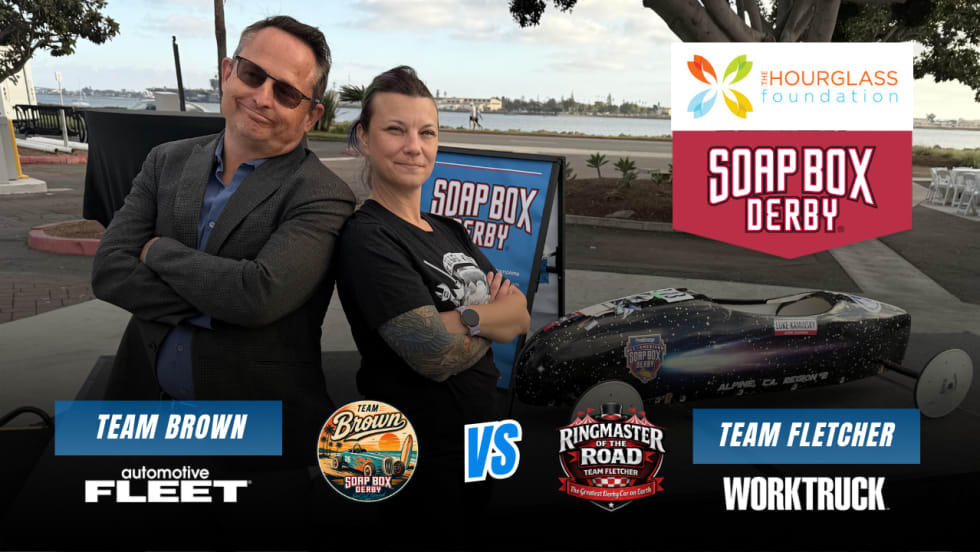
It's All Downhill from Here! Fleet Industry Raises $22,000 for Skilled Trades Scholarships
Work Truck’s Lauren Fletcher and Automotive Fleet’s Chris Brown turned a friendly racing rivalry into $22,000 for automotive technology and skilled trades scholarships.
Read More →