





Related: Operating Costs Remain Flat for Fifth Consecutive Year
Operating Costs Increase After Remaining Flat for Five Years
Fleet operating costs increased in 2018, primarily due to higher fuel prices and maintenance costs. Upward pressure on maintenance labor rates and higher commodity prices are impacting the cost of replacement tires.
November 1, 2018

Upward pressure on fuel pricing over the past 15 months has been the No. 1 factor contributing to higher fleet operating costs.
Graphic courtesy of Getty Images.
5 min to read
Editors note: This article is part of a four-part package dealing with operating costs in 2018. Read related articles that offer and in depth look at tire prices, fleet maintenance, and warranty recovery.
Calendar-year 2018 marks the first time in five consecutive years that fleet operating costs have increased, primarily due to higher gasoline and diesel prices, higher maintenance labor costs, and price increases for replacement tires.
This, along with other findings, are revealed in Automotive Fleet’s 27th annual operating cost survey, and are based on data provided by seven survey partners, including ARI, Donlen, Element Fleet Management, Emkay, Enterprise Fleet Management, Merchants Fleet Management, and Wheels, Inc.
This year’s survey, which had the largest-ever industry participation, is based on the analysis of actual operating costs incurred by 800,961 vehicles operated by commercial fleets, which are managed by the seven participating fleet management companies.
Higher Fuel Prices
Upward pressure on fuel pricing over the past 15 months has been the No. 1 factor contributing to higher fleet operating costs.
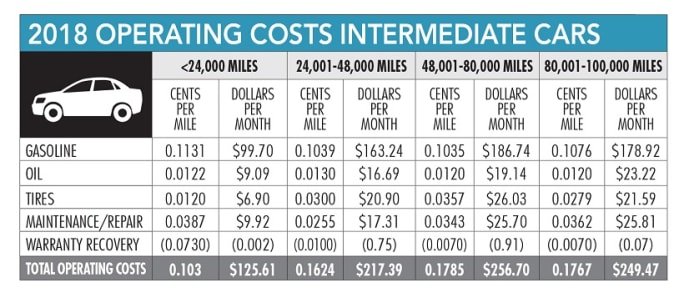
Chart courtesy of Armie Bautista.
“Fuel prices rose to their highest level in four years, with most of the increase occurring during the spring season. Prices have remained high, but stable, from July through September. Markets along the West Coast were hit the hardest, while markets in the Midwest and South fared much better,” said Kelley Hatlee, CAFS, national service department technical support supervisor for Enterprise Fleet Management.
Fuel represents approximately 60% of a fleet’s total operating costs, so the higher price per gallon of fuel has had a dramatic impact on overall fleet costs by increasing the prices of components made from oil, primarily replacement tires.
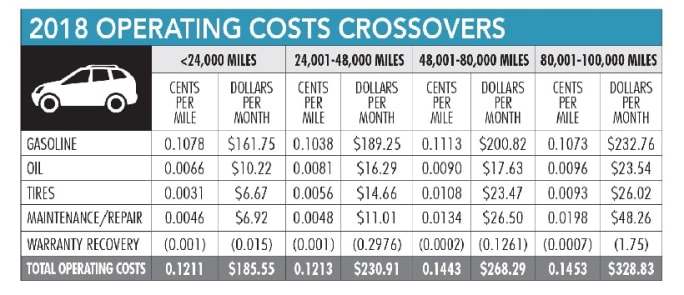
Chart courtesy of Armie Bautista.
To adjust, fleets are rightsizing their vehicle selectors to take advantage of fuel-efficient technologies, weight reduction measures, higher-speed transmissions, and appropriate drivetrains to meet their business necessity. The focus continues to be to acquire the most fuel-efficient models that can fulfill the fleet requirement. In addition, the increased implementation of telematics systems has also resulted in improved route optimization and easier identification of drivers who are engaging in driving behaviors that decrease mpg.
What is the forecast for per gallon fuel prices in calendar-year 2019? As many have learned through experience, fuel prices are impossible to forecast with certainty, and are influenced by a number of external variables, such as macroeconomic activity, geopolitical dynamics, and domestic supply/demand.
Most fleet management companies use the U.S. Energy Information Administration (EIA) of the U.S. Department of Energy forecasts for internal planning and external fuel price forecast dissemination. The EIA projects fuel costs will continue to rise modestly over the next 12 months. The forecast for CY-2019 also predicts that global supply will decrease while demand will slightly increase, which will help exert upward pressure on fuel prices.
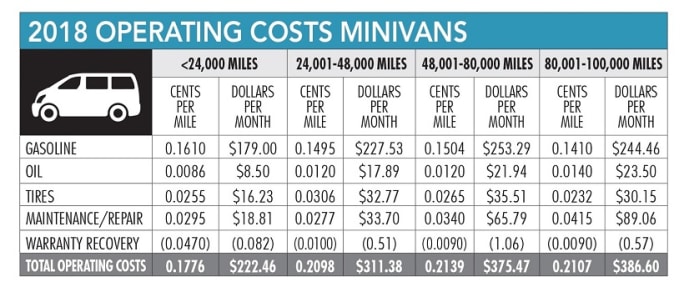
Chart courtesy of Armie Bautista.
“The biggest wildcard for the forecast of fleet fuel prices is the Trump administration and pending sanctions on oil production, which will impact supply, demand, and pricing. Diesel will continue to be in the top three most expensive petroleum products into 2019,” said George Albright, assistant director of maintenance for Merchants Fleet Management.
One area that is of particular interest for the entire industry is how threatened automotive tariffs may influence fleet operations, along with the impact of recently instituted tariffs on some steel and aluminum producers.
“Throughout 2018, the prospect of automotive tariffs have been a particular area of focus as we continue to monitor all tariff-related news. But, right now, it is still too early to evaluate the long-term impact of these tariffs, but as these regulations continue to unfold, it is certainly a subject that is top-of-mind for many businesses,” said Chris Foster, manager, truck account administration for ARI.
Tire Prices Increase
Replacement tire prices are experiencing upward pricing pressures due to higher prices for the commodities used to manufacture tires, in particular, crude oil. Raw material prices increased 5% to 10% year-to-date in calendar-year 2018.
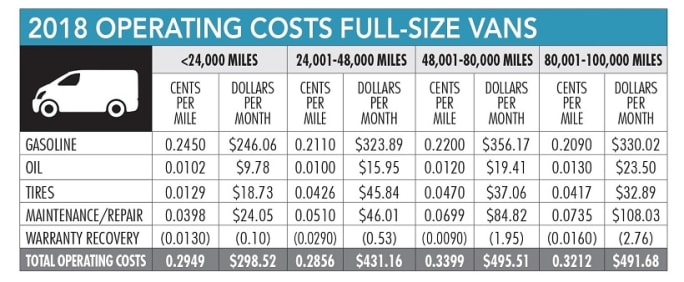
Chart courtesy of Armie Bautista.
The trajectory for replacement tire prices in 2018 is upward due to the forecast of ongoing higher commodity pricing, which exert pressure on tire OEMs to maintain margins as their production costs increase.
Maintenance Costs Increase
Fleet maintenance costs have increased over the past 12 months.
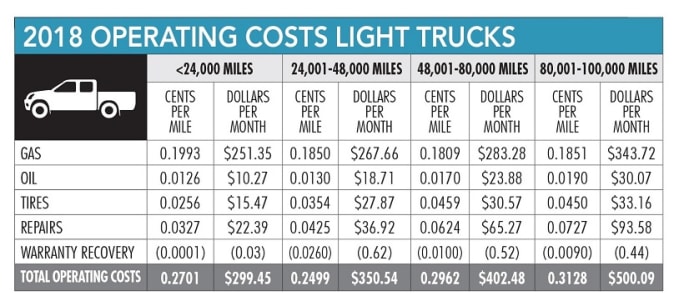
Chart courtesy of Armie Bautista.
Other areas in the fleet maintenance spectrum are also exerting upward pricing pressures, such as rising labor rates, especially in high cost-of-living markets. But maintenance still represents a relatively small segment of overall operating costs, accounting for just 10% of total operating costs. In order for higher maintenance costs to have a dramatic impact on total operating costs, it would require far more significant increases than what occurred in 2018 and is anticipated in 2019.
Flat Preventive Maintenance Cost Trends
Preventive maintenance (PM) expenses in calendar-year 2018 were stable compared to 2017, primarily due to improvements in engine design, onboard vehicle technology, and improved oil quality, which is allowing fleets to extend oil drain intervals. However, the price of finished lubricant products did increase due to the higher cost of crude oil, which is the foundation of these products.
Most subject-matter experts anticipate that PM costs will continue to remain stable in 2019, contingent upon the price of crude oil, which has an impact on the price of finished lubricant products. However, extended drain intervals, and the continued acceptance of synthetics will help keep PM costs stable.
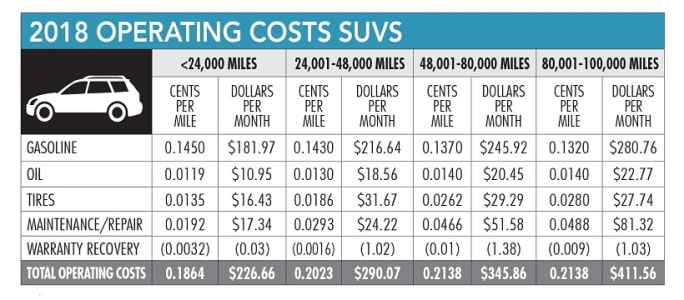
Chart courtesy of Armie Bautista.
One concern on the horizon is the potential impact of higher labor rates at quick lube shops and whether these increased overhead costs will be passed on to fleet customers.
Subscribe to Our Newsletter
More Operations

Avis Budget Group Deploys Neology Toll Management Technology Across Major Brands
Neology’s neoFleet platform will manage toll transactions and toll-authority operations for vehicles across Avis, Budget, Payless, Budget Truck and Zipcar.
Read More →
Fleet Personal-Use Charges Edge Higher in 2026
Nearly eight in 10 surveyed fleets allow personal use of company vehicles, while just over half of respondents report charging employees for the privilege.
Read More →
The Future of Fleet + What’s Changing Right Now | AF News Recap
Could developments overseas offer a preview of what’s coming for U.S. fleets? This week, we’re looking at the future of AI, autonomy, and electrification, plus Ford Pro’s new certified pre-owned program, smarter vehicle offboarding, and a new way for fleets to manage toll expenses.
Read More →
How to Handle Vehicle Offboarding
What do fleet managers need to do when a driver leaves?
Read More →
Sponsored•October 1, 2026
Fleet Manager’s Ultimate Playbook: Navigating the New Standard in OEM Connectivity
Rising operating costs, driver safety concerns, and unplanned downtime are putting unprecedented pressure on modern fleets. Discover how fleet managers use embedded OEM connectivity and real-time vehicle data to cut TCO, prevent downtime, and protect drivers without aftermarket telematics hardware.
Read More →
U.S. Bank Adds Verra Mobility Toll Management to Voyager Fleet Platform
The integration allows U.S. Bank Voyager fleet customers to manage toll payments and violations alongside fuel, EV charging and maintenance expenses.
Read More →
ADAS Prevents Crashes. But Repairs Cost More | AF News Recap
ADAS-equipped vehicles may crash less often, but they can cost more when they do. This week, we’re breaking down what that tradeoff means for fleets, plus Subaru’s first Forester Wilderness Hybrid, Nissan’s new e-POWER Rogue, and why Calstart has become Catalyst Mobility.
Read More →
Moventum Fleet Management Names Mark Iorillo Head of Sales
Iorillo brings nearly 20 years of fleet management and sales experience to the role, including previous positions at Element Fleet Management, CEI, Donlen and Ryder.
Read More →
Fleet Has a Talent Pipeline Problem. What Comes Next? | AF News Recap
Where will fleet’s next generation of leaders come from? This week, we’re looking at the industry’s talent pipeline, what certification can add to a fleet career, how to build an award-worthy track record, and the return of Automotive Fleet’s Personal Use Survey.
Read More →
Smith System Launches Driver Risk Management Program
Fleets have more driver data than ever, but identifying risky behavior doesn't necessarily correct it. Smith System's new Driver Risk Management program combines monitoring, training, and follow-up coaching to help fleets connect risk signals with driver intervention.
Read More →