




One Formula for Success: Focusing on Small Fleets
A newcomer can establish marketshare in the mature fleet leasing industry by buying an existing portfolio or by generating new business. World Omni has taken the latter approach to become the nations 11th largest lessor.
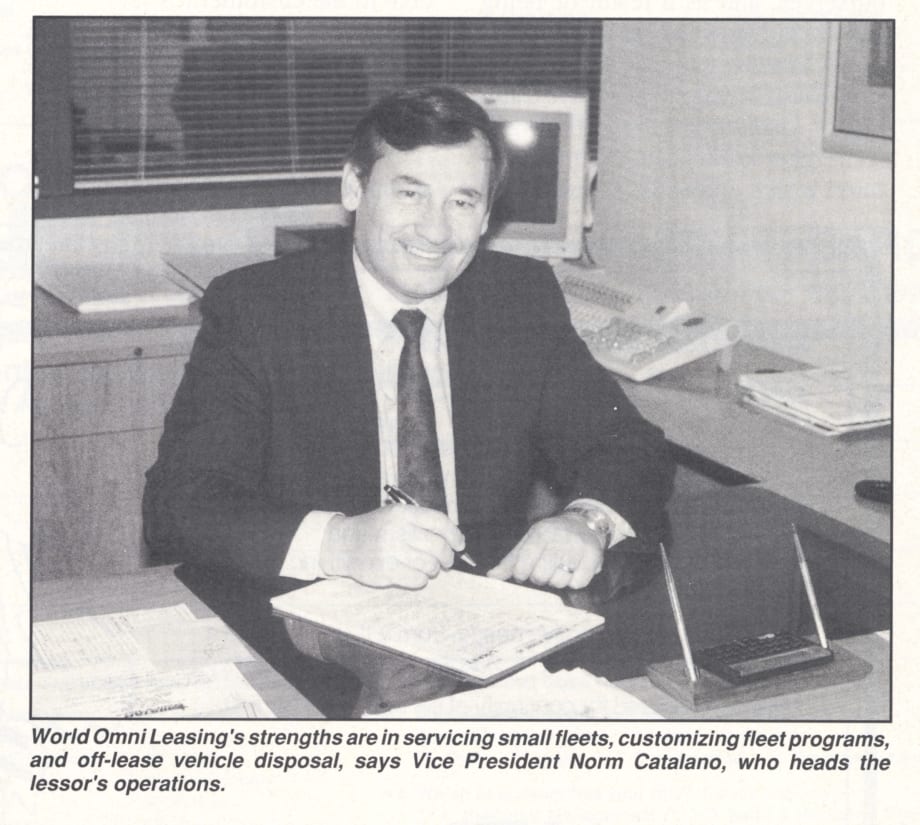
When World Omni Leasing was formed in 1982, its initial challenge was to create a market identity in the fleet leasing industry. Eight years later, with a car and truck fleet of over 29,000 units, World Omni Leasing seems to have found that market identity by servicing 500-unit and smaller fleets.
Headquartered in Deerfield Beach, FL, World Omni Leasing is part of a holding company called J.M. Family, Enterprises, Inc., which also owns Southeast Toyota Distributors, Inc., the exclusive distributor of Toyota vehicles in the five-state area of Alabama, Florida, Georgia, and North and South Carolina.
In its early years, World Omni provided consumer leasing in this five-state area, but subsequently expanded its services to provide fleet and commercial leasing on a nationwide basis. Ultimately, World Omni Leasing concentrated all of its efforts to commercial fleet leasing, turning its consumer leasing business over to World Omni Financial Corp., a corporation also owned by J.M. Family, which provides dealer financing in Southeast Toyota's five-state distribution territory.
World Omni offers lessees a choice of open- or closed-end leasing, plus a full line of fleet management and maintenance programs and a courtesy dealer delivery service. In addition, the lessor is currently developing an in-house computer system to generate complete, state-of-the-art client management reports.
Guiding the lessor through this growth period is World Omni Leasing's vice president, Norman Catalano, who originally started with World Omni Financial as assistant vice president in April, 1982. (At the time, World Omni Leasing was a branch of World Omni Financial.) As the various branches of World Omni Financial developed, Catalano was promoted to vice president in charge of the fleet department - commercial division.
"The commercial division's business grew to the point where the department was becoming too big to be just a small piece of World Omni Financial," says Catalano. Hence, World Omni Leasing was born.
Presently, World Omni's headquarters is staffed by 45 employees with sales branches in Atlanta, Tampa, FL, and a recently-opened office in Mission Viejo, CA. In the next three years, the lessor plans to open six additional sales offices in Chicago, Dallas, San Francisco, and the Northeast region of the country.
Although the company continues to grow in size, it holds true to its philosophy that small fleets are among its most important customers. "Being a smaller company ourselves, and as a result of being newer and pushing harder, World Omni Leasing has paid more attention to smaller accounts," says Catalano. "Also, since we aren't as big as some other lessors, we aren't as structured which allows us to customize many programs that are very conducive to the customer."
Another strength of World Omni Leasing, according to Catalano, is its off-lease vehicle disposal program.
"We feel disposal is one of our strong points," he says. "We have a strong working relationship with new-car dealers, wholesalers, and auctions across the country."
According to Catalano, another business area that World Omni Leasing feels it offers a competitive edge is in forklift and industrial equipment leasing.
More Operations

Moventum Fleet Management Names Mark Iorillo Head of Sales
Iorillo brings nearly 20 years of fleet management and sales experience to the role, including previous positions at Element Fleet Management, CEI, Donlen and Ryder.
Read More →
Fleet Has a Talent Pipeline Problem. What Comes Next? | AF News Recap
Where will fleet’s next generation of leaders come from? This week, we’re looking at the industry’s talent pipeline, what certification can add to a fleet career, how to build an award-worthy track record, and the return of Automotive Fleet’s Personal Use Survey.
Read More →
Smith System Launches Driver Risk Management Program
Fleets have more driver data than ever, but identifying risky behavior doesn't necessarily correct it. Smith System's new Driver Risk Management program combines monitoring, training, and follow-up coaching to help fleets connect risk signals with driver intervention.
Read More →
Automotive Fleet Opens 2026 Personal Use Survey for Commercial Fleet Managers
Less than two weeks left! Commercial and corporate fleet managers are invited to share how their organizations handle company vehicle personal-use policies, charges, and driver eligibility.
Read More →
From AI Prompts to AI-Generated Safety Songs | AF News Recap
Can better prompts make AI more useful for fleet managers? This week, we’re breaking down smarter fleet analysis, an AI-assisted experiment that turned safety training into music, and what happened to fuel prices in August.
Read More →
How to Write Better AI Prompts for Fleet Analysis
Include these six elements in your fleet prompts to generate more relevant analysis and accurate answers.
Read More →
Fleet Meets: Eric Kilgore
This edition of the Fleet Meets series features one of the industry's best leaders driving multi-market and national operations.
Read More →
Why Reactive Fleet Management Is Becoming Too Expensive to Sustain
Research highlights a growing need for proactive management strategies to address rising costs in fleet operations effectively.
Read More →
What Your Fleet KPIs Aren’t Telling You
Tracking fleet metrics is only useful when the data leads to better decisions. This guide helps fleet leaders assess cost, utilization, and downtime more accurately, identify performance gaps, and prioritize the actions that can improve operational results.
Read More →
Hidden in Plain Sight: Fleet Compliance Risks
Fleet compliance isn't just about having policies — it's about consistently enforcing them. This practical guide reveals six hidden compliance risks common in public sector and shared fleet operations and outlines proven strategies to improve visibility, accountability, and audit readiness
Read More →