




NW Natural to Test 'Absorbed' Storage Systems
Natural gas tanks and compressors have been fairly standardized in the past few years due to the pressure needed to fill an on-board tank. But, a new tank could drastically change the market.
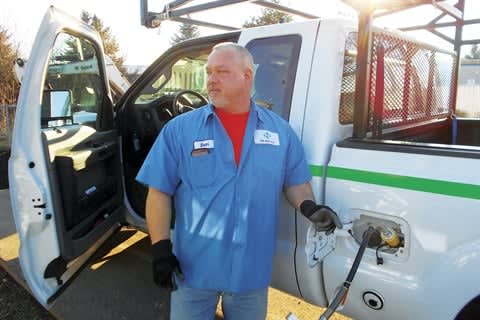
NW Natural will test new CNG tank technology from EnerG2 to see whether it’s viable in real-world scenarios, particularly for fleet applications. Photo: NW Natural
With about 100 compressed natural gas (CNG) bi-fuel vehicles in its fleet and experience with more than 1,000 CNG vehicles over the course of a 150-year history, Portland, Ore.-based NW Natural is offering up its fleet as a testing ground for a new tank technology: adsorbed natural gas (ANG) storage systems. The tests will be conducted in partnership with the energy storage systems company EnerG2, headquartered in Seattle.
The ideas surrounding an ANG system have been around for more than 100 years, but research and development on the technology didn’t surface until recently. The EnerG2 and NW Natural tests will shed light on whether it’s viable in real-world scenarios, particularly for fleet applications.
A New Take on Older Tech
An ANG system is engineered to gain more out of an on-board CNG tank. It is made with a porous, synthetic carbon-based interior, which allows the gaseous fuels to essentially soak into the “nano pores” of the material.
This liquid-like state, in which the gas becomes very dense around these materials, is what’s referred to as an “adsorbed state,” according to Aaron Feaver, Ph.D., EnerG2’s chief technology officer.
“It’s somewhere between a liquid and a gas, so when you use these types of materials, you’re able to store gas at a higher density but lower pressure,” he said.
The main goal of the EnerG2 ANG system is allowing the user to fill up at much lower pressures. This means that a high-end 3,600-pound-per-square-inch (psi) compressor would not be required to fill up a tank, nor would the cylindrical tank shape be necessary to provide the strength needed for high pressures.
According to Feaver, you can store the same amount of CNG per volume on a lower-pressure ANG tank as you would using a 3,600 psi compressor, but using an 800-1,000 psi compressor instead. This lowers the cost of the compressor and helps reduce the electricity costs associated with running a CNG compressor.
Another benefit is the fact that engineers can depart from the standard cylindrical shape seen in CNG tanks because an ANG tank can be filled at lower pressures.
“The efficiency you gain from changing the tank geometry allows you to get a lot more natural gas on board the vehicle because you’re putting gas in unoccupied corners. Most vehicles have roughly rectangular spaces available, not spherical or cylindrical spaces. You want to be able to fill in all those gaps and really have efficient geometric utilization of the space on board the vehicle,” Feaver said.
If you were to take a 3,600 psi compressor and fill up two same-sized cylindrical tanks, with one using ANG materials, the ANG cylinder would hold 10-20 percent more gas, according to Feaver. Taking it a step further and comparing that to a low-pressure, non-cylinder-shaped tank that utilizes as many nooks and crannies available on board the vehicle, he says the increased fuel capacity could add up to 50 percent. This increase, he said, could make CNG a more appealing option for higher-mileage routes such as in long-haul trucking or in areas where public infrastructure is scarce.
An Obvious Choice
As a natural gas company, NW Natural has obvious alignments with the alternative fuel, and according to a recent announcement, the utility has also received approval from the Public Utility Commission of Oregon to offer a service to install, own, and maintain CNG compression equipment for its business customers. In addition to its own fleet, NW Natural has its eye on fleet customers and the consumer market as well.
Chris Galati, NW Natural’s CNG program manager in business development, who has been with the company for 15 years, said that tank technology and fuel compression is what the utility sees as one of the biggest hurdles in growth and could help reduce the “chicken and egg” problem with CNG infrastructure.
“We got into ANG because it has a lot of promise for all fleets, regardless of vehicle size or weight,” he said. “It has this tremendous promise of either increasing range or decreasing pressure for the same range. For example, on a passenger vehicle, what’s important could be range, but also conformal tank technology that fits the geometry of the vehicle better.”
Galati added that from what he’s observed, not only is it providing range and shape benefits, but the materials are lighter weight than CNG tanks currently in use.
But, it really comes down to the compressor, especially when it comes to proliferating CNG into the fleet and consumer markets. “The capital expenditure upfront for a 3,600 psi compressor is significant,” Galati said. “It can cost as much if not more than the incremental cost of your CNG vehicle.”
The ANG Tests
NW Natural and EnerG2 will first conduct bench tests, and will then put the tanks into two Ford F-150 bi-fuel trucks in the next couple months.
“The first thing we want to do is understand the properties we’re testing out,” Galati said. This includes:
Understanding in detail the differences in filling up the ANG tank at different pressures.
How easy it is to release the gas from the vessels with an ANG storage tank in it.
What the migration characteristics are of the material.
How easy it is overall to work with an ANG tank.
The conclusions from the bench tests will guide the field tests and how they’re conducted. Galati expects the field tests to take about two months. From there, EnerG2 may decide to modify the tanks or move forward with the current model.
With a total fleet size of around 1,000 vehicles, NW Natural has high hopes for the study.
“The real story is if a company like NW Natural starts embarking on this in a meaningful way, others will follow,” Galati said. “Companies like ours have a role to play in the CNG market beyond just being a gas supplier. We’re on the cutting edge of something that’s potentially game changing, and that’s exciting.”
NW Natural is also testing other CNG-related technology, such dual fuel applications and refining CNG fill nozzles at the pump.
More Green Fleet

EV Charging Use Is Outpacing Infrastructure Growth
ChargePoint’s 2026 Charging Forward Report points to rising charger use, higher-powered charging, commercial vehicle electrification, and energy-management technology. Here’s what fleets should know.
Read More →
Merchants Fleet Reports 290M EV Miles as Fleets Navigate Changing Electrification Market
From millions in operating savings to hundreds of millions of EV miles, Merchants Fleet’s latest report reveals what’s working and what’s changing in fleet electrification.
Read More →
The EV Breakdown Nobody's Talking About: Why Most Electric Vehicle Roadside Calls Aren't Mechanical Failures
Here's why EV breakdowns are widely misunderstood.
Read More →
ChargePoint Now Available in Energy Pass
ChargePoint and additional planned charging network integrations were added to GM's Energy Pass.
Read More →

First Look: Slate Auto's Electric Fleet Pickup
Could an affordable, modular EV pickup make electrification more practical for fleets?
Read More →
Slate Debuts Colorful, Unique EV Models
A recent media and client event, studded with electric vehicles dressed up on platforms, planted a new position for the manufacturer in the wider EV market. Fleets will find cost-saving advantages.
Read More →
Slate Electric SUV, Pickup Switchable Model Aims For Light-Duty Fleets
Everything about this EV is counterintuitive and understated, making it stand out from the crowd.
Read More →
Inspiration Mobility Acquires Key Electrada Assets
Inspiration Mobility Group has acquired select assets of Electrada, adding the fleet electrification provider's team, technology, and charging infrastructure development capabilities to its energy management business.
Read More →
Turning Connected Vehicle Data Into Decisions That Matter
Fleet leaders have more data than ever, but turning that data into clear, actionable decisions remains a challenge. This white paper shows how leading organizations are using connected vehicle data to improve safety, reduce costs, and optimize fleet performance. Learn how to turn insight into action across your fleet.
Read More →