




NETS Developing Road Safety Tools
Drawing from the success of the Comprehensive Guide for Road Safety, the Network of Employers for Traffic Safety (NETS) is rolling out a new guide and toolkits to provide a better view of road safety.

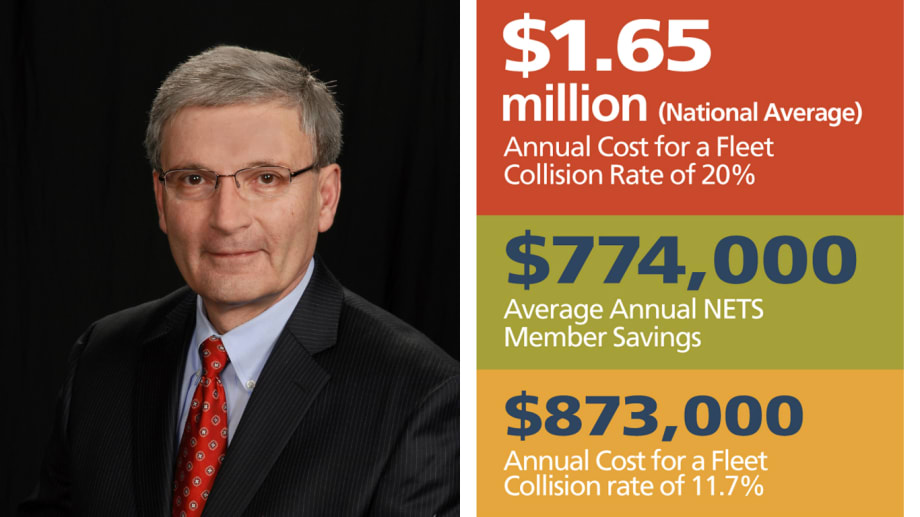
Hanley (left) and chart of estimated collision costs. Source: NETS
Hanley (left) and chart of estimated collision costs. Source: NETS
A global resource for road safety, the Network of Employers for Traffic Safety (NETS) is developing new tools to help fleet safety managers learn where and how they can improve their fleet safety programs.
The organization ended 2015 on a high note, receiving the Prince Michael International Road Safety Award for its Comprehensive Guide to Road Safety.
“We are very pleased with the recognition,” said Jack Hanley, executive director of NETS. “We provided a global road safety guide that allows fleet safety leaders to build a program from the ground up.”
According to Hanley, the guide has been downloaded 10,000 times since its introduction on May 31, 2014, and is available in 21 different languages.
Moving Road Safety Forward
Apart from the guide, the organization annually conducts the NETS STRENGTH IN NUMBERS Fleet Safety Benchmark Program.
“The Benchmark includes light-, medium-, and heavy-duty vehicles,” said Hanley. “By country and by type of vehicle, we collect total mileage, total vehicles, and collisions. NETS gathers injury data for the UK and U.S. The program also surveys members about their fleet safety programs. The metrics and survey results are used to identify best practices and emerging trends.”
The STRENGTH IN NUMBERS program serves as a basis for fleet safety managers to compare their collision rates to other fleets and identify ways to improve their programs. The 2016 Benchmark collected data from 146 countries and included over 600,000 vehicles and 11.5 billion miles.
“The Benchmark program is suitable for small companies with only a few vehicles just starting out, to large companies with thousands of vehicles and advanced road safety programs,” Hanley said.
In the first-quarter of 2016, NETS will publish NETS’ Guide to Defensive Driver Training.
“It will be a practical guide for companies — local and global — looking to put together a training program for their company drivers,” Hanley said. “It would apply to all drivers, from occupational to professional drivers with a commercial driver’s license (CDL). Just like the Comprehensive Guide to Road Safety, the Guide to Defensive Driver Training will be available electronically and free of charge on NETS’ homepage.”
Developing New Resources
Hanley said NETS is completing two projects for the National Highway Traffic Safety Administration (NHTSA) that focus on improving seat-belt usage and understanding the cost associated with vehicle crashes.
A free e-tool kit — 2seconds2click — for use by fleets will be available on NETS’ website later this year. It provides the steps fleet safety managers need to conduct a low cost, low effort, and highly effective seat belt campaign directed at all employees.
The Coca-Cola Company, a member of the board of directors for NETS, has already successfully put it to the test in Bismarck, N.D.
Later in 2016, NETS will make another resource available, The Cost of Vehicle Crashes to Employers. This tool is also a result of a cooperative agreement with NHTSA and it provides road safety and fleet managers with the information they need to build business cases to support investments in fleet and company-wide road safety.
“We are pleased to make these road safety resources available to employers. Plus, we have others, such as the Drive Safely Work Week annual campaign and NETSWORK, our monthly e-newsletter. Everything but the Benchmark program is free of charge. ” Hanley said. “Employers can play a big role in making our roads safer and NETS has the tools to make this possible.”
More Safety

What’s Next for Fleet? Safety, AI & Industry Recognition | AF News Recap
Could your company's culture be encouraging distracted driving? This week, we're exploring how workplace expectations affect driver safety, what AI, EVs, and autonomous vehicles could mean for the future of fleet management, and how fleet professionals can strengthen their award nominations.
Read More →
Does Your Fleet's Culture Encourage Distracted Driving?
What happens when the people responsible for enforcing safety rules are the ones setting the wrong example? The answer may reveal why some of the biggest risks to fleet drivers have little to do with what's written in the employee handbook.
Read More →
Fleet Manager’s Ultimate Playbook: Navigating the New Standard in OEM Connectivity
Rising operating costs, driver safety concerns, and unplanned downtime are putting unprecedented pressure on modern fleets. Discover how fleet managers use embedded OEM connectivity and real-time vehicle data to cut TCO, prevent downtime, and protect drivers without aftermarket telematics hardware.
Read More →
From Driver Well-Being to EV Charging | AF News Recap
Mental health belongs in the fleet safety conversation. This week, we’re looking at five ways fleets can support employee well-being before a crisis, plus Holman’s expansion in Mexico, new one-day Fleet Forward passes, and why EV charging demand is outpacing infrastructure growth.
Read More →
Nexar-Nauto Merger Aims to Give Fleets Better Safety Intelligence Through Larger Driving Dataset
Stefan Heck tells Automotive Fleet that combining more than 10 billion miles of driving history with Nexar's AI models will give fleets deeper insights into driver risk and roadway conditions than either company could provide independently.
Read More →
Don't Wait for a Crisis: 5 Ways to Build Mental Health Into Your Fleet Safety Program
For Suicide Prevention Month, fleet and safety leaders have an opportunity to put mental health where it belongs: at the center of workplace safety.
Read More →
How Camera Data Can Strengthen a Fleet’s Insurance Renewal
Insights from a commercial insurance carrier and a broker show how fleets can turn video telematic data, driver coaching, and improved claims results into a stronger case at insurance renewal.
Read More →
The Safest Fleets Aren’t the Ones with the Most Technology
You’ve made the telematics investment. Here’s how to capture the other half of its value and build the safest fleet on the road.
Read More →
Hidden in Plain Sight: Fleet Compliance Risks
Fleet compliance isn't just about having policies — it's about consistently enforcing them. This practical guide reveals six hidden compliance risks common in public sector and shared fleet operations and outlines proven strategies to improve visibility, accountability, and audit readiness
Read More →
NETS Sets 2026 Fleet Safety Benchmark Conference for Indianapolis
The Sept. 15–17 program will feature fleet benchmarking data, case studies, emerging technologies, and implementation strategies while running alongside the NSC Safety Congress & Expo.
Read More →