





Related: Merging Methodically Onto Highways
How to Park With Extreme Caution
A balance of technology and old-fashioned driver training can eliminate common vehicle collisions. Fleet managers need to ensure safety technology complements what drivers already know.
October 16, 2015
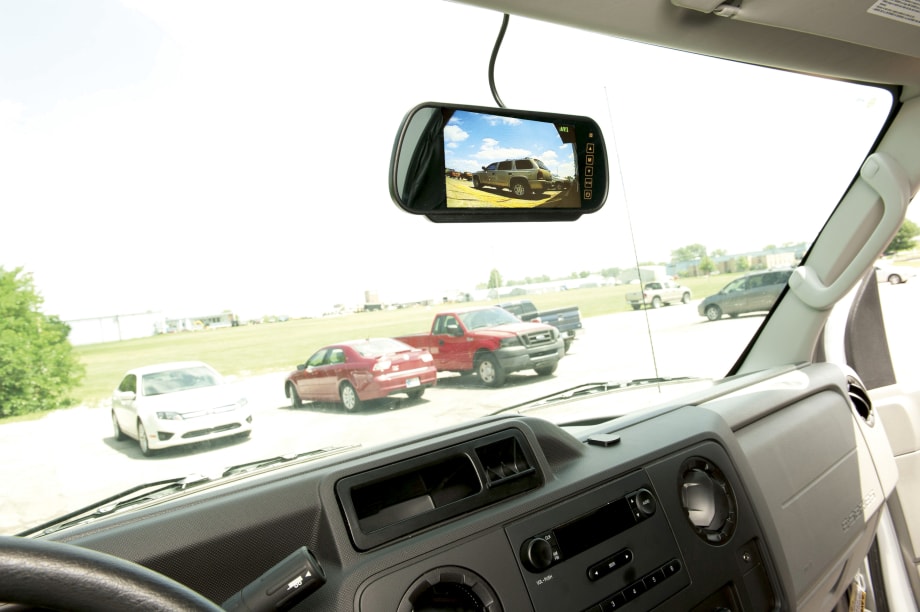
Convoy Technologies’ Rear-view Monitor System helps drivers stay safe as they navigate parking lots and other environments.
3 min to read
Convoy Technologies’ Rear-view Monitor System helps drivers stay safe as they navigate parking lots and other environments.
Collisions in parking lots are the most common and least reported in the fleet industry.
What can be done to improve driver and vehicle safety when operating in a parking lot and trying to squeeze into a spot?
“The best way to avoid a parking lot crash is to backup as little as possible,” said Phil Moser, vice president of Advanced Driver Training Services (ADTS).
Moser offered safety tips and practices that fleet drivers should keep in mind.
Setting a Safety GOAL
First, Moser advised fleet drivers to look for pull-through parking spaces. By parking in a pull-through space, drivers would decrease their chances of getting into an accident, Moser stated.
“If the driver can’t pull-through a parking space, they need to back in,” Moser said.
And, drivers should also remember the vehicle’s pivot points. Not to forget, the front tires give the vehicle direction and the rear wheels help with pivoting.
Also, he cautioned drivers to wait for the rear wheels to align with the center pillar and then make the turn. Otherwise, they will turn into the obstacle.
Next, drivers need to judge whether the vehicle is going to fit and keep a watchful eye on other vehicles to make sure they do the same.
Therefore, the best way to do this is to get close to the side they can see through the best.
“The left front provides the best view as the driver moves the vehicle, and they can judge it the best,” Moser said. “The rest of the car should follow through, don’t stare at the obstacle.”
Finally, Moser provided a simple acronym to help fleet drivers to remember to be safe: GOAL, or “get out and look” at what surrounds the vehicle.
GOAL allows drivers to become aware of any obstacles that may be in their way as they pull out of the parking space.
“Drivers should approach from the passenger’s side and do a walk around,” Moser said. “There could be kids back there or a pole the driver forgot about.”
Moreover, when drivers are backing out, they need to make sure backing lights activate, the vehicle is in reverse, and they should linger for a few seconds. Before reversing, drivers need to tap on the horn a couple of times.This will serve as a warning for pedestrians and those distracted by their smart phones to move away from the vehicle because it will be backing out shortly.
Integrating Safety Technology
Moser sees rear-view cameras and other safety technology as added benefits that supplement drivers’ safety techniques and practices.
“It’s terrific technology that allows drivers to see what is directly behind their vehicles, whether it be obstacles or a child running up behind the car,” Moser said.
But, he warned that cameras and safety technology cannot give a complete view, and over-reliance on this technology will result in the development of bad habits.
“Cameras and other safety technology work best when used in conjunction with safe driving techniques,” Moser said.
The addition of cameras and other technology to improve driver safety can serve as a secondary line of defense.
“Parking safety is a big challenge in the fleet industry,” said Blake Gasca, CEO of Convoy Technologies, a provider of safety solutions such as backup camera systems, sensors, and live video recording services.
When taking the issues of parking and driver safety into account, Gasca highlights key points fleet managers need to be aware of.
“Fleets need to recognize parking collisions as an ongoing issue,” according to Gasca.
Therefore, fleet managers need to plan ahead and do their research on what kind of tools would work best for their fleets.
Additionally, fleet managers need to know where the industry is going.
“With the advancement in the technology available to fleets, fleet managers must adapt and use this tech as training tools,” said Gasca.
This technology will help fleet managers coach drivers on how to maneuver.
Subscribe to Our Newsletter
More Safety

Sponsored•October 1, 2026
Fleet Manager’s Ultimate Playbook: Navigating the New Standard in OEM Connectivity
Rising operating costs, driver safety concerns, and unplanned downtime are putting unprecedented pressure on modern fleets. Discover how fleet managers use embedded OEM connectivity and real-time vehicle data to cut TCO, prevent downtime, and protect drivers without aftermarket telematics hardware.
Read More →
From Driver Well-Being to EV Charging | AF News Recap
Mental health belongs in the fleet safety conversation. This week, we’re looking at five ways fleets can support employee well-being before a crisis, plus Holman’s expansion in Mexico, new one-day Fleet Forward passes, and why EV charging demand is outpacing infrastructure growth.
Read More →
Nexar-Nauto Merger Aims to Give Fleets Better Safety Intelligence Through Larger Driving Dataset
Stefan Heck tells Automotive Fleet that combining more than 10 billion miles of driving history with Nexar's AI models will give fleets deeper insights into driver risk and roadway conditions than either company could provide independently.
Read More →
Don't Wait for a Crisis: 5 Ways to Build Mental Health Into Your Fleet Safety Program
For Suicide Prevention Month, fleet and safety leaders have an opportunity to put mental health where it belongs: at the center of workplace safety.
Read More →
How Camera Data Can Strengthen a Fleet’s Insurance Renewal
Insights from a commercial insurance carrier and a broker show how fleets can turn video telematic data, driver coaching, and improved claims results into a stronger case at insurance renewal.
Read More →
The Safest Fleets Aren’t the Ones with the Most Technology
You’ve made the telematics investment. Here’s how to capture the other half of its value and build the safest fleet on the road.
Read More →
Sponsored•August 7, 2026
Hidden in Plain Sight: Fleet Compliance Risks
Fleet compliance isn't just about having policies — it's about consistently enforcing them. This practical guide reveals six hidden compliance risks common in public sector and shared fleet operations and outlines proven strategies to improve visibility, accountability, and audit readiness
Read More →
NETS Sets 2026 Fleet Safety Benchmark Conference for Indianapolis
The Sept. 15–17 program will feature fleet benchmarking data, case studies, emerging technologies, and implementation strategies while running alongside the NSC Safety Congress & Expo.
Read More →
Off-the-Job Crashes Account for 43% of Employers’ $61.7 Billion Crash Burden
NETS quantifies costs dispersed across fleet, risk, HR, and other departments while providing new per-crash benchmarks for employers.
Read More →
Ram Recalls More Than 1.27 Million 1500 Pickups for Seat Belt Anchor Issue
The recall affects certain 2019-2026 Ram 1500 pickups that may have improperly attached second-row seat belt buckle anchors.
Read More →