




National Park Adds Propane Buses, Trucks
Partnering with a local Clean Cities coalition, Kentucky's Mammoth Cave National Park's propane-powered buses and pickup trucks have helped reduce its carbon footprint, as well as educate the public on the benefits of alternative fuels.

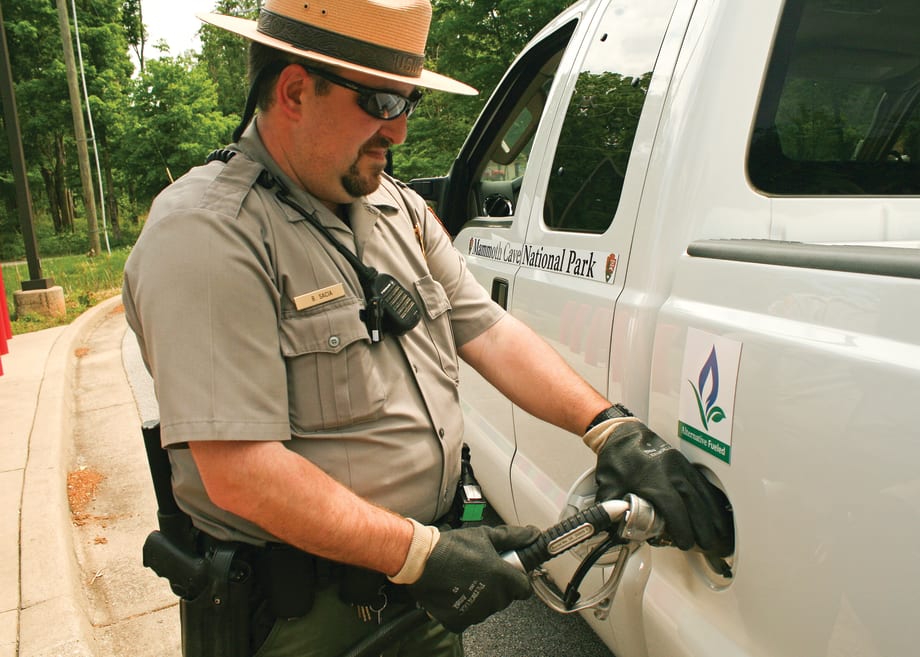
Brian Sacia, a Mammoth Cave National Park ranger, refuels one of the park's propane-powered F-250 pickup trucks.
Brian Sacia, a Mammoth Cave National Park ranger, refuels one of the park's propane-powered F-250 pickup trucks.
As a national park, it is important to protect the environment and the local resources for visitors to enjoy.
For Mammoth Cave National Park, its sustainability initiatives cover everything from reusing waste materials to installing recycled materials in the visitor center to incorporating alternative fuel vehicles into its fleet.
Since 2002, this Kentucky-based national park has used alternative fuels in its vehicle fleet, including E10 bi-fuel (ethanol and gasoline), biodiesel and propane.
“We feel a strong responsibility toward stewardship of what’s here and protection of the resources,” says Vickie Carson, Mammoth Cave’s public information officer. “Because air and water quality are of great concern, fuels like propane help us to show our visitors that there’s another fuel that can be used.”
To help incorporate alternative fuels into its infrastructure, Mammoth Cave has collaborated on alternative fuel and advanced transportation technology projects with the Kentucky Clean Fuels Coalition (KCFC), part of the Department of Energy’s Clean Cities coalition program, since the late ‘90s.
More recently, KCFC helped Mammoth Cave obtain funding for new propane-powered buses and propane pickup trucks, according to Melissa Howell, KCFC’s executive director.
Propane Funding
In 2011, Mammoth Cave received a $505,000 grant from the DOE’s Clean Cities program to replace its aging vehicles with new propane-fueled vehicles.
With this grant, the national park replaced four old propane buses (three 1990 models and one 1977 model) with four new autogas Bluebird school buses, as well as two bi-fuel pickups with two propane Roush CleanTech Ford F-250 pickups, according to Carson.
“KCFC was approached in 2011 by the U.S. Department of Energy with a request for Mammoth Cave National Park to serve as the first national park to participate in a direct Green Parks initiative, which carried with it funding for vehicles,” says Howell.
The Green Parks Plan also educates the public about the benefits of alternative and renewable fuels.
“It’s a good demonstration project,” says Carson. “The 200,000 people who ride the [propane] buses can experience riding in an alternative fuel vehicle.”
In addition to using propane-powered vehicles, Mammoth Cave also uses propane in other areas of its operation. The Propane Education & Research Council (PERC) recently donated propane-powered equipment, including three John Deere mowers, two Generac portable generators and a CleanFuel USA propane dispenser.

A cave tour at Mammoth Cave National Park.
Maintaining Vehicles
From small sedans to passenger vans to a dump truck, a majority of Mammoth Cave’s fleet runs on bi-fuel (ethanol and gasoline) and biodiesel, according to Bobby Sanders, Mammoth Cave’s heavy equipment mechanic.
The eight propane buses transport visitors daily on the cave tours. According to Sanders, the Mammoth Cave Hotel — operated by Forever Resorts — operates the propane buses and takes them to an outside vendor for regular maintenance.
Averaging about 500 miles per week, the two propane-powered F-250 pickups are used by the park’s law enforcement division for patrol and emergency response. Sanders takes care of routine maintenance for the trucks on-site at Mammoth Cave’s garage.
For filling up the vehicles, Mammoth Cave has an on-site refueling area with E10, biodiesel and propane. When it comes to fuel consumption, the savings for propane would be in the cost per gallon; propane is $1.89 per gallon, says Sanders.
“There is no performance difference with propane,” says Sanders. “It is an efficient fuel. Propane is so much cleaner than other fuels; even the engine parts stay cleaner.”
Originally posted on Work Truck Online
More Global Fleet
Holman Takes Full Ownership of ARIZA in Mexico
Holman is bringing its Mexican fleet management operation fully under its own brand after more than 30 years as a joint venture. The change gives multinational fleet customers a single Holman operation across the U.S., Canada, and Mexico.
Read More →
Proven Ways to Reduce Work Truck Downtime
The age-old problem of downtime will always be a reality, but with new strategies at hand, fleets have more ways to keep trucks on the road longer.
Read More →
The Top 300 Commercial Fleets
The Top 300 Commercial Fleets: See the List
Read More →

Cameras, Safety and Insurance: From Reactive Claims to Real-Time Prevention (Part 2 of 2)
Part Two: Commercial auto remains one of the most challenging and costly lines of coverage for fleet operators and insurers alike. Continue learning more about how to effectively address these issues from Onur Aksan, Enterprise Business Development Executive, Geotab
Read More →
Cameras, Safety and Insurance: From Reactive Claims to Real-time Prevention
Commercial auto remains one of the most challenging and costly lines of coverage for fleet operators and insurers alike. Learn more about how to effectively address these issues from Onur Aksan, Enterprise Business Development Executive, Geotab.
Read More →
Fleet Costs Are Rising: Here’s How Leaders Are Responding
Fleet leaders are under pressure to reduce costs, adapt to economic uncertainty, and make smarter decisions. See how peers across North America are responding with real data, proven strategies, and forward-looking insights. Download the 2026 Market Pulse Report to benchmark your strategy and uncover where you can gain an edge.
Read More →
Enterprise Fleet Management Surpasses 900,000 Vehicles in U.S. & Canada
Enterprise Mobility connects with mobility solutions around the globe
Read More →
Automotive Fleet's Guide to Fleet Electrification
Unlock the secrets to a successful transition to electric fleets with Automotive Fleet's comprehensive Fleet Electrification Guide!
Read More →
Sumitomo Rubber Industries to Acquire Viaduct
Viaduct will join Sumitomo as an independent subsidiary. Partnership strengthens global reach and accelerates AI-driven innovation for fleets and manufacturing.
Read More →