Mercedes-Benz plans to introduce 30 new models by 2020. What do fleets have to look forward to?
by By Shelley Ernst
May 19, 2016
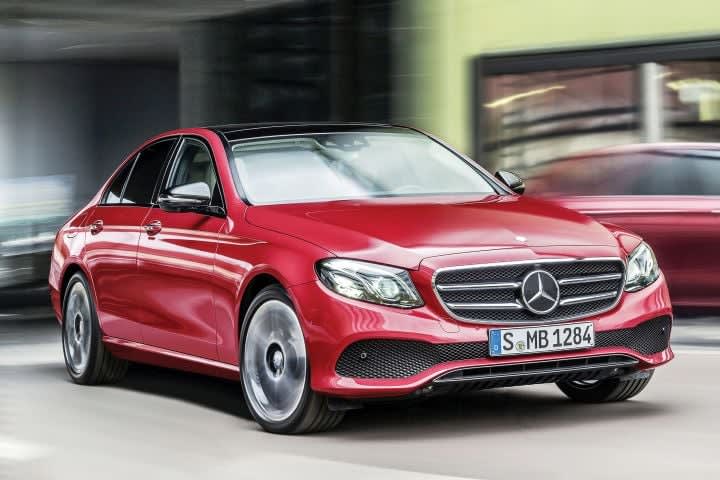
Photo of 2017 E-Class courtesy of Mercedes-Benz.
7 min to read
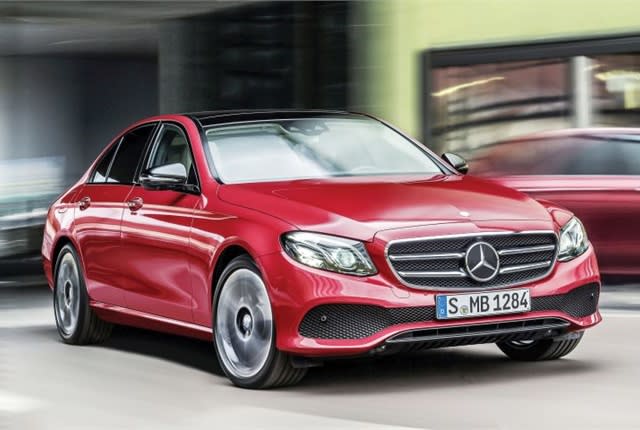
Photo of 2017 E-Class courtesy of Mercedes-Benz.
Mercedes Benz has big plans over the next few years. By 2020, the automaker will introduce 30 new models to its lineup. Of those 30, three model-year 2017 vehicles are already hitting the assembly line.
Ad Loading...
"We will be debuting vehicles from across our product lineup, from the C-Class Cabriolet that was just unveiled at the Geneva Auto Show to the E-Class sedan, which was revealed at the North American International Auto Show," said Christopher Duffner, department manager, Fleet Operations for Mercedes-Benz. "It's mainly about developing products to accommodate new customers."
Ad Loading...
The new model-year 2017 vehicles include the E-Class luxury sedan, the GLS SUV, and the GLC mid-size SUV. Each boasts new features that may appeal to the needs of fleets and drivers.
The E-Class: The Most Intelligent Street Car
This is the 10th generation of the Mercedes E-Class luxury sedan — and with the new model come several innovations. The company calls it the "most intelligent street car ever," and for good reason. The car features several technical innovations, enhanced safety features, improved comfort, and interior features for the connected driver.
"The new E-Class will be the smartest vehicle on the road when it arrives in dealerships later this year," Duffner said. "With class-leading safety features, several autonomous and semi-autonomous driving functions, and a next-level interior, both driver and passengers feel right at home in the E-Class. A powerful-yet-efficient turbocharged four-cylinder engine paired with a 9-speed automatic transmission (9G-TRONIC) ensures great performance and fuel economy."
The new E-Class is different from its predecessors in a number of ways. For one, it's larger, with a wheelbase that has grown by 2.6 inches (115.7 inches vs. 113.1 inches) and an overall length that has grown 1.7 inches. In the U.S. market, it will also feature a turbocharged 2.0L four-cylinder gasoline engine producing 241 hp and 273 lb-ft of torque — and further engine variants are to come. Every E-Class model will come standard with the new 9G-TRONIC 9-speed automatic transmission, which enables fast gearshifts and low engine revs while cruising, providing efficiency and improvements in interior noise levels.
"Both the turbocharged 2.0L four-cylinder and Biturbo 3.0L V-6 engines are paired with an in-house developed 9-speed transmission," Duffner said. "It's smaller and lighter than the previous 7-speed. In terms of benefits for fleets, there are major fuel efficiencies, resulting in less downtime."
Ad Loading...
The E-Class is just one of the models to see engine upgrades: Mercedes Benz is introducing new engine variants in 12 models for MY-2017.
Mercedes-Benz is also taking strides toward fully autonomous driving with the E-Class.
The E-Class comes standard with several next-generation driver assistance systems.
PRE-SAFE Sound, a system based on a protective human reflex in the inner ear, emits a short interference signal through the vehicle's sound system when the risk of a crash becomes imminent. This signal, in turn, triggers the driver's stapedius reflex and prepares the occupants' ears for the sound of the accident.
Likewise, Active Brake Assist warns the driver of impending crashes, providing the appropriate level of support during emergency braking and automatically applying the brakes if necessary. The system can detect slower-moving, stopped, and stationary vehicles as well as pedestrians passing in front of the vehicle.
Ad Loading...
While PRE-SAFE Sound and Active Brake Assist detect dangers outside of the car, ATTENTION ASSIST detects a dangerous occurrence that often happens within vehicles: inattentiveness or drowsiness. When the system detects the driver is tired or distracted, it sounds a warning. Crosswind Assist aids the driver as well, preventing the vehicle from drifting too far off track when experiencing the effects of strong crosswinds.
For further intelligent driving functions, fleets can opt to add the Driver Assistance Package Plus, which includes additional steering, braking, and driving assistance systems.
The new E-Class also marks the first time a car has featured touch controls on the steering wheel. Just like a smartphone, the touch controls respond to horizontal and vertical swiping so drivers can control the entire infotainment system without taking their hands off the steering wheel. This design makes for a safer driving experience; minimizing driver distraction and helping them keep their eyes on the road and hands on the wheel.
The 2017 Mercedes-Benz E-Class comes in both a luxury version and sport model, and will be available at U.S. dealers this summer.
Photo of Euro-spec 2017 GLS courtesy of Mercedes-Benz.
The GLS: The 'S-Class' Among SUVs
The GLS also hits markets this year. Serving as the only seven-seater in the European premium SUV segment, the 2017 model-year has gotten a facelift as well as improved safety features, increased performance, and enhanced connectivity.
Ad Loading...
"Replacing the GL, the GLS is the 'S-Class' of our SUV lineup. Offering seven seats, ample cargo room, and an impressive suite of driver safety features, the GLS is a leader in the luxury SUV segment," Duffner explained. "The GLS combines luxury with impressive levels of comfort, agile dynamics and best-in-class safety. With both gasoline and diesel engines available, the GLS is the ideal vehicle for any environment."
Available engines on the new GLS offer improved performance across the model line. The GLS550 4MATIC with V-8 Biturbo engine now generates 449 hp — 20 hp more than the preceding model — and has a maximum torque of 516 lb-ft. The GLS450 4MATIC comes equipped with the 3.0L V-6 Biturbo engine, which produces 362 hp and 369 lb.-ft. of torque from 1,800 rpm. Both engines feature direct injection and have an ECO start/stop function.
The Mercedes-AMG GLS63 also has over 27 more horsepower than its predecessor. The peak torque of 561 lb.-ft. is now available from 1,750 rpm.
The GLS350d 4MATIC offers a V-6 diesel engine rated at 255 hp and with 455 lb-ft. of torque.
At the launch of the new GLS generation, all versions will feature the 9-speed 9G-TRONIC automatic transmission as standard except the Mercedes-AMG GLS63. The AMG features a quick-shifting, 7-speed automatic transmission.
Ad Loading...
Like the E-Class, the GLS offers safety features that take the strain off of drivers. The GLS comes standard with numerous driver assistance systems, including COLLISION PREVENTION ASSIST PLUS, Crosswind Assist, ESP and ATTENTION ASSIST. The PRE-SAFE system, Brake Assist System (BAS), electronic all- wheel drive traction system 4ETS, ESP, and cruise control are also standard.
Drivers can also operate better at night and in adverse weather conditions with an available LED Intelligent Light System that improves night-time vision and MAGIC VISION CONTROL, a heated adaptive windscreen wiper system, which provides optimum water distribution.
The GLS is more connected, too. It includes the latest generation of Mercedes-Benz telematics, which includes Internet access and remote-start capability. An extensive package of free Standard Services and Remote Online Services is available, including automatic emergency call, Accident Recovery and breakdown assistance, and after-sales service. Remote Online functionality allows access to vehicle information from anywhere at all times, including the status of windows and doors, mileage, tire pressures, and other diagnostic data.
The GLS has been available for order since December 2015, and the first deliveries in the U.S. market are arriving at dealerships now.
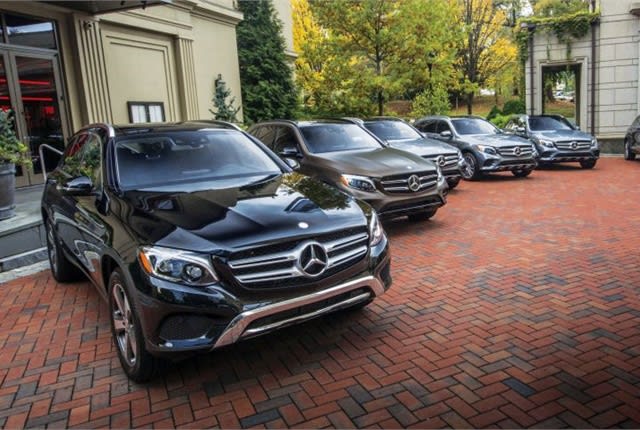
Photo of 2016 GLC courtesy of Mercedes-Benz.
GLC: A Versatile, Midsize SUV
The GLC is the new name for the GLK, but the sleekness of the new, larger design is a clear departure from its predecessor.
Ad Loading...
"The GLC, replacing the outgoing GLK, has a powerful-yet-efficient turbocharged four-cylinder engine paired with a 9-speed transmission (9G-TRONIC), ensuring great performance and fuel economy," Duffner said. "Great exterior looks and ample interior space make the GLC appealing both inside and out."
Although larger than the GLK, the GLC is actually lighter, weighing about 176 pounds less than its predecessor. The body alone weighs 110 pounds less, as it's made of a mix of aluminum and high- to ultra-high-strength steels. Aluminum components reduce the weight of the suspension as well, making for a smooth and comfortable ride.
The GLC has a new turbocharged 2.0L four-cylinder engine and offers 4MATIC all-wheel-drive for agility and traction on a variety of road surfaces. The GLC's performance and space beats that of the GLK. The luggage compartment is now larger and features a level load area. Compared to the GLK, capacity behind the rear seat increases by 2.8 to 3.9 cubic feet, for a total of up to 20.5 cubic feet. In all, the GLC is able to transport up to 56.5 cubic feet of cargo — 1.8 cubic feet more than the GLK.
The GLC has seen safety upgrades, including all-new air bags, which include combined thorax/pelvis side bags for the driver and front passenger and a newly developed window bag extending over both seat rows, optional side bags for the outer rear seats, and a driver's knee bag.
Like the GLS, the GLC also comes with the mbrace Connect package, which includes mobile app, Web services, roadside connection, MB Apps (non-streaming), diagnostics data, and remote update for five years. When triggered, mbrace can also place emergency calls automatically.
Ad Loading...
Sales of the GLC began in December.
More Power, Improved Safety, Better Connectivity
Although each model meets different needs, the new model-year 2017 Mercedes Benz models do have a lot in common: they offer improved performance, safety, and connectivity — and they ensure Mercedes Benz is better meeting the needs of its fleet customers.
As fleet costs and insurance pressures rise, fleet managers are taking a closer look at which employees need company-provided vehicles and when a reimbursement program may make more sense.
In this opening keynote of the 2026 Fleet Forward Conference, John Rossant, founder of CoMotion, How can fleet managers navigate a never-ending, changing industry landscape?
This week, we're breaking down which industries have the highest rates, how Jamie McKay manages 2,400 vehicles, what's happening with the 2027 fleet awards, and why software-defined vehicles could introduce new costs.
Fleet managers continue to rely on FMCs for essential services but are taking a closer look at where working directly with suppliers can improve efficiency and responsiveness.
Meet Erin Gilchrist, the inaugural Mike Antich Spirit of Fleet Award winner, as she shares insights on leadership, mentorship, the power of industry connections, and why people remain at the heart of fleet's future.
How do you keep 2,400 vehicles running across 37 states? Fleet Visionary Award winner Jamie McKay shares how collaboration, flexibility, and a few simple strategies help her tackle fleet management challenges at Aptive Pest Control.
Fleet operating costs have risen more than 20% since 2020, raising a key question: When does extending a vehicle's service life stop making financial sense?
A stolen catalytic converter can cost fleets far more in downtime and lost productivity than in repairs. A total-cost-of-risk approach can help fleet managers quantify their exposure and prioritize theft prevention.