




Maven Makes Shared Mobility Possible
Launched by General Motors in January 2016, Maven is a car-sharing service that is spreading across North America and offering technology and terms that could prove irresistible to mobile fleets.

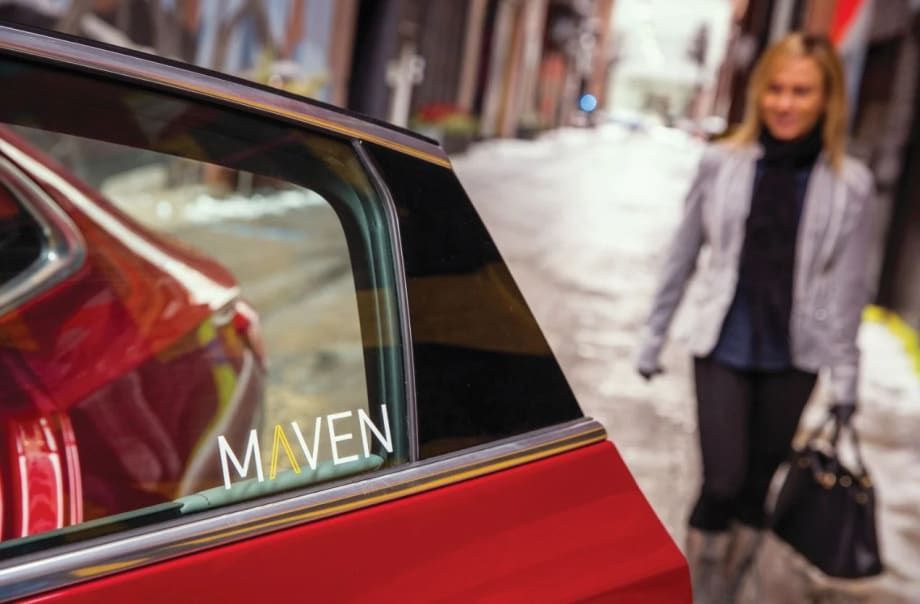
Maven is a car-sharing program offered by General Motors in partnership with a number of mobility service providers. Though targeted to young urban dwellers, the service could prove useful to fleets seeking to reduce their inventory or give drivers more transportation options. Photo courtesy of GM.
Maven is a car-sharing program offered by General Motors in partnership with a number of mobility service providers. Though targeted to young urban dwellers, the service could prove useful to fleets seeking to reduce their inventory or give drivers more transportation options. Photo courtesy of GM.
If you don’t live in a Maven city, you may not yet be aware of General Motors’ relatively new and highly disruptive car-sharing service. Launched on the University of Michigan campus in Ann Arbor, Mich., in January 2016, Maven has since opened operations in Baltimore, Boston, Chicago, Denver, Detroit, Jersey City, N.J., Los Angeles, New York, Orlando, San Francisco, Washington, D.C., and multiple locations in Ontario, Canada.
The service sets itself apart in two key ways: First, Maven vehicles run the gamut of GM’s portfolio — including sedans, SUVs, and pickups bearing the Chevrolet, GMC, Cadillac and Buick marques — all equipped with OnStar, 4G LTE Wi-Fi, and Apple and Android connectivity. Second, there is no application or membership fee and no cost for fuel or insurance. Users simply download the Maven app and use it to reserve, access, and pay for shared vehicles on an hourly or daily basis.
Designed to cater to mobile professionals as well as urban residents, Maven offers a new and compelling option to businesses that are looking for new ways to get drivers from place to place and reduce the size of their fleets.
Steeped in Car-sharing Knowledge
The term “car-sharing” applies to any rental operation that includes hourly options; Hertz and Avis, among other national rental providers, offer “on-demand” options. But in the U.S., car-sharing largely remains a specialized segment dominated by a few big national players and countless local and regional agencies. (Zipcar alone accounted for 80% of the U.S. car-sharing market as recently as 2010.)
GM veteran Bob Tiderington was there for Maven’s inception and now serves as the company’s senior manager of member management and experience. He was a member of an internal think tank, Urban Active Solutions, that conducted several rounds of research and testing in markets worldwide. In the U.S., the result was Maven, a new company with roots in established services and experiments. This was not GM’s first endeavor in the “sharing economy.” Other activities included a ride-sharing partnership pilot with Google, investments in ride-sharing companies such as Lyft, Sidecar and Turo (formerly known as RelayRides), a peer-to-peer car-sharing service, and Let’s Drive NYC, a New York-based, “closed-community” car-sharing group.
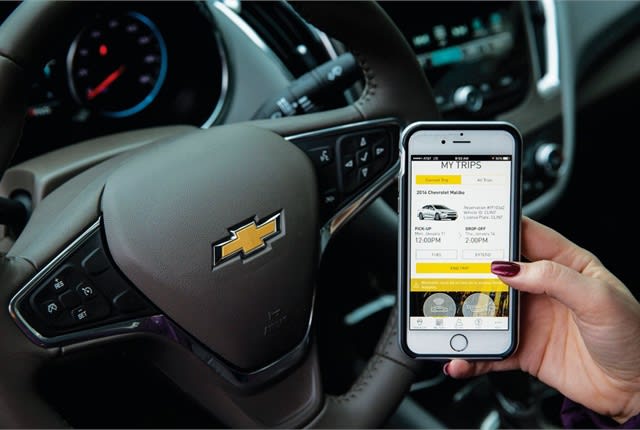
Maven users simply need to download the company’s free mobile app to find, reserve, access, and pay for the use of vehicles. A fuel card in each vehicle can be used to refuel it without additional charge. Photo courtesy of GM.
“By the time we launched in Ann Arbor, we had a variety of ‘sharing related’ experiences under our belts,” Tiderington said. “We had folks with operational experience, and some of us were familiar with Southeast Michigan and the University of Michigan campus.”
The program proved highly popular among its test subjects, but Tiderington and his team had confidence in the service well before its launch. They were certain car-sharing would appeal to drivers — particularly millennials — who sometimes needed a vehicle but might not be willing or able to buy, lease or store one.
“In early 2014, a small group of us laid out a balance sheet. On one side of the ledger was the cost to own a vehicle in certain U.S. states and cities. On the other side was a variety of shared services.” Weighing factors such as the cost of insurance, gas, and parking, Tiderington said, the group found that ownership did make sense in some cities. In others, “it had already reached that tipping point. It didn’t financially make sense to own a car anymore.”
Download the App
To Iman Jefferson, Maven represents GM’s desire to be at the forefront of mobility, self-disrupting its century-old model of building and selling vehicles to individuals and fleets. As GM’s assistant manager of urban mobility and Maven communications, she describes millennials as the car-sharing service’s “core audience” but says the appeal translates to users of all ages and occupations.
To that end, the service itself is multifaceted. Maven is currently available in three distinct flavors:
Maven City: The core service allows individual users to find, select, reserve, and access vehicles available in their city, all from the free Maven mobile app.
Maven Home: The “Home” version was designed specifically for residents of communities, including retirement communities, to access a dedicated fleet of vehicles parked at their location.
Maven Gig: Aimed at ride-hailing and -sharing and delivery drivers, Maven Gig was designed to offer a variety of vehicles to those who drive for a living or to supplement their income. Maven Gig is built upon partnerships with Uber, Grubhub, HopSkipDrive, and more.
The cost to rent a Maven vehicle starts at $8 per hour, plus tax, and insurance (minus deductibles) is paid for by the company. Users are asked to use the fuel card placed in each vehicle to gas up; if it doesn’t work, drivers are asked to pay for the gas, get a receipt, and request reimbursement.
“It’s all the benefits of owning a car without the hassle,” Jefferson said. “We take care of all those things, and you’re still able to have access to newer models of GM cars. We make it a point to take pride in what we offer and ensure that every experience is a positive one.”
Future Plans
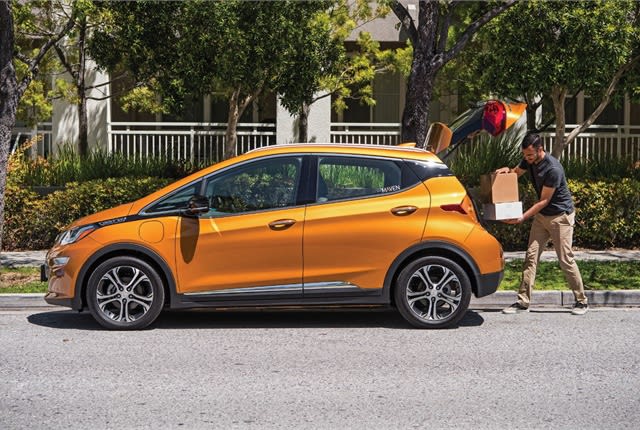
The Chevrolet Bolt has proven popular among Maven Gig drivers in California, logging a total of more than 2.3 million miles over more than 130,000 rides. Photo courtesy of GM.
As of writing, Maven users had made more than 82,000 reservations and driven more than 193 million miles. Of those, about 130,000 rides and 2.3 million miles were logged by Maven Gig users driving Chevrolet Bolt EVs to, from, and within California. The Bolt, which boasts a listed range of 238 all-electric miles, has proven to be the most popular vehicle among Gig users in that state, and GM plans to double the number of Bolts in Maven service by the end of this year.
The service is also expanding to other continents. Through a partnership with Uber, GM began testing Maven Gig in Sydney, Australia, in July. By September, the companies made it official: Sydney’s Uber drivers can now choose to rent one of a number of Holden vehicles for a minimum one-month term.
More locations and services are likely to follow. Based on the amount of research that went into the project and the expertise and talent of the team GM dedicated to it, Tiderington said the successful launch and rapid growth of Maven was not entirely unexpected. As expected, the service’s popularity has been driven by millennials: About 80% of Maven users are age 34 or younger, far lower than the average age of GM’s car buyers.
But members of every generation can appreciate the latest technology, Tiderington said, and clean, well-maintained vehicles only sweeten the deal. “One of the things we think distinguishes us from the competition is our product and the value you get for that product. … We’ve seen a very steep growth rate in the number of people who want to use the service, and we believe it’s due in large part to the variety of our portfolio and the consistency of the experience we provide.”
More Global Fleet
GeoFencing Adds to Your Truck Security Arsenal
Geofencing is a familiar fleet tool today, but its early adoption marked a major shift in vehicle tracking, route monitoring, and the debate over employee privacy.
Read More →
Holman Takes Full Ownership of ARIZA in Mexico
Holman is bringing its Mexican fleet management operation fully under its own brand after more than 30 years as a joint venture. The change gives multinational fleet customers a single Holman operation across the U.S., Canada, and Mexico.
Read More →
5 Tire Maintenance Tips to Help Prevent Work Truck Downtime
Regular tire checks can do more than extend tread life. These five maintenance practices can help work truck fleets catch problems early, reduce costs, and prevent downtime.
Read More →

Proven Ways to Reduce Work Truck Downtime
The age-old problem of downtime will always be a reality, but with new strategies at hand, fleets have more ways to keep trucks on the road longer.
Read More →


Cameras, Safety and Insurance: From Reactive Claims to Real-Time Prevention (Part 2 of 2)
Part Two: Commercial auto remains one of the most challenging and costly lines of coverage for fleet operators and insurers alike. Continue learning more about how to effectively address these issues from Onur Aksan, Enterprise Business Development Executive, Geotab
Read More →
Cameras, Safety and Insurance: From Reactive Claims to Real-time Prevention
Commercial auto remains one of the most challenging and costly lines of coverage for fleet operators and insurers alike. Learn more about how to effectively address these issues from Onur Aksan, Enterprise Business Development Executive, Geotab.
Read More →
Fleet Costs Are Rising: Here’s How Leaders Are Responding
Fleet leaders are under pressure to reduce costs, adapt to economic uncertainty, and make smarter decisions. See how peers across North America are responding with real data, proven strategies, and forward-looking insights. Download the 2026 Market Pulse Report to benchmark your strategy and uncover where you can gain an edge.
Read More →
Enterprise Fleet Management Surpasses 900,000 Vehicles in U.S. & Canada
Enterprise Mobility connects with mobility solutions around the globe
Read More →