




Maintenance: A Look at the St. Louis Police
Two years ago the St. Louis Police Department checked its books and found that its maintenance procedures were costing a lot of unnecessary money.
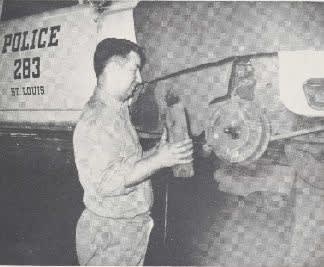
Mechanic pulls brake on St. Louis police vehicle as he prepares to repack wheel bearing.
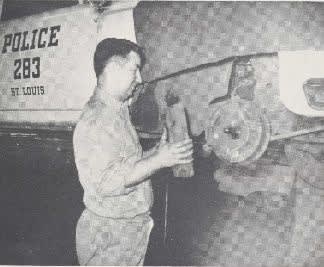
Maintenance is a serious business with the St. Louis Police Department.
Two years ago the department checked its books and found that its maintenance procedures were costing a lot of unnecessary money. Not only had the regular inspections failed to prevent many failures, but untimely breakdowns were resulting in serious down time and lost man-hours.
So, under the direction of Maj. Andrew Aylward, commander of the department's bureau of services, a new preventive maintenance program was instituted. The program was formulated by Ernst and Ernst, nationwide management consultant firm with the approval of St. Louis Police Chief Curtis Brostron.
The assigned driver is the key to the new program which went into effect in January 1959. He is responsible for bringing his car in for a maintenance check every 1,500 miles. To assist him, every car has a visor card listing the date of the last check and what was done.
According to Henry C. Hansen, repair service manager, each car has a preventive maintenance folder with a check list so that the mechanics and servicing personnel are able to perform the necessary work.
A standard 1,500 mile check consists of an oil change and lubrication plus a check of vital parts. The oil is refilled in the car from a convenient pumping system that originates from the oil drum. The breather cap and air cleaner are both cleaned every 3,000 miles with the filter element replaced every 4,500 miles.
Hansen said the department has a "Special D" 6,000 mile inspection that includes brake adjustment, front wheel bearing service, tire rotation and balancing and complete wheel alignment. Spark plugs are changed every 12,000 miles and the transmission fluid, differential grease and universal joints serviced every 18,000 miles.
Brake shoes are simply exchanged with the local Laher Spring jobber who guarantees 20,000 miles on each lining.
Each car is washed and vacuumed at least once a week, according to Hansen.
Tires come in for particular attention with the department. Because of the heavy duty and the rough St. Louis streets, tires are replaced approximately every 12,000 miles, said Hansen. Because of the frequency of change, the department carries only a $2,200 tire inventory.
The parts inventory usually averages about $5,500, Hansen said, with the objective being an "adequate but minimum" inventory.
"The jobbers we deal with provide excellent service and help us to hold our inventory at a low level and still permit efficient operation," said Hansen.
The department's maintenance shop is equipped to perform all maintenance chores, including engine and transmission overhaul as well as body work and painting.
The maintenance staff consists of 25 mechanics and three supervisors. Because of the round-the-clock operation, two mechanics are on duty at all times. A jeep is used for emergency repairs and a 1 ½ ton truck for towing disabled vehicles.
The average yearly mileage turned in by the department's vehicles is 30,000 miles with replacement planned for every 75,000 to 80,000 miles.
"On the surface it might appear we are pampering our vehicles, Hansen said, but you must remember that police vehicles pile up quite a bit of idling time on the engine."
The department's 438 vehicles consist mainly of Chevrolets, Fords and Plymouths, although there are a few Dodge, Pontiac, Oldsmobile and Chrysler models. In addition, there are 29 tri-cars.
Maj. Aylward said that this year for the first time replacement is being done on a staggered basis. Deliveries are being made in each month of a four month period that began in December. All cars are purchased on a competitive bid basis.
By operating this way, Aylward said, the department is better able to better prepare the cars for police service.
"Also, by waiting until December, we are assured of avoiding some of the small bugs that sometimes occur in new cars," said Aylward.
Most of the cars used are two door models. All the cars used for traffic work have eight cylinder engines. There are no compacts in the St. Louis police fleet.
Aylward said that he has studied reports from other police departments concerning the use of compacts as police vehicles and has concluded that the economies gained do not offset the uniformity of standard car maintenance.
Each car in the fleet is equipped with a two-way radio, a desk rack and side view mirror. Every other car has a special gun rack and most have a siren-light on the roof. All Chrysler cars have a Leece-Neville alternator; other makes have heavy duty generators with corresponding regulators.
Two licensed radio repair men work each of the three shifts a day repairing and servicing the department's 550 two-way radio units. About 25 sets a day are repaired. Units are removed as the cars are replaced and installed in the new cars.
Both Aylward and Hansen agree that the department's stepped up maintenance program has paid off in both dollar savings and more effective applied working time by the force. They offer proof in the average cost per mile figures for their vehicles. The 1961 cost per mile ranged from a high of 7.25 cents in June to a low of 6.0 cents per mile in July.
More Operations

Fleet Has a Talent Pipeline Problem. What Comes Next? | AF News Recap
Where will fleet’s next generation of leaders come from? This week, we’re looking at the industry’s talent pipeline, what certification can add to a fleet career, how to build an award-worthy track record, and the return of Automotive Fleet’s Personal Use Survey.
Read More →
Smith System Launches Driver Risk Management Program
Fleets have more driver data than ever, but identifying risky behavior doesn't necessarily correct it. Smith System's new Driver Risk Management program combines monitoring, training, and follow-up coaching to help fleets connect risk signals with driver intervention.
Read More →
Automotive Fleet Opens 2026 Personal Use Survey for Commercial Fleet Managers
Less than two weeks left! Commercial and corporate fleet managers are invited to share how their organizations handle company vehicle personal-use policies, charges, and driver eligibility.
Read More →
From AI Prompts to AI-Generated Safety Songs | AF News Recap
Can better prompts make AI more useful for fleet managers? This week, we’re breaking down smarter fleet analysis, an AI-assisted experiment that turned safety training into music, and what happened to fuel prices in August.
Read More →
How to Write Better AI Prompts for Fleet Analysis
Include these six elements in your fleet prompts to generate more relevant analysis and accurate answers.
Read More →
Fleet Meets: Eric Kilgore
This edition of the Fleet Meets series features one of the industry's best leaders driving multi-market and national operations.
Read More →
Why Reactive Fleet Management Is Becoming Too Expensive to Sustain
Research highlights a growing need for proactive management strategies to address rising costs in fleet operations effectively.
Read More →
What Your Fleet KPIs Aren’t Telling You
Tracking fleet metrics is only useful when the data leads to better decisions. This guide helps fleet leaders assess cost, utilization, and downtime more accurately, identify performance gaps, and prioritize the actions that can improve operational results.
Read More →
Hidden in Plain Sight: Fleet Compliance Risks
Fleet compliance isn't just about having policies — it's about consistently enforcing them. This practical guide reveals six hidden compliance risks common in public sector and shared fleet operations and outlines proven strategies to improve visibility, accountability, and audit readiness
Read More →
Turning Fleet Payment Data into Executive Insights
Does data alone drive results in operations?
Read More →