




LeasePlan USA Employees Embrace Cell-Phone Ban
Despite initial resistance to a policy banning cell-phone use while driving, the fleet management company has achieved full employee acceptance after just a few months.

Fleet management company LeasePlan USA implemented a cell phone ban policy for its employees.

Fleet management company LeasePlan USA implemented a cell phone ban policy for its employees.
In November 2012, Mike Pitcher, president/CEO of LeasePlan USA, and his wife were driving on a local highway when they noticed a man in a nearby vehicle texting while driving. According to Pitcher, this continued for about two miles.
"We were watching him and thinking, ‘This is insane,’ ” Pitcher recalled. “We backed off from his vehicle by several hundred yards, just so he wouldn’t hit us.”
The timing of that incident was an interesting coincidence. Just a few weeks earlier, in October, the fleet management company (FMC) implemented a policy prohibiting its employees from cell-phone use while driving. The policy states that “the use of cell phones/smartphones/tablets/iPods [collectively ‘mobile devices’] by any driver … of a company vehicle while it is in motion is strictly prohibited.”
(See “Distracted Driving Policy Sample” on next page.)
Failure to abide by the rule could result in disciplinary action, including termination, or a requirement to complete a defensive driving course, revocation of the company-provided cell phone, or loss of company or pool vehicle privileges. The policy also applies to distracted driving activities, such as operating a vehicle while eating, reading, or performing personal grooming activities.
Pitcher said LeasePlan USA leadership had discussed the possibility of implementing the policy for the past few years, starting with a conversation between the company’s senior management and its client advisory board, Future Directions, which is a cross-section of LeasePlan clients that meet in person and via webinars several times a year.
Taking a Stance
In 2009, LeasePlan USA implemented a ban on texting while driving. However, clients at the July 2012 Future Directions meeting stressed they were looking for best practices in taking a stand against distracted driving, and the company could take that leadership role by eliminating cell-phone use in the vehicle completely. The policy also extends to employees who use a LeasePlan USA-provided cell phone in their personal vehicles. Soon afterward, the company decided to make the move.
But, LeasePlan USA’s new policy banning the use of cell phones while driving didn’t come easy. Pitcher said some push back against the policy came from members of the sales and sales management teams, who were concerned the policy would harm productivity.
“We understand those issues, but they are far outweighed by our position on safety — we believe we are making our drivers safer on the roads,” Pitcher said. He has not heard whether any other FMCs have instituted a similar total cell-phone use ban. “And, by the way, remember a crash usually involves two people. So, it’s not only making our team safer, but the people who drive on the roads with us safer as well.”
Statistics from the National Highway Traffic Safety Administration (NHTSA) and other groups on the dangers of cell-phone use while driving also helped convince Pitcher to make the move. Twenty-three percent of all vehicle crashes involve cell-phone use, according to the National Safety Council. Pitcher noted that highway deaths had decreased for 10 consecutive years, but had ticked back up in the first six months of 2012.
“To me, it was a wake-up call that there is something happening on our roads and highways. And, while I don’t have the data on whether the increase is directly caused by cell-phone use and technology in the cockpit, as a father and looking at a generation that is growing up feeling the need to be connected 24/7/365, I feel there is a correlation,” Pitcher said.
LeasePlan USA is currently studying the issue in more detail, working with a local behavioral psychology professor in Atlanta to “understand how people learn,” Pitcher said. The study looks at drivers’ abilities to handle distracted driving while in the driver’s seat of a vehicle.
“We have safety programs, and other fleet management companies have safety programs, but we’re trying to understand how different generations learn and adhere to knowledge they’ve gained with regard to safety in the vehicle,” he said.
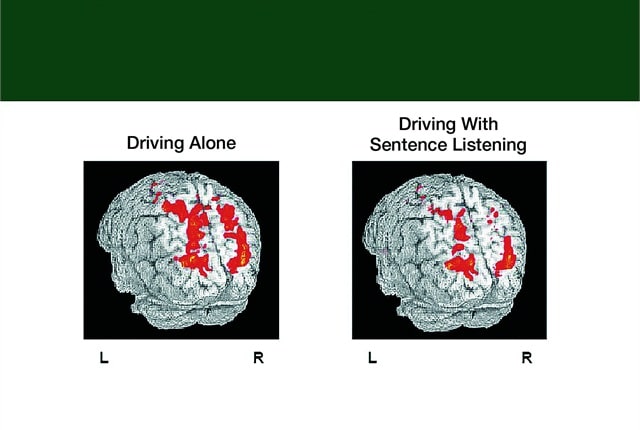
A Carnegie Mellon University study used functional magnetic resonance imaging (fMRI) of the brain to map the effects of driving while speaking on a cell phone. The study found that listening to sentences on cell phones decreased activity by 37 percent in the brain’s parietal lobe, which reflected driving problems, such as weaving out of the lane and hitting guardrails. Scientists concluded there is only so much the brain can do at one time while operating a vehicle.
Adapting to Policy
Pitcher acknowledged that his employees might still make a phone call in the car if it’s an emergency. But, he said most of his drivers have told him they have gotten used to cell- phone-free driving.
“After two full months of having it in place, it has become a non-issue,” Pitcher said. “There was a kind of withdrawal syndrome, but two months later, people are saying, ‘it’s a policy; it’s not a big deal.’”
While driving, Pitcher still occasionally sees non-employee drivers behaving similarly to the man he and his wife observed texting while driving.
“Since we’ve instituted the policy, it is amazing to drive on the highway and be aware of the number of people who are swerving in lanes, almost back-ending people. You see them with their thumbs on their cell phone, texting and talking on the phone. It’s just an awareness of your surroundings and how much you notice people doing it,” he said.
Key points in LeasePlan USA’s cell-phone ban include:
● Applies to all company employees operating a company car, demo, or pool vehicle.
● Bans all mobile device use while operating a company vehicle.
● Disciplinary action for violating policy includes completion of a defensive driving course, loss of company mobile devices and vehicle privileges, and possible termination.
[PAGEBREAK]
Distracted Driving Policy sample
Introduction
This document in its entirety is the approved “Distracted Driving Policy.” This policy exists to ensure that all company car drivers and pool car drivers are operating company-owned or manufacturer demos (collectively “company vehicles”) in a safe and secure manner.
Scope
This policy applies to all COMPANY employees operating a company car, demo, or pool vehicle. This policy does not apply to employee-owned vehicles.
Policy (Operation of Mobile Devices While Operating Company Vehicle)
The use of cell phones/smartphones/tablets/iPods (collectively “mobile devices”) by any driver of COMPANY’S vehicle while it is in motion is strictly prohibited. “In motion” in this case means the vehicle is being operated on the road, including when the vehicle is stopped at a stop sign or red light. If it is necessary to use the mobile device while in transit, it is always best to find a “safe” place to pull off the road so that you may use your mobile device while your vehicle is in a stationary position.
Failure to abide by this policy may result in disciplinary action, up to and including termination. In addition, one or more of the following actions may result from failing to abide by the policy.
● Completion of a defensive driving course as mandated by management.
● Temporary or permanent revocation of company mobile device(s).
● Loss of company car (and/or pool car) privileges.
Distracted Driving
While most examples of distracted driving come from mobile devices, this policy also applies to other acts of possible distracted driving, including, but not limited to operating a vehicle while eating; reading books, magazines, or newspapers; personal grooming, operating the radio or navigation device, etc.
COMPANY Employee Responsibilities
All employees of COMPANY are expected to assist in the enforcement of this policy. If an employee witnesses a COMPANY vehicle driver operating a company vehicle while significantly “distracted,” we ask that you advise either Human Resources, the Compliance Officer (VP Risk Management), and/or the President/CEO.
More Safety
What’s Next for Fleet? Safety, AI & Industry Recognition | AF News Recap
Could your company's culture be encouraging distracted driving? This week, we're exploring how workplace expectations affect driver safety, what AI, EVs, and autonomous vehicles could mean for the future of fleet management, and how fleet professionals can strengthen their award nominations.
Read More →
Does Your Fleet's Culture Encourage Distracted Driving?
What happens when the people responsible for enforcing safety rules are the ones setting the wrong example? The answer may reveal why some of the biggest risks to fleet drivers have little to do with what's written in the employee handbook.
Read More →
Fleet Manager’s Ultimate Playbook: Navigating the New Standard in OEM Connectivity
Rising operating costs, driver safety concerns, and unplanned downtime are putting unprecedented pressure on modern fleets. Discover how fleet managers use embedded OEM connectivity and real-time vehicle data to cut TCO, prevent downtime, and protect drivers without aftermarket telematics hardware.
Read More →
From Driver Well-Being to EV Charging | AF News Recap
Mental health belongs in the fleet safety conversation. This week, we’re looking at five ways fleets can support employee well-being before a crisis, plus Holman’s expansion in Mexico, new one-day Fleet Forward passes, and why EV charging demand is outpacing infrastructure growth.
Read More →
Nexar-Nauto Merger Aims to Give Fleets Better Safety Intelligence Through Larger Driving Dataset
Stefan Heck tells Automotive Fleet that combining more than 10 billion miles of driving history with Nexar's AI models will give fleets deeper insights into driver risk and roadway conditions than either company could provide independently.
Read More →
Don't Wait for a Crisis: 5 Ways to Build Mental Health Into Your Fleet Safety Program
For Suicide Prevention Month, fleet and safety leaders have an opportunity to put mental health where it belongs: at the center of workplace safety.
Read More →
How Camera Data Can Strengthen a Fleet’s Insurance Renewal
Insights from a commercial insurance carrier and a broker show how fleets can turn video telematic data, driver coaching, and improved claims results into a stronger case at insurance renewal.
Read More →
The Safest Fleets Aren’t the Ones with the Most Technology
You’ve made the telematics investment. Here’s how to capture the other half of its value and build the safest fleet on the road.
Read More →
Hidden in Plain Sight: Fleet Compliance Risks
Fleet compliance isn't just about having policies — it's about consistently enforcing them. This practical guide reveals six hidden compliance risks common in public sector and shared fleet operations and outlines proven strategies to improve visibility, accountability, and audit readiness
Read More →
NETS Sets 2026 Fleet Safety Benchmark Conference for Indianapolis
The Sept. 15–17 program will feature fleet benchmarking data, case studies, emerging technologies, and implementation strategies while running alongside the NSC Safety Congress & Expo.
Read More →