




Is Fuel Hedging Right for Your Fleet?
Controlling fuel costs through hedging is an option for fleets looking to gain budget stability. As with any strategy, fleets must weigh the pros and cons to determine if a fuel hedging strategy is suitable to their specific needs.

Fueling vehicles is undoubtedly one of the most frustrating and overpriced expenses companies have endured over the past few years. Dealing with the uncertainty of fuel prices has left even the most knowledgeable and experienced fleet managers searching for stability in an unpredictable economic environment.
Many companies and agencies have implemented fuel cost reduction programs to combat price instability, including downsizing to four-cylinder vehicles, restricting personal use of company vehicles, and even conducting online meetings in lieu of traveling off-site.
While these solutions are all beneficial, the price volatility of fuel must still be addressed.
Controlling fuel costs through hedging is one solution fleets can explore to gain a sense of security. As with any strategic initiative, fleets must first weigh the advantages and disadvantages to determine if fuel hedging is the appropriate solution suited to their specific fleet needs.
Exploring the Options
A hedging program can prove an invaluable tool to help manage the price of fuel and offset the risk of adverse price movements, according to David Maxsimic, executive vice president of sales and marketing for Wright Express.
"Hedging should not be viewed as betting, investing, or a way to guarantee savings," said Maxsimic. "Hedges should be embraced as a chance to avoid some volatility in business costs. In addition to price stability, a well-managed program can aid in securing corporate objectives and profit margins through improved management planning."
Gearing Up for the 'Unknown'
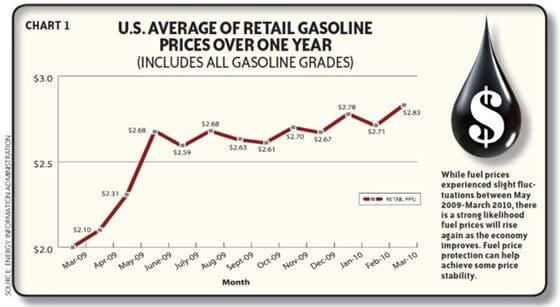
Gaining a sense of security and stability in an unstable fuel market (see Chart 1) can provide peace of mind to those who prefer structure. Reduced vulnerability to price fluctuations, improved planning, and insured profit margins are some advantages to fuel hedging.
"Any organization that is sensitive to fuel price fluctuations and is looking for stabilization and predictability of fuel costs will find fuel hedging beneficial," according to Thomas Noh, finance director, claims, for Farmers Insurance Exchange. Noh is responsible for conducting financial planning, monitoring, and cost management of the claims department's 5,000-vehicle fleet.
Farmers' Claims fleet fuel consumption varies year-to-year based on workload requirements, said Noh. "On average, we use approximately 5 million gallons of unleaded gasoline annually."
Since January 2009, Farmers has been working with Pricelock, a company that provides fuel price predictability to businesses. Founded in 2006, Pricelock protects businesses against volatile fuel prices and is responsible for more than 100 million gallons of price-protected fuel. Customers include Chrysler, Hyundai, and Aegis Communications Group, a subsidiary of Aegis Limited, which offers customer lifecycle management and a variety of value-added interactive and back-office services for global enterprise clients.
Providing "the ability to hedge fuel prices to businesses of all sizes, large and small," Pricelock is "trying to create predictability. Our primary product is fuel price protection," said Liat Rorer, vice president of marketing, Pricelock.
According to Rorer, users pick a protection level based on national averages from the Department of Energy (DOE). "If prices go up, we pay them. If they go below, fleets benefit."
Businesses receive a payout when national average fuel prices rise above their set protection price. Fuel price protection does not entail pre-purchasing fuel, so partners benefit from lower fuel prices at the pump when prices fall. Pricelock allows users to purchase a plan protecting against increases in fuel prices. When the national average fuel prices go above the selected protection price, users receive a payout. If the national average is below the protection price, users do not receive a payout.
Since users do not pre-purchase fuel, they are free to use less gas or find cheaper prices at any time. With fuel prices varying all over the U.S., Pricelock uses the national average (calculated by the U.S. DOE) to determine a fleet's monthly payout. There is no change to existing fuel methods and no paperwork to manage.
While traditional hedging firms do business in 42,000-gallon increments, Pricelock does not require a minimum number of gallons. Plan sizes vary widely from a couple hundred gallons to hundreds of thousands per month, Rorer explained.
"We engaged Pricelock through our relationship with the Wright Express fuel card program in January 2009," said Noh. "We chose Pricelock while exploring different options of stabilizing the volatile fuel prices we experienced in 2008."
Prior to using Pricelock, Farmers monitored fuel use, costs, and data gathered with the Wright Express fuel card program and evaluated weekly expense reports.
"The benefits of the fuel hedging program is that it brings stability to our price for fuel," Noh said. "It supports our financial planning and meeting targets and it allows the investment department to identify opportunities by us being able to secure long-term prices at favorable terms."
A number of providers are available to assist fleets with fuel hedging. In addition to companies that focus primarily on fuel price protection, banks and fuel card companies offer hedging services and can settle transactions on a fleet's monthly billing statement, centralizing all fuel purchasing activity.
Companies can gauge the best estimate for their specific fleet based on current fuel prices for their geographic area. In setting a target price and goal, users can better predict what is realistic for their fleet budget. With fuel fleet's largest variable cost, large fuel price swings can play havoc with fleet budget. Better up-front risk planning using a fuel price protection plan can help protect against fuel price increases, eliminate fuel budget variability, and create a competitive advantage.
Consider Potential Challenges
While hedging can prove beneficial, there are some important factors to consider. Fuel price protection can be risky if not planned and executed appropriately.
According to Noh, Farmers experienced some challenges "primarily related to due diligence and ensuring we had all the information and ongoing support to comply with insurance regulations." Information provided by Pricelock helps Farmers comply with accounting regulations.
In addition, Noh said "the fuel hedge program would better suit our needs if it were integrated with [our] fuel program. Realized gains or losses would then be settled through the fleet program."
Fleets must also determine what fuel price will allow it to achieve stated goals. This may be difficult for fleet managers who are less experienced in budgeting for fuel costs. While not all vendors provide consultative services and expect clients to design their own fuel price protection strategy, vendors such as Pricelock provide online tools, pricing calculators, and access to experts to help fleets.
Some programs require the holder to give up some opportunity if the price falls below a "floor" price. If a program does require this, then the holder continues to have to pay the floor price even if the price at the pump is lower than that of the floor.
"With fuel price protection, the customer does not receive a payout from Pricelock when prices fall, but they benefit from lower prices at the pump," Rorer explained.
A potential up-front premium may be required. As with the Pricelock product, the program is similar to an insurance plan, wherein a premium is required for coverage, said Pricelock's Rorer. Another expense to consider is the possibility of a brokerage fee.
Whether fuel hedging is the right solution depends on the factors mentioned. Regardless of the fleet solution, protecting fleets against their biggest variable expense should be a priority.
Fuel Price Hikes Anticipated
According to the results of a recently released survey conducted by Pricelock Inc., a company that provides fuel price predictability to businesses of all sizes, 91 percent of respondents anticipate fuel prices will rise and are concerned about the impact on their business. Reasons cited included speculation, increased consumption in emerging markets, world events, a weaker U.S. dollar, and volatile supply and demand.
Respondents included 525 fleet professionals, including executives, fleet managers, directors, and other industry professionals associated with small, mid-sized, and large fleets. Respondents also represented a broad range of industries, including auto and transport, energy and utilities, construction, business services, government, industrial manufacturing, healthcare, and consumer products.
Of those who have implemented a fuel price protection plan, nearly 90 percent indicate satisfaction with a fuel price protection program, according to Pricelock.
Many respondents said they have not protected their fleets against rising fuel prices because they believe their company is too small or they lack the necessary expertise to implement a protection plan.
More Operations

A buyer's guide to fleet management software in 2027
Buying fleet management software in 2027 means looking beyond features and price. As fleet operations, technology and expectations evolve, this guide explores what today’s fleet professionals should consider when choosing a system that can deliver value now and adapt to what comes next.
Read More →
What Will Shape the Next Era of Fleet Management?
EVs, AI, and autonomous vehicles are reshaping fleet management. Discover what’s ahead—and how fleet leaders can prepare for the next era.
Read More →
How Fleets Can Recruit and Train Veterans for Technician Roles
Here's how the technician shortage has affected uptime for fleets, and what to do about it.
Read More →

Avis Budget Group Deploys Neology Toll Management Technology Across Major Brands
Neology’s neoFleet platform will manage toll transactions and toll-authority operations for vehicles across Avis, Budget, Payless, Budget Truck and Zipcar.
Read More →
Fleet Personal-Use Charges Edge Higher in 2026
Nearly eight in 10 surveyed fleets allow personal use of company vehicles, while just over half of respondents report charging employees for the privilege.
Read More →
The Future of Fleet + What’s Changing Right Now | AF News Recap
Could developments overseas offer a preview of what’s coming for U.S. fleets? This week, we’re looking at the future of AI, autonomy, and electrification, plus Ford Pro’s new certified pre-owned program, smarter vehicle offboarding, and a new way for fleets to manage toll expenses.
Read More →
How to Handle Vehicle Offboarding
What do fleet managers need to do when a driver leaves?
Read More →
Fleet Manager’s Ultimate Playbook: Navigating the New Standard in OEM Connectivity
Rising operating costs, driver safety concerns, and unplanned downtime are putting unprecedented pressure on modern fleets. Discover how fleet managers use embedded OEM connectivity and real-time vehicle data to cut TCO, prevent downtime, and protect drivers without aftermarket telematics hardware.
Read More →
U.S. Bank Adds Verra Mobility Toll Management to Voyager Fleet Platform
The integration allows U.S. Bank Voyager fleet customers to manage toll payments and violations alongside fuel, EV charging and maintenance expenses.
Read More →
ADAS Prevents Crashes. But Repairs Cost More | AF News Recap
ADAS-equipped vehicles may crash less often, but they can cost more when they do. This week, we’re breaking down what that tradeoff means for fleets, plus Subaru’s first Forester Wilderness Hybrid, Nissan’s new e-POWER Rogue, and why Calstart has become Catalyst Mobility.
Read More →