




Related: Penske, Waymo Share Vision for Future of Autonomous Trucking
How Will Waymo Monetize Autonomy?
The largest windfalls from autonomous services won’t come from making driverless cars or advertising in them. Look instead to what Google does best when disrupting and democratizing technology.
by Hari Sripathi
May 22, 2020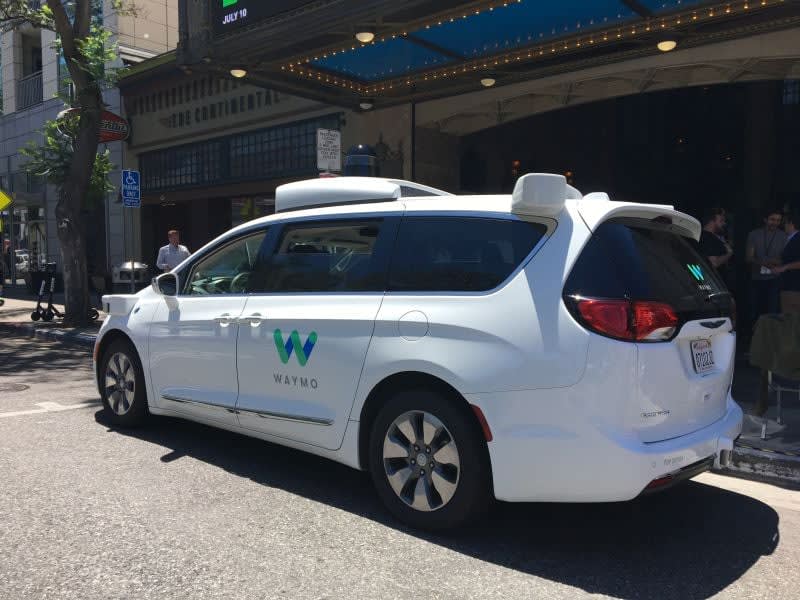
It is unlikely for Waymo to monetize individual users, and more likely to monetize either rides taken or the number of miles driven.
Photo by Chris Brown.
6 min to read
Autonomous driving will be huge a beneficiary of the lingering effects of social distancing. Just as with e-Commerce for grocery, telemedicine and video conferencing, the pandemic has lowered one of the biggest, most significant costs for innovative companies - customer education. Customers will now be increasingly supportive of avoiding contact with strangers. Waymo, being the world's leading consumer facing Autonomous Vehicle company, stands to benefit immensely.
At this inflection point, it is exciting to speculate on pathways Waymo will take as it begins to commercialize its first customer facing autonomous vehicles. Specifically, who will Waymo target, how will they monetize and how will they scale their business?
Alphabet’s Historical Playbook
Historically, Alphabet's (Google’s) business models have relied on earning few dollars per user but enabling a vast number of users. For example, the average video on YouTube earns just $3 a year. But the revenues keep coming in since there are 2 billion users with over 5 billion videos. Android has 85% share of the smartphone market but revenues far less than Apple.
Also, Alphabet tends to capture value from software rather than produce consumer products end to end. They provide underlying platforms on which others can deploy their creations on top. YouTube does not produce its own content. Android does not make the cellphone. Google revolutionized search by taking you away from their page. In the same vein, I doubt Waymo will ever make a car.
Who Will They Target?
Waymo's recent funding of $2.5 billion from external investors has two implications. First, investors other than Alphabet think it has a legitimate chance at success. And second, it has a path to satisfy an investor appetite for around $8 to $10 billion dollars in returns over the next four to five years.
This would require a pre-IPO valuation in the hundreds of billions, which would need a user base of a hundred million to a billion users very soon. To keep investors from getting anxious, Waymo has to commercialize quite soon and think big, really big.
I predict Waymo will try to commercialize by the end of 2020 and quickly start experimenting with ways to maximize user adoption by 2025. Car users are famously price sensitive, but above all want safety and convenience. Waymo has to be affordable, while being comfortable and demonstrably reduce accidents on the road.
I find it unlikely for Waymo to monetize individual users. It is quite farfetched to scale billions of them in five years, navigating thousands of street regulations — even for Google. They are more likely to monetize either rides taken or more likely, the number of miles driven.
In other words, Waymo will price or incentivize the use of the platform by distance covered. This implies they start with high utilization robo-taxis for passenger travel and package delivery for goods. These vehicles can be shared across users and be both affordable by mile and earn strong revenues as a whole with high mileage.
Given the incentives to maximize mileage, I prognosticate that the first focus will be on long-distance travel to replace planes, trains, and buses rather than last mile urban transport. Consumer frustration particularly with airlines has long boiled over. Moreover, none of the dominant players seem to be turning over a new leaf.
A safer, more convenient, and possibly cheaper alternative to flying will be very welcome. Furthermore, cars on long-distance highway trips are less likely to face pedestrian interference, follow more consistent traffic rules, and thus be able to demonstrate their safety benefits more easily.
How Will They Monetize?
In the distant future, it is conceivable that passengers of self-driving cars see advertisements, or do their shopping, instead of watching the road. That said, customers will consider ads dangerously distracting while in a car, even when not driving. More so, consumers are fast reaching advertisement saturation and are likely to roll their eyes if such a model is followed, severely limiting adoption.
It is more likely that Waymo will do what Google and Alphabet do best, capture vast quantities of data to sell to the highest bidders. It will build an open-source infrastructure platform and “rent” it out to other developers to create a self-driving ecosystem.
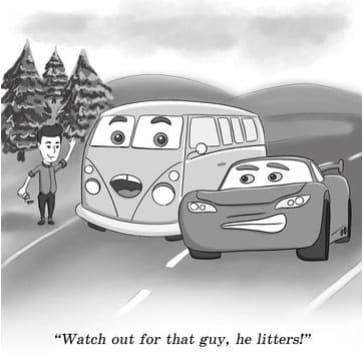
Illustration courtesy of Hari Sripathi.
With package delivery, the play is obvious — what products are shipping, where they are shipping, to whom and when. Senders and recipients pay to track their packages in real time without anyone having to key in antiquated systems. They may pay instead for added safety and the lower likelihood of product wastage.
While advanced logistics companies have analytical systems to address these today, Waymo will make them a lot more seamless and cheaper and available to everybody. Soon, the boutique chocolate shop in New Jersey can order a specific amount of sugar to be shipped from Louisiana just in time for candy making.
Meanwhile, entirely new frontiers will be unlocked with passenger traffic: Who are the users, where do they live, where do they travel, what are their habits, and who do they interact with?
Far beyond what is captured today by social media, Waymo’s information will be a lot more personalized. For example, Facebook assumes you are interested in a certain restaurant if you have visited their page. Waymo will know for a fact that you take your son there after the ballgame based on where you stopped and who you went with.
It will likely know you stock up on groceries every Saturday right after going to the gym and that you badly need a haircut. The restaurant is recommended to stock up on Yankees merchandise while you get shown the neighborhood salon as soon as you are done grocery shopping.
The Android of Autonomy
In the long term, far from reducing traffic on the street, I expect self-driving cars to democratize access to vehicles and increase traffic. Despite car ownership being at an all-time high, it currently is a luxury affordable to middle-class earners. Driving is also limited to those who are old enough and know to drive.
The advent of self-driving cars will enable sharing and hence make cars accessible to all income classes, just like how the smartphone revolution has reached far flung corners. It will mean newfound freedom for the disabled. And since you won’t need a license to “not drive,” toddlers may travel unaccompanied.
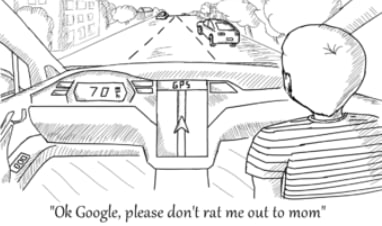
Illustration courtesy of Hari Sripathi.
I think Waymo may even provide the self-driving technology for free to quicken adoption. Revenues then come from the improved synergistic income on their other advertising platforms due to knowing habits so much better.
Waymo could also earn money from specialty service vehicles such as bulldozers and ambulances built on top of their platform. When you feel drowsy, you beckon the sleeping car. You have a date in a restaurant car while driving along the seashore and curl up in the armchair in the library car. And every time you get in, temperatures are set to your preference with the perfect music station playing.
With lower pricing and the post-pandemic preference to avoid human contact, public transport would be severely disrupted. With driving eliminated for private cars, morning commutes become less of a concern. Families willing to commuting longer distances will drastically transform real estate.
Meanwhile, Waymo will become to human mobility what Android became to phones, and Google search became to the internet – an invisible operating system that captures a very small amount of revenue per use but enables everything built on it while bringing access to everybody.
In other words, Waymo will follow the classic Alphabet playbook.
Hari Sripathi was until recently Senior Director Corporate Strategy at Avis Budget Group. He was responsible for driving innovation for the rental car provider in the face of market and fleet disruption. He lives in New York. Views expressed are his own and not of any company. He can be reached at harisripathi@outlook.com for comments or suggestions.
Subscribe to Our Newsletter
More Fleet Forward
Erin Gilchrist Receives Mike Antich Spirit of Fleet Award
Last week at AFLA in Vegas, Erin Gilchrist received the inaugural, brand-new Spirit of Fleet Award.
Read More →
Dominika Leja Named the 2026 Fleet Manager of the Year
The AstraZeneca associate director of fleet was recognized for her leadership in fleet electrification, cost savings, and operational transformation.
Read More →
Jamie McKay Named the 2026 Fleet Visionary Award Winner
The Aptive Pest Control fleet manager was recognized for her approach to operations, data, lifecycle management, and driver needs.
Read More →
Fleet Forward Conference Introduces One-Day Passes for 2026
New one-day registration gives fleet professionals the flexibility to attend Tuesday, Wednesday, or Thursday, with passes available for $199 through Sept. 18.
Read More →
Vibe Coding: When Fleet Managers Become Software Builders
Five fleet professionals — none with programming skills — discuss how they’re using AI to build fleet solutions in-house and in a fraction of the time.
Read More →
Fleet Forward Conference Tackles Fleet Industry’s Growing Leadership Gap
This session will examine succession planning, knowledge transfer, and the skills the next generation of fleet leaders will need as veteran professionals leave the industry.
Read More →
2026 Fleet Manager of the Year Finalists Announced
Who are the 2026 Fleet Manager of the Year finalists?
Read More →
John Rossant to Deliver Opening Keynote at 2026 Fleet Forward Conference
The CoMotion founder will draw on developments across Europe, China, the Middle East, and other international markets to identify trends that could influence how U.S. fleets plan for the coming decade.
Read More →
How to Build Custom Fleet Tools With AI and Vibe Coding [Webinar]
A new Automotive Fleet webinar explores how fleet managers are using AI and vibe coding to automate routine work and create simple operational tools without traditional programming skills.
Read More →