




How to Justify a Fleet Budget in Tight Times
Budgets are too often done using a ‘3 percent increase and done’ method. If things were that simple, you wouldn’t need a budget. Here are some ways to help make forecasting fleet expenses easier for fleet managers.
Crystal balls being in short supply, forecasting fleet expenses is one of the most difficult and frustrating tasks a fleet manager has to perform. Volatility in energy markets, interest rates, used-car values, and more make it most difficult to choose just how much higher, or lower, vehicle expenses will move.
Part of the problem has to do with methodology. Taking last year’s budget, then essentially guessing how much things will change, is probably the most common method of forecasting, and is not unlike throwing darts at a board, and no more accurate as well. Are there better, more accurate ways to budget fleet costs? Though there is no magic bullet, there is a less inaccurate, so to speak, method.
Historical Data is Critical
“Those who don’t learn from history are condemned to repeat it,” or something of that nature. It is impossible to make any educated attempt at forecasting unless there exists some level of historical data to provide a starting point, and to reveal trends. For fleet expense, the following costs are needed:
1. Fixed cost
Depreciation
Interest/lease expense
Insurance
2. Variable cost
Fuel
Maintenance/repair
Tires
Oil
Five years’ worth of data in the above categories would be optimum; at least three at a minimum, as most fleets are on a three-year replacement cycle, and this would cover one complete turnover of the entire fleet.
Expenses can be expressed either in total dollars, or as a cost/use ratio, then converted back. Sources of such history are usually your fleet management vendors such as lessors, fleet management providers, and fuel card companies. Most of them have been providing your fleet manager with this information all along; if not, they will likely be happy to respond to a request. One way or another, the historical data is necessary; without it, your fleet manager may as well throw darts at a board.
Historical data reveals not only the hard dollars that have been spent, but, equally as important, both the trends expense categories have taken as well as the ratios of various expenses to one another, and/or to the total cost.
Projecting Fixed Costs
Among the major expense categories above, there will usually be one that stands out as the easiest to project. That is, in many cases, fixed cost; either the combination of depreciation and interest expense (for an owned fleet), or lease expense. Most companies will fund capital assets (including fleet vehicles) with fixed debt, or fixed lease rates. Fleet lessors do offer floating rate leases, however usually with the ability to fix the rate at some point in time.
Say, for example, that the company, in the prior three years, spent $2.4 million, $2.55 million, and $2.62 million in lease expense for a 500-unit fleet. Again, barring any major change in fleet size, composition, or mission, existing lease obligations can be projected for the coming year. Using a sample policy of a one-third replacement next year, the fleet manager can predict fairly accurately what the remaining two-thirds of the vehicles will cost, as well as project the lease cost for the one-third vehicles to be replaced. Since it is more difficult to project variable expenses such as fuel and maintenance/repair, the baseline cost to project will be lease costs.
Now, determine the ratio of the lesser expenses to lease expense. For example, in 1999, fuel was 16 percent of lease expense ($385,000/ $2,400,000), in 2000, 15.2 percent, in 2001, 15 percent. Over the three-year period, fuel was 15.4 percent of lease cost. Using the historical data, it is clear that, whatever the economic circumstances, fuel has consistently been between 15 and 16 percent of lease expense.
The same calculations should now be used to determine the ratio of the other expenses to lease expense, both yearly as well as over the full historical period chosen, and lay the results out in a similar chart, substituting the ratios for the gross dollars (except for leasing, which is our benchmark category). See Chart 2.
Using Ratios to Forecast
We chose lease expense because, in our model, we determined that of all the categories of vehicle expense, a fleet manager could most accurately forecast it. It would not be surprising if, in general terms, lease expense is indeed the easiest to forecast, as a number of its components (primarily lease rates) are contractually fixed.
Let’s say that a fleet manager has forecast, using his or her lease rates, replacement plans, and some level of forecasting of capitalized costs, that, in 2002, the lease expense will be $2,670,000.
The next step will be to apply the ratios calculated in the previous exercise to this lease expense. For example, historically, maintenance and repair expense has been 7.1 percent of lease costs. Lease cost has been forecast to be $2.67 million; 7.1 percent of that number is $189,570 ($2,670,000 x .071 = $189,570). This is now done for each of the other expense categories. There may be, of course, specific instances that caused a rise or drop in a particular expense category. For example, it is clear from Charts 1 and 2 that fuel expense, as a ratio of lease costs, has declined over the three-year period. Let’s say that in 1999, the fleet manager downsized his fleet, instituted a fuel management program, or initiated some action that reduced the rate of increase in fuel dollars expended. This trend can be applied to the forecast. (See Chart 3.) If the fleet manager has determined that the full effect of the action has not yet been realized.
There are, naturally, any number of forecasting methods. However, ratios can be very useful in that they use the relationships between the various expense categories to carry forward the numbers.
*Note that in the forecast, rather than using the overall three-year average ratio, the fleet manager used the ratio from the immediate prior year. You’ll recall that we assumed that some action was taken that resulted in a decline in the rate of fuel expense gross dollar increase, resulting in a decline in the ratio. The fleet manager determined that the action has taken its full effect, and while the dollars increase, the ratio remains steady.
More Operations

Turning Connected Vehicle Data Into Decisions That Matter
Fleet leaders have more data than ever, but turning that data into clear, actionable decisions remains a challenge. This white paper shows how leading organizations are using connected vehicle data to improve safety, reduce costs, and optimize fleet performance. Learn how to turn insight into action across your fleet.
Read More →
Cameras, Safety and Insurance: From Reactive Claims to Real-time Prevention
Commercial auto remains one of the most challenging and costly lines of coverage for fleet operators and insurers alike. Learn more about how to effectively address these issues from Onur Aksan, Enterprise Business Development Executive, Geotab.
Read More →
Are You Tracking Your Fleet's True Total Cost of Ownership?
Bobit Business Media surveyed 190 fleet professionals and found that while most fleets are tracking costs, fragmented systems and data gaps are keeping true TCO visibility out of reach. With rising pressure to control spend in an increasingly volatile environment, the gap between what fleets think they know and what the data actually shows is wider than you might expect. See how your peers are managing costs today and where the industry still has room to improve.
Read More →
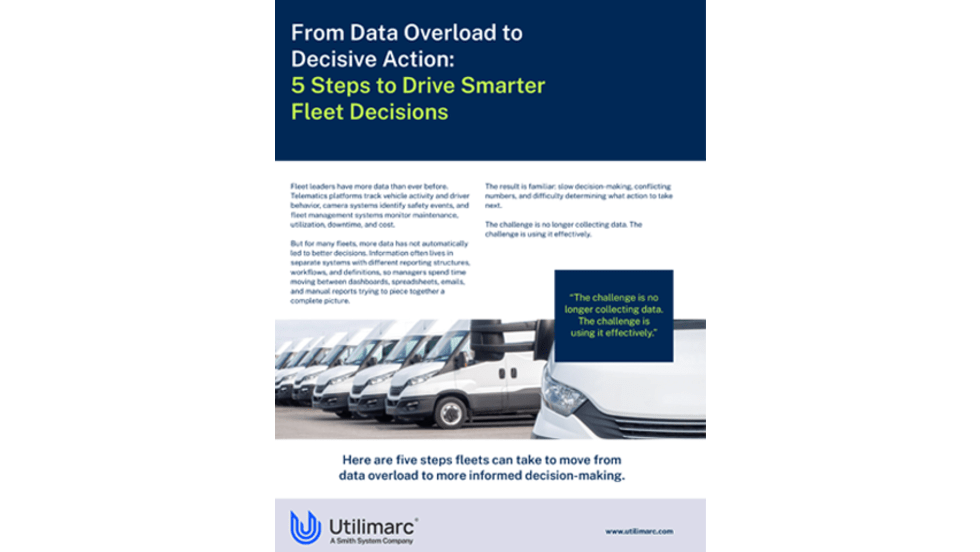
Turn Fleet Data Into Smarter Decisions
Fleet leaders have access to more operational data than ever, but disconnected systems and unclear metrics often slow decision-making instead of improving it. This article outlines five practical steps fleets can take to transform fragmented data into actionable insights that improve planning, safety, utilization, and long-term performance.
Read More →
Hybrids: Electrification Without the Challenges
For fleet managers, fuel is one of the biggest line items in the budget — and it's one hybrids can shrink without changing how your people work. Download the eBook to see the numbers, understand the technology, and get a step-by-step guide to making the switch.
Read More →
How NOV Uses Telematics to Improve Fleet Safety Across 160 Locations
James Victory of NOV discusses how the company manages fleet safety, maintenance, and telematics across more than 150 locations supporting oilfield operations throughout the U.S.
Read More →
Fleet Meets: Steven Santostasi
This edition of the Fleet Meets series features Steven Santostasi, the current TSP channel manager for Ford Pro.
Read More →
Why Fleet Managers Are Replacing Departmental Vehicles with Shared Motor Pools
Departmentally assigned vehicles often create hidden costs through underutilization, poor visibility, and increased administrative burden. This white paper explores how shared motor pool strategies help fleets reduce costs, improve accountability, and optimize vehicle utilization.
Read More →
Soap Box Derby Challenge: Assembling the Crew
Meet Gabriel, Matthew, and Angel — the team helping bring this soap box derby build to life.
Read More →
BBL Fleet Acquires Velcor Leasing Corporation
BBL Fleet expanded its footprint in the fleet management industry with the acquisition of Velcor Leasing Corporation of Madison through a stock purchase agreement finalized Feb. 27, 2026.
Read More →