




How to Balance Truck Application Against Resale
Your primary goal is to spec a truck to meet the intended job function, but how it is spec’ed has a direct bearing on future resale value. Therefore, it is similarly important to maintain a remarketing mindset when identifying specs.


Public domain iImage courtesy of Flickr.
Correctly spec’ing a truck is vital to giving it the ability to fulfill the intended fleet application. While this is your primary responsibility, truck specifications are important factors in optimizing your remarketing strategy.
When spec’ing a truck, you also need to think about the impact of specifications and equipment on a vehicle’s ultimate resale value. It is important to have a remarketing mindset right from the start when identifying the required truck specifications.
This is easier said than done. It is a fine art to creating a balance between fleet application needs and factors that enhance resale while keeping a lid on the total cost of ownership (TCO).
In addition, there are other factors that influence resale value that goes beyond vehicle specifications. For example, mileage and general condition will play a major contributory role in determining desirability and resale value.
More and more fleets are selecting powertrains that do not exceed horsepower and torque needed to fulfill the fleet application. While buying minimal horsepower and low-torque engines and the least expensive transmission may get your job done, will this be desirable to the next owner? This is the art of finding a balance between fleet application needs and factors that enhance resale values.
Balancing Application & Resale
Take into account which engine will be more desirable in the secondary market. Make sure the truck is equipped with an engine that has enough power to be used in a variety of applications, which will expand your used-vehicle buyer pool.
Spec’ing higher horsepower and torque ratings will allow a truck to be used for a wider range of applications, expanding the potential pool of customers on the secondary market.
The key is determining the horsepower/torque “sweet spot” where the truck offers sufficient power for its initial duty cycle while increasing possibilities for future resale, without paying too much up front.
Likewise, many fleets acquire the lowest acceptable axle weight ratings and GVWR. While important in minimizing acquisition cost, it will limit the number of buyers who might consider buying the used unit. Similarly, many remarketing professional advise not to spec light-duty frame rails, wheels, and tires, because this will negatively affect how a used unit sells.
This is where balancing fleet application against resale considerations become very complex. For instance, a truck may be intentionally under-spec’ed because it is designated to carry a very light load or is part of an initiative to achieve better fuel economy to reduce fuel spend and to lower initial acquisition cost. These units at resale may be less attractive because they do not have enough “general use” ability. The question you need to answer is whether the loss in resale is offset by the fuel savings and lower initial price.
Most trucks today come standard with the necessities for resale and everything else is a choice about spec’ing the truck for a particular job purpose. It’s really only a spec’ing mistake if the truck is spec’ed wrong for the job and either doesn’t last and has to be sold too early (with problems) or can’t do the intended job and hurts driver productivity. A vehicle can also be over-spec’ed where the resale isn’t hurt (and maybe helped a little), but the initial cost, lower fuel economy, etc., can be negatively impacted causing total lifecycle costs to be too high.
Over- and under-spec’ing also impacts resale from the standpoint of weight. Many companies over-spec to handle more weight than necessary, which costs much more up front and is not necessarily recouped on the resale. Conversely, many companies under-spec their trucks then run heavier than allowed, causing damage and incurring higher maintenance and repair costs, along with long-term damage to the truck chassis and components which could impact resale.
The challenge is to achieve the right balance between the truck’s job requirement and expected annual mileage to help produce the lowest operating cost per mile. Don’t make the truck’s wheelbase longer than necessary. A long-wheel truck reduces maneuverability and turning radius, which can be a disadvantage when operating at crowded job sites.
Similarly, a body that is too short limits the available cargo space, while a longer body requires an extraordinary wheelbase, which makes it much more difficult, slower, and riskier to maneuver within a confined yard or in an urban environment. There are advantages to a longer wheelbase. A longer wheelbase may be required when auxiliary equipment is installed on a truck. In larger GVW trucks, Class 7-8, a longer wheelbase may be more desirable for spreading the load.
Resale value will also be inhibited by unique trailer lengths – any dimension outside the standard 53-foot in a van trailer. When you have a remarketing mindset, you need to assess the ROI in buying equipment solely on basis of cost. The old saying: “You get what you pay for” has a direct bearing on successfully spec’ing trucks or upfits.
This not only has a bearing on quality and durability, but also on resale value.
The argument is that when quality components are spec’ed, there is a strong likelihood that this will be appealing in the secondary market, commanding higher resale values.
Spec PTO Even if Not Needed
Even if there’s no need for PTO (power take-off) for the truck’s initial use, the availability of the PTO provision will make the truck more attractive to buyers in the secondary market because it saves the future owner from having to pay to add the provision. Not being PTO-ready, which is a relatively inexpensive option when ordering a truck, can kill the sale if the buyer needs a PTO.
Spec’ing a Manual Transmission
automatic transmissions are required by most companies when selecting a vehicle, which makes automatics more desirable from a resale perspective. There are fewer qualified drivers today capable of operating a manual transmission than in the past. A manual transmission may be desirable if you are operating in mountainous terrain, but most applications work fine with an automatic.
In addition to resale value, an automatic transmission assists in driver acquisition and retention, along with lowering maintenance costs and creating more uptime.
Skimping on Driver Amenities
Another important resale consideration is not to skimp on driver amenities. Avoid spec’ing bare-bone units without suspension seats, Bluetooth, automatic or automated transmissions, "economy" grade interior, no radio, or power windows and locks, or even no air conditioning. This will not only result in a lower resale value, but also impact driver morale and productivity, and potentially create ergonomic issues that can germinate into future workers comp claims.
Attempting to save money by minimizing driver amenities is penny-wise, pound foolish. While spec’ing minimal driver amenities will reduce acquisition dollars, it is guaranteed to hurt resale value. This is where you will need to determine which one offsets the other.
Spec White (Not Unusual Colors)
Some fleets prefer to have their vehicles “stand out” and may have elaborate paint schemes or unusual colors. While this may be important in meeting a corporate image or marketing campaign, these units require additional expense to be “de-identified,” further chipping away at a net resale return. Other, non-standard colors will negatively impact the initial sale price of a unit. If possible, stay with white as a base color. You can use a wrap for any branding scheme instead of using a non-traditional exterior color. The typical buyer is looking to put the vehicle into service quickly and the need to repaint it will kill a sale.
Not selecting white as the exterior color is typically a marketing decision, but you should try to influence this decision by pointing out the detrimental effect on resale. If pushed, you could recommend using a wrap for a branding scheme instead of spec’ing a factory color other than white.
If the corporate decision is to use a wrap, you will need to take into consideration the ease of removal when the vehicle is taken out of service to be sold in the secondary market. A full-vehicle wrap or complicated graphics impact the de-identification time and cost. If the graphics are particularly difficult to remove, repainting may be necessary.
The same goes with painting trucks in non-standard, “unusual” colors as part of a corporate branding program. Sometimes unusual exterior colors make trucks harder to sell, but your company will need to weigh this consideration against its investment in brand image and how the truck branding leverages its advertising spend.
Spec to Fulfill the Intended Job
In the final analysis, trucks are tools of a trade and the chassis merely provides mobility and power to operate equipment, carry the payload, and transport crews and their tools.
Trucks specifications are much more about TCO and being able to do a very specific job then they are for resale. Trucks are typically in service for longer periods, accumulating higher miles before they are sold. With this in mind, sometimes truck specification choices aren’t good for resale, but are good over the life of the vehicle, despite the lower resale value.
However, when trucks are built to perform at their optimal performance, specifically in the areas of reliability, fuel economy, ergonomics, and driving experience, there will always be a demand and a market to resell these trucks.
While resale is a very important lifecycle consideration, the most important part of a lifecycle calculation for any type of truck, especially medium-duty applications, is building the right truck for the intended job function.
At the end of the day, a work truck is a tool and, as with any tool, it has to be able to fulfill a function. A fleet manager’s role is to provide a proper tool for the intended job application while maintaining a remarketing mindset that doesn’t unnecessarily impact resale value in the secondary market.
Originally posted on Work Truck Online
More Vehicle Research
Can AEB Really Prevent Intersection Crashes? | AF News Recap
This week we covered the latest AEB test from AAA, a new scholarship opportunity, and Holman's huge leadership change.
Read More →
Holman Announces Fleet Leadership Changes as Bob White Retires
Nick Caller will become president of Fleet, while Mark Bryan will take on the role of executive vice president and chief operating officer of Fleet, effective Jan. 1, 2027.
Read More →
Toyota Fleet Briefs Fleet Leaders on Rapidly Growing Fleet Service Program, Successes of Hybrids, and Supply
During the annual Toyota Fleet Executive Meeting, fleet leaders learned about Toyota’s legacy of driving fuel efficiency with hybrids, its investments in U.S. production, the early success of Toyota Fleet Service Advantage, and much more.
Read More →
NAFA Launches CAFM Scholarship Program for Fleet Professionals
The new program will award up to four scholarships annually to help eligible fleet professionals cover the cost of Certified Automotive Fleet Manager certification.
Read More →
Your Fleet Experience Deserves a Vote in the 2027 Fleet Awards
Cars, trucks, vans, SUVs, and upfits. Help choose the 2027 fleet award winners and unlock early-access resources for voters. Ballots close December 31.
Read More →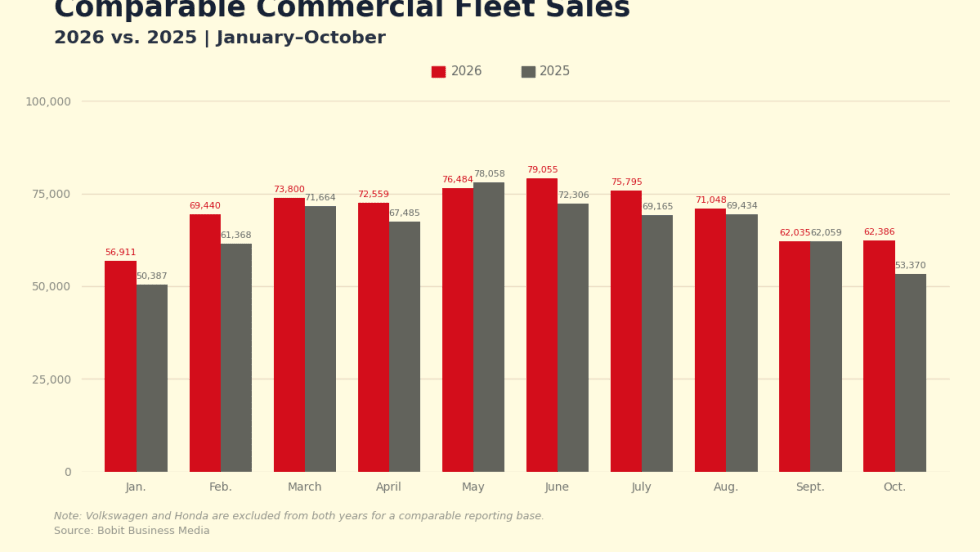
Commercial Fleet Sales Rebound 16.9% Through October
October's stronger results lifted commercial fleet sales growth to 6.7% through the first 10 months of 2026.
Read More →
Which Vehicles Earn Your Fleet’s Vote? Voting Opens for 2027 Fleet Vehicle of the Year
Which vehicles earn your fleet’s vote? Cast your ballot to unlock early access to our analysis of ownership costs across 55 vehicle nameplates.
Read More →
Crash Tests, Catalytic Converter Theft & Fleet Safety | AF News Recap
A stolen catalytic converter can cost a fleet far more than the replacement part. This week, we're exploring how to reduce theft-related risk, what fleet managers learned from live IIHS crash testing, the 2027 Jeep Compass's new safety features, and why supporting original industry reporting matters.
Read More →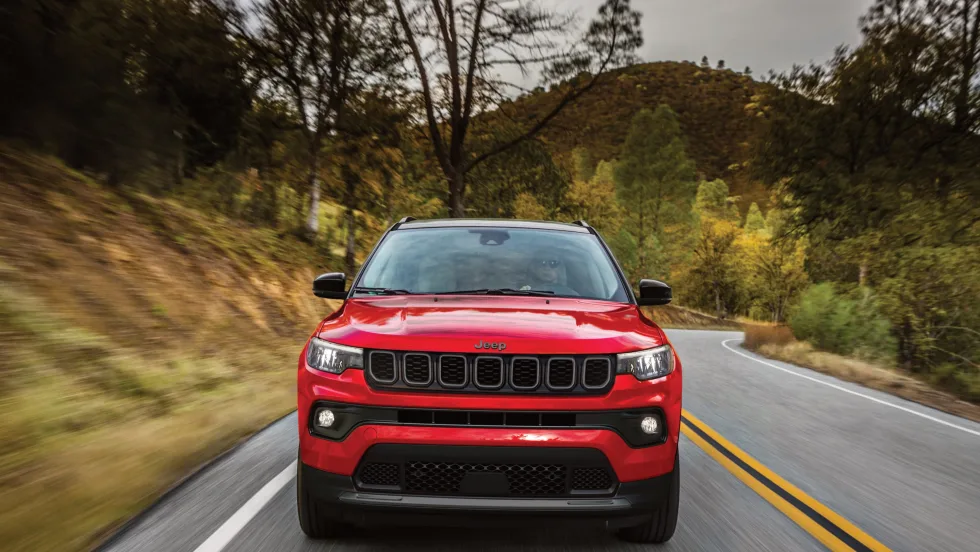
2027 Jeep Compass Adds Standard Driver-Assistance Features, Starts at $31,985
The 2027 Jeep Compass adds standard adaptive cruise control across the lineup, along with additional technology and equipment options on select trims.
Read More →
2027 Subaru Outback Adds Base Trim, Lowers Pricing Across Lineup
The 2027 Outback starts at $32,995, with price reductions on several trims and expanded availability of hands-free driver-assistance technology.
Read More →