




How Ford Manages Commercial Sales in the West
As Ford’s head of commercial sales for the Western region, Don Borthwick manages a massive territory that is filled with a variety of heavy industries and that rely upon trucks, vans, and his team’s expert counsel.

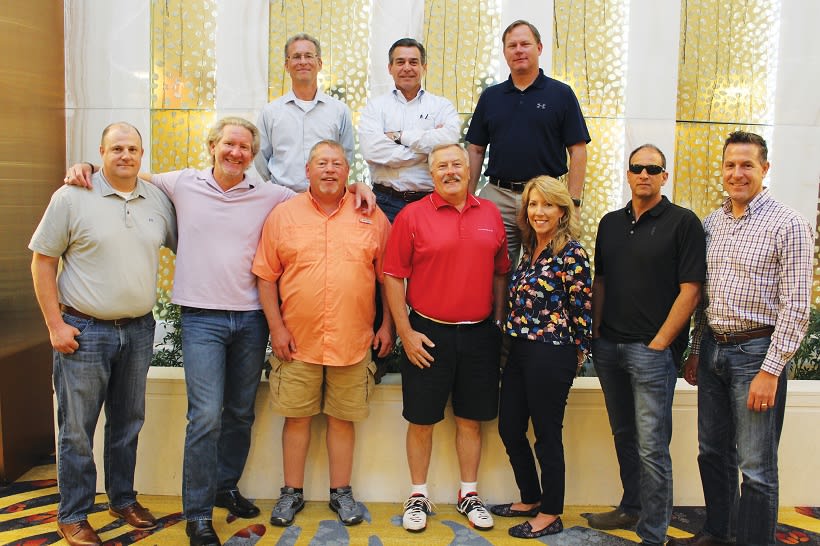
Don Borthwick (center of rear row) leads a 10-person team that includes eight strategically located field representatives serving fleet customers in 18 states.
Photo courtesy of Ford.
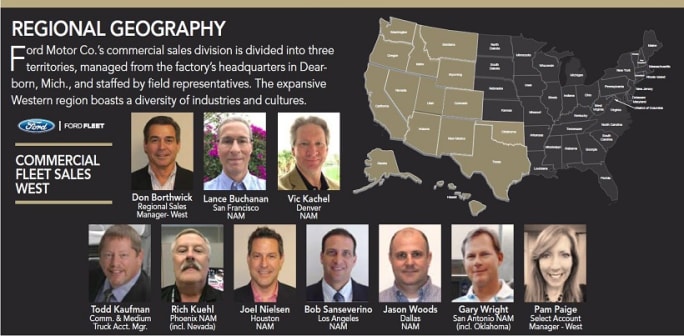
The Western United States is big, broad, and bustling with heavy industry, and Don Borthwick is right in the middle of it — figuratively, at least — as Ford Motor Co.’s Western regional sales manager for commercial. From his offices at the OEM’s headquarters in Dearborn, Mich., Borthwick leads a 10-person team that includes eight strategically located field representatives serving fleet customers in 18 states.
Much of their business revolves around trucks and vans, including America’s No. 1-selling vehicle, the venerable F-150 light-duty pickup.
“We’re dealing with the most sophisticated, knowledgeable buyers on the planet, and it really helps to have seasoned, experienced sales professionals,” Borthwick said. “Our field people understand the customer, their specific industry, and the type of product they need and desire. And they understand how our product differentiates itself from the competition.”
Ford's Western Regional Sales Manager
Borthwick is a Michigan native who grew up in Northville, a Detroit suburb, and is a long-term Ford employee. He joined the company in 1985 as a member of the Ford College Graduate Program, specializing in marketing and sales. He had initially intended to forge a career as a numbers man after studying accounting at Miami University in Oxford, Ohio.
He enjoyed an auspicious start in the field, securing a position at Deloitte, which is currently ranked as the world’s largest accounting firm. It didn’t last.
“That profession just wasn’t me,” Borthwick said. “I didn’t really like the work and knew it pretty early on. So I started looking.”
He didn’t have to go far to find his next job. In the mid-1980s, Deloitte’s Detroit office and Ford’s marketing and sales operations were housed in the same complex. Borthwick was hired in April 1985 and began what he describes as a “typical career path”: calling on dealers, learning the retail side of the business, and progressing upward through positions in district and regional sales offices.
He spent significant time in Milwaukee and Chicago and then Atlanta, which he left in 1999 to return to the Detroit area full-time. Relocation may not be for everyone, but for Borthwick, it was a positive experience and one that he believes made him a more well-rounded person and created lasting friendships.
“In the car business, you have extreme highs and lows. It was, in the good years, a lot of fun. I made a lot of friends working in those small teams, and the dealers I was working with became not only business partners but friends as well. And when the tough times come, that’s whom you learn to count on.” In the rare case in which a product line was not selling well, he added, those partnerships were the company’s saving grace. “They worked with us to find ways to retail them. We took a lot of pride in helping dealers, and they put a lot of pride in helping the company. It was very much a team approach and a team effort.”
Managing Operations in the West
Borthwick has led Ford’s Western fleet sales for the past seven years. His territory is wide-ranging and highly diverse in numerous ways, extending west to Hawaii, north to Alaska, and south to Texas. But he doesn’t see it as a state-to-state job, noting, for example, that a client based in California, could be procuring vehicles that will operate all over the country. Instead, he and his team focus on learning about the various industries they support and how Ford’s products will be used.
“We have to be able to adjust and, in some instances, anticipate the needs of an industry. We’ve done a good job, but it is challenging.” From the “oil patch” to the mining industry, Borthwick added, trucks rule the land, and Borthwick believes Ford has that market all but cornered. “Ford pickups account for more than one out of every two registrations in the commercial business. The customers really value our product, and the product does what it’s intended to do.”
Graphic courtesy of Ford.
The vast majority of those orders require some customization, typically facilitated through the client’s Ford dealer and the factory’s transportation division. The company works closely with a number of trusted upfitters as well as an extended network of shops with which various clients have existing partnerships.
Good communication is key to a successful and expedient upfit, Borthwick said, but “whatever the customer wants in terms of the vehicle and how it should perform, we will do our best to get it the way they want it. Most industries are looking for a very specific type of truck or van. They have a very specific spec they want us to build to and that’s part of the knowledge the field sales team has to have.”
Fleet Customer Service
Equally important to Borthwick’s team’s success is the ability to support fleet clients before and after the sale. Finding the right fit can be a complicated pursuit, particularly as more companies attempt to rightsize their fleet operations. For executives, that could mean migrating from six-cylinder D-class sedans to a four-cylinder C- or B-class car or SUV. As for service fleets, compact van options continue to proliferate, and even the F-150 has lost some weight in recent generations.
“The commercial fleet business is not early adopters of new products and technology. They’re entrusted with spending their company’s money judiciously,” Borthwick said. “It’s up to us to make sure they’re educated, have the facts, and have the chance to see, drive, and feel the product.”
Much of his team’s time is spent consulting on such matters as capability, total cost of ownership, and utilization analyses — for which Borthwick’s accounting background remains applicable — they are regularly asked to offer input on reports produced by clients’ fleet management companies. Any of those conversations could result in changes to vehicle selection as well as a company’s business processes.
“We do that each and every week with some customers. There are no problems or issues we aren’t willing to attempt to solve,” Borthwick said. “Ford Motor Company is a leader in the truck business for a variety of reasons. We have a huge array of commercial products that can fit just about any need. Couple that with the experience and knowledge of our sales team, we really believe we can assist any fleet manager or company to provide the vehicles they need.”
Related: Ford's 2019-MY Fleet Preview
More Operations

Avis Budget Group Deploys Neology Toll Management Technology Across Major Brands
Neology’s neoFleet platform will manage toll transactions and toll-authority operations for vehicles across Avis, Budget, Payless, Budget Truck and Zipcar.
Read More →
Fleet Personal-Use Charges Edge Higher in 2026
Nearly eight in 10 surveyed fleets allow personal use of company vehicles, while just over half of respondents report charging employees for the privilege.
Read More →
The Future of Fleet + What’s Changing Right Now | AF News Recap
Could developments overseas offer a preview of what’s coming for U.S. fleets? This week, we’re looking at the future of AI, autonomy, and electrification, plus Ford Pro’s new certified pre-owned program, smarter vehicle offboarding, and a new way for fleets to manage toll expenses.
Read More →
How to Handle Vehicle Offboarding
What do fleet managers need to do when a driver leaves?
Read More →
Fleet Manager’s Ultimate Playbook: Navigating the New Standard in OEM Connectivity
Rising operating costs, driver safety concerns, and unplanned downtime are putting unprecedented pressure on modern fleets. Discover how fleet managers use embedded OEM connectivity and real-time vehicle data to cut TCO, prevent downtime, and protect drivers without aftermarket telematics hardware.
Read More →
U.S. Bank Adds Verra Mobility Toll Management to Voyager Fleet Platform
The integration allows U.S. Bank Voyager fleet customers to manage toll payments and violations alongside fuel, EV charging and maintenance expenses.
Read More →
ADAS Prevents Crashes. But Repairs Cost More | AF News Recap
ADAS-equipped vehicles may crash less often, but they can cost more when they do. This week, we’re breaking down what that tradeoff means for fleets, plus Subaru’s first Forester Wilderness Hybrid, Nissan’s new e-POWER Rogue, and why Calstart has become Catalyst Mobility.
Read More →
Moventum Fleet Management Names Mark Iorillo Head of Sales
Iorillo brings nearly 20 years of fleet management and sales experience to the role, including previous positions at Element Fleet Management, CEI, Donlen and Ryder.
Read More →
Fleet Has a Talent Pipeline Problem. What Comes Next? | AF News Recap
Where will fleet’s next generation of leaders come from? This week, we’re looking at the industry’s talent pipeline, what certification can add to a fleet career, how to build an award-worthy track record, and the return of Automotive Fleet’s Personal Use Survey.
Read More →
Smith System Launches Driver Risk Management Program
Fleets have more driver data than ever, but identifying risky behavior doesn't necessarily correct it. Smith System's new Driver Risk Management program combines monitoring, training, and follow-up coaching to help fleets connect risk signals with driver intervention.
Read More →