




How Ford Manages Commercial Sales in the East
Ford Motor Co.'s Brion Gopigian believes that, in what could prove to be a major turning point in automotive history, the East Coast will lead the nation in embracing new fleet trends — including the widespread adoption of autonomous vehicles.

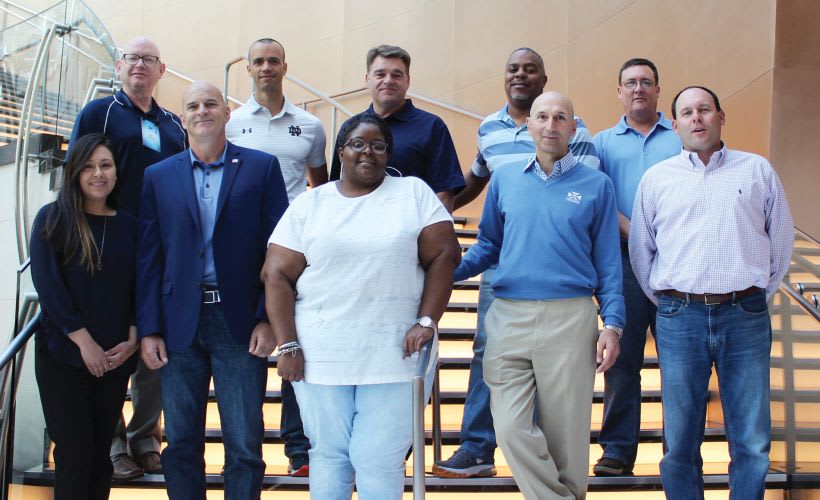
Brion Gopigian (first row, second from right) is Ford Motor Co.'s Eastern regional sales manager for commercial.
Photo courtesy of Ford.
The Eastern United States is dynamic and highly diverse, and it's driven by fleets of all shapes and sizes, many of which are operated by the world's largest and most powerful companies. Ford Motor Co.'s Brion Gopigian says the East is well-positioned to lead the nation in embracing new trends in fleet management, including vehicle selection and technology.
"The density, the number of cities, including our capital, and the size and volume of Fortune 500 companies on the East Coast is something you don't see anywhere else in the world," said Gopigian, a 30-year Ford veteran who currently serves as Eastern regional sales manager for commercial; he is also Ford's global business development director. "When we look back, we're going to realize this is an incredible moment in automotive history, from the shift toward SUVs and crossovers to electrification. And we can't get to autonomous vehicles soon enough."
Based at Ford headquarters in Dearborn, Mich., Gopigian manages a team of eight account managers dedicated to fleet clients "from Maine to Miami," all with unique needs. "Our role is to make Ford easy to do business with and solve problems for our customers," he said.
Detroit Family Tradition
Gopigian is a Detroit native and a third-generation member of the Ford team. His grandfather emigrated from Armenia in 1915 to take a job at a Ford plant. His father worked for the company as an engineer. Gopigian studied the economics of developing nations at the University of Michigan, planning for a career that would take him overseas.
He explored a number of opportunities and had another job offer in hand before he interviewed with Ford. That meeting convinced him to turn down the other company and continue his family's tradition, even if that meant waiting a bit longer to travel the world.
"When I interviewed at Ford, that's what I asked to do. They told me there was no chance. They didn't just put people in jobs like that," Gopigian recalled. So in August 1988, he reported to Ford's New York offices, where he would spend the next nine years working his way up through a number of departments, culminating in a move to fleet. It was commercial sales that gave him his first opportunity to work overseas.
"Ford was already a global manufacturer, probably the first. We were manufacturing in Europe, Russia, South America, and the Middle East by the 1990s. But I took the path less traveled. It was more like automotive missionary work. There was no recipe, no process," Gopigian said, listing Burma and Cambodia among Ford's early successes in new and emerging markets. "It was a challenge, but the company supported us and we were empowered to figure it out."
Moving Toward Autonomous Vehicles
Gopigian would spend just over 20 years working and often living overseas, including a total of 12 years in Dubai, Thailand, and China. Although he still has global duties, he has embraced his latest challenge: making sales, service, and support happen for Ford's Eastern U.S.-based fleet customers.
"I have one of the most diverse pieces of geography, and I love all the different industries and types of companies we serve," he said. "We have big pharma, medical supply and support, insurance, finance, consumer goods, construction — that's one of the things that makes this the best job in the business. I get to call on all these incredible American and international companies."
Understanding how best to equip and serve those companies requires a deep dive into specific needs, applications, and utilization.
"It's not just their history. It's what they're thinking. One fleet may need a smaller carbon footprint while another just needs a truck that can meet the needs of their duty cycle," Gopigian said.
One need shared by Ford's East Coast fleet clients is enhanced safety. Gopigian noted that, despite the long list of advanced safety measures — from safety glass and antilock brakes to forward-collision and lane-departure warnings — accident rates remain unacceptably high. The latest report from the National Safety Council (NSC) estimates a total of 40,100 motor vehicle deaths in the U.S. last year. It was a slight decline from 2016 that followed two years of increased fatalities. NSC analysts said numerous factors could be to blame, including distracted driving and stretched speed limits. Gopigian said that, whatever the reason, it all points to the same solution: autonomous vehicles.
"That is going to be so exciting. Look at how much more productive our country is going to be. It's going to happen." He suggested those who are not yet convinced to consider places like New York City, Detroit, and Silicon Valley, which "desperately" want to be more autonomous. The goal, shared by public and private interests, is to reduce collisions and, ultimately, make traffic more manageable. New York City's commitment to Vision Zero, a global campaign to eliminate motorist, cyclist, and pedestrian deaths, was cited by NSC analysts as one possible reason vehicle-related fatalities have fallen 15% statewide since 2015. "The answer is always in the market," Gopigian said.
Increasing Awareness of Ford's Strengths
In the Eastern U.S. and beyond, over the course of his fleet career, Gopigian has observed a growing awareness of the key role fleet can play in a company's success. Company cars — and SUVs — are a key HR benefit and retention tool. Reducing collisions, claims, and fuel spend protects the bottom line. Telematics and connected-vehicle technologies produce highly valuable data sets.
"This business operates at a higher level than it did 20 years ago. Our customers are getting great data from their fleet management companies and telematics providers. They've sharpened their games and so have the OEMs," said Gopigian. "We want to be the OEM of choice, the one they can work with to run their business. It can't be about who has the deepest discount or the cars they won't retail but will supply fleets with."
Gopigian credits Ford's product designers and dealer network with delivering the vehicles their customers need. His team's role is to keep those customers educated and informed and deliver the aftersales service and support they need to succeed.
"At the end of the day, this is still a people business, and the team I have in the East is a team of superstars," he said. "They are some of the finest people I've worked with. They do so much for our brand and we're lucky to have them. My job is to support them."
More Operations

How Fleets Can Recruit and Train Veterans for Technician Roles
Here's how the technician shortage has affected uptime for fleets, and what to do about it.
Read More →
Avis Budget Group Deploys Neology Toll Management Technology Across Major Brands
Neology’s neoFleet platform will manage toll transactions and toll-authority operations for vehicles across Avis, Budget, Payless, Budget Truck and Zipcar.
Read More →
Fleet Personal-Use Charges Edge Higher in 2026
Nearly eight in 10 surveyed fleets allow personal use of company vehicles, while just over half of respondents report charging employees for the privilege.
Read More →
The Future of Fleet + What’s Changing Right Now | AF News Recap
Could developments overseas offer a preview of what’s coming for U.S. fleets? This week, we’re looking at the future of AI, autonomy, and electrification, plus Ford Pro’s new certified pre-owned program, smarter vehicle offboarding, and a new way for fleets to manage toll expenses.
Read More →
How to Handle Vehicle Offboarding
What do fleet managers need to do when a driver leaves?
Read More →
Fleet Manager’s Ultimate Playbook: Navigating the New Standard in OEM Connectivity
Rising operating costs, driver safety concerns, and unplanned downtime are putting unprecedented pressure on modern fleets. Discover how fleet managers use embedded OEM connectivity and real-time vehicle data to cut TCO, prevent downtime, and protect drivers without aftermarket telematics hardware.
Read More →
U.S. Bank Adds Verra Mobility Toll Management to Voyager Fleet Platform
The integration allows U.S. Bank Voyager fleet customers to manage toll payments and violations alongside fuel, EV charging and maintenance expenses.
Read More →
ADAS Prevents Crashes. But Repairs Cost More | AF News Recap
ADAS-equipped vehicles may crash less often, but they can cost more when they do. This week, we’re breaking down what that tradeoff means for fleets, plus Subaru’s first Forester Wilderness Hybrid, Nissan’s new e-POWER Rogue, and why Calstart has become Catalyst Mobility.
Read More →
Moventum Fleet Management Names Mark Iorillo Head of Sales
Iorillo brings nearly 20 years of fleet management and sales experience to the role, including previous positions at Element Fleet Management, CEI, Donlen and Ryder.
Read More →
Fleet Has a Talent Pipeline Problem. What Comes Next? | AF News Recap
Where will fleet’s next generation of leaders come from? This week, we’re looking at the industry’s talent pipeline, what certification can add to a fleet career, how to build an award-worthy track record, and the return of Automotive Fleet’s Personal Use Survey.
Read More →