




About the Author: Kobi Eisenberg is co-founder and CEO of Autofleet, the end-to-end software platform for optimized, reliable and sustainable transportation services for fleets and mobility operators.
How Fleet Optimization Drives Higher ROI in Transition to EVs
Running a simulation that inputs fleets’ vehicle types, routes, and duty cycles can show which ICE vehicles are better candidates for electrification.
by Kobi Eisenberg, Autofleet
February 8, 2023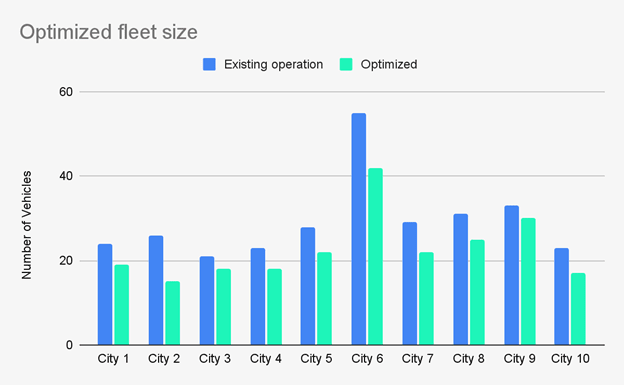
Source: Autofleet
5 min to read

Source: Autofleet
Fleets are under significant pressure to become more sustainable by going electric. However, the implications of going electric for a professional fleet are complex and costly, and include massive operational challenges.
Planning ahead is the only way to keep sight of your fleet’s objectives, maintain the level of service your business needs, and make the shift to EVs, all at the same time.
The most effective way to plan complex professional fleet operations is by simulating them – performing “experiments” before buying a single new vehicle or installing a charger. Careful, data-driven planning can save fleets from incurring the double penalty of fixing expensive mistakes after the fact.
Autofleet recently released a self-serve version of its Fleet Planning Simulatorthat allows companies such as Terawatt, Scania, and Ford to use real trip or demand data, alongside telematics and actual traffic information to simulate the dynamics of an EV fleet and the required infrastructure.
Here is a quick look at the power of simulations.
The Test Fleet
Meet ACME, Autofleet’s fictitious fleet of technicians providing service for home appliances. We used aggregated trip data from several sources to create ACME’s fleet data with the following specifications:
Fleet size: Just over 300 vehicles.
Operating in: 10 U.S. cities
Number of service calls: 250-600 per day
Fleet composition: 100% ICE vehicles from over 20 different OEMs
Process: We uploaded the data into the simulator (it’s actually as simple as uploading a file) and let it do the math.
What we wanted to learn:
What is the optimal mix of vehicle types?
What is the most suitable charging strategy for the fleet?
How will electrification affect the fleet’s carbon footprint?
How to de-risk the switch to EVs effectively?
First Thing First: Optimizing the Fleet to Make Sure We Get the Greatest Returns
The first step to electrification is actually to make sure the current fleet is optimized. The transition to EVs can be pricey, but it offers much better ROI when the vehicles are utilized the most — leveraging the lower energy and maintenance costs of an EV to offset the high initial cost and reduce total cost of ownership (TCO).
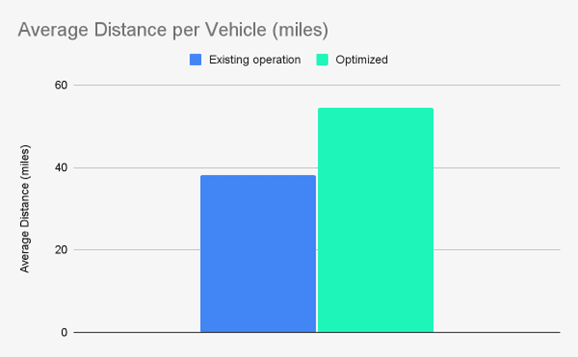
In our test fleet (based on real data) and using Autofleet’s Route Optimization, we were able to serve the same demand with 20% fewer vehicles — each covering more distance.
A smaller fleet with higher utilization makes the TCO of EVs more attractive compared to the existing ICE vehicles. This is because the fleet is expected to cover more miles, and thus the much lower cost per mile of EVs plays a bigger role when calculating the total cost of ownership.
Source: Autofleet
What Vehicle Mix Will Yield the Best Results?
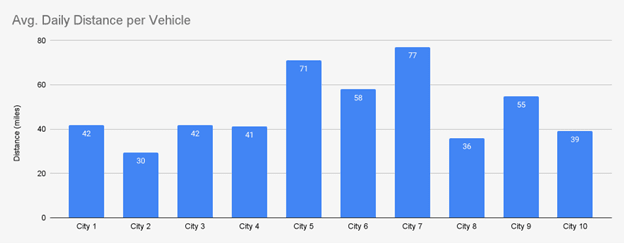
Electrification becomes even more attractive financially when it is coupled with route planning and optimization. However, we had to ensure that electrification would not disrupt existing schedules for midday recharging. That is, routes were optimized for maximum utilization, yet they needed to complete the full route without exceeding the projected range.
We found that most vehicles in our simulated test fleet can operate the whole day without stopping to top off their batteries.
Source: Autofleet
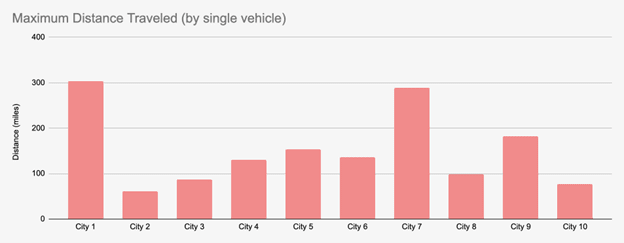
That was not always the case, however, and some vehicles did need charging during the day. For example, the graph below shows that some vehicles in City 1 and City 7 needed to top off their batteries during the day, which may entail long breaks and detours.
Source: Autofleet
What Will It Cost? Assessing the Financial Implications of Moving to EVs
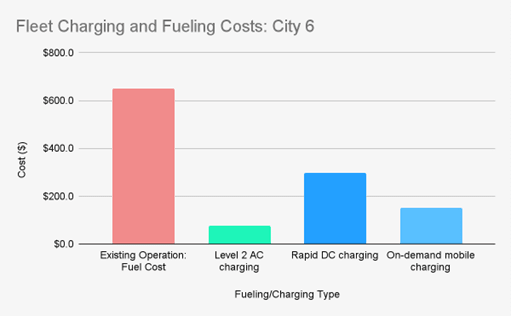
In order to get a better understanding of the financial implications of adopting EVs, we dove deeper into the data of one particular city to find out the best EV charging policy that will allow us to maintain the current level of service and expenses.
The different charging options are:
Depot or home overnight charging using level 2 AC charging stations.
Public rapid DC charging stations (from the likes of Electrify America, EVgo or ChargePoint, for example).
Or even an on-demand mobile charging truck that can deliver DC charging to the vehicles at their location.
Source: Autofleet
Since the optimized routes strategy we chose does not require topping off the batteries during the day in this city, using Level 2 AC chargers with overnight charging is the best solution. This can be done either by using a depot or by compensating workers for their charging costs at home.
The energy cost savings is easily calculated by looking at the difference between the cost of powering ICE vehicles (using gas prices) and EVs. That cost difference is the leeway ACME has above the current costs, to either cover higher leasing costs or improve its bottom line.
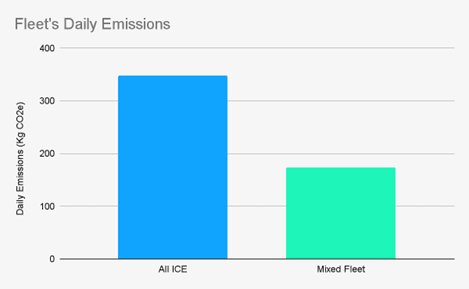
As is to be expected, even a partial switch to EV reduces the carbon footprint of the fleet significantly.
Source: Autofleet
Simulations Can Reduce Costs and Overhead
There is no one-size-fits-all answer to the electrification question. Every fleet has different needs and different considerations affecting TCO. It is not uncommon to discover that a mix of EV and ICE assets may be the best plan in the present time.
Planning requires accurate tools like the one offered by Autofleet to avoid costly mistakes. Successful electrification projects we saw recently were backed with data to help streamline the transition without letting the service levels slip.
Start by answering the big questions - who and what does the fleet serve? What’s the impact on the TCO and emissions? How do you maintain the level of service your business offers?
Then test different scenarios, fleet composition, and optimizations that will be tailored to your needs, increasing your chances of success.
Subscribe to Our Newsletter
More Green Fleet
Sponsored•October 1, 2026
New Propane Autogas Program Offers Fleet Compensation
Qualified commercial fleets can receive $7,500 per eligible propane autogas vehicle and up to $10,000 for new refueling site prep. Learn how the program works and see whether your fleet qualifies.
Read More →
EV Charging Use Is Outpacing Infrastructure Growth
ChargePoint’s 2026 Charging Forward Report points to rising charger use, higher-powered charging, commercial vehicle electrification, and energy-management technology. Here’s what fleets should know.
Read More →
Merchants Fleet Reports 290M EV Miles as Fleets Navigate Changing Electrification Market
From millions in operating savings to hundreds of millions of EV miles, Merchants Fleet’s latest report reveals what’s working and what’s changing in fleet electrification.
Read More →
The EV Breakdown Nobody's Talking About: Why Most Electric Vehicle Roadside Calls Aren't Mechanical Failures
Here's why EV breakdowns are widely misunderstood.
Read More →
ChargePoint Now Available in Energy Pass
ChargePoint and additional planned charging network integrations were added to GM's Energy Pass.
Read More →

First Look: Slate Auto's Electric Fleet Pickup
Could an affordable, modular EV pickup make electrification more practical for fleets?
Read More →
Slate Debuts Colorful, Unique EV Models
A recent media and client event, studded with electric vehicles dressed up on platforms, planted a new position for the manufacturer in the wider EV market. Fleets will find cost-saving advantages.
Read More →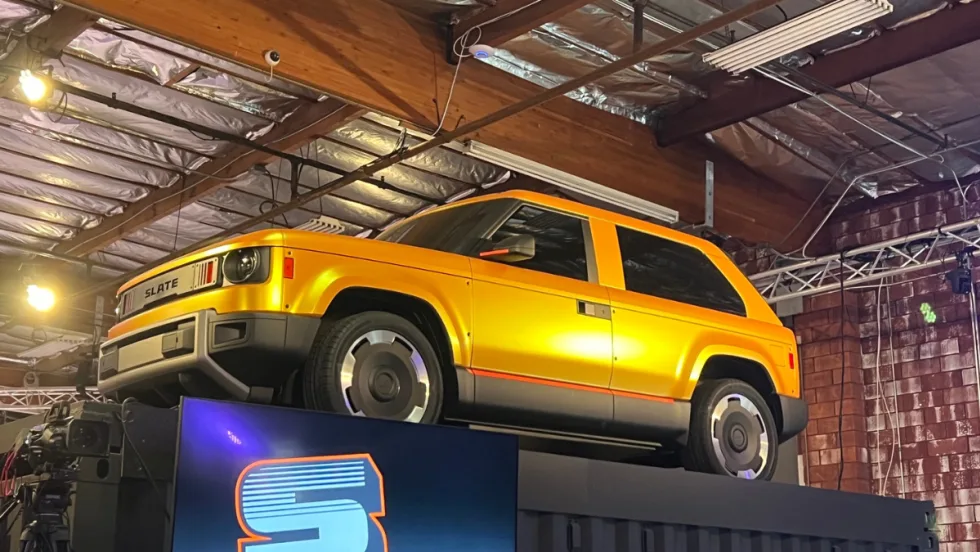
Slate Electric SUV, Pickup Switchable Model Aims For Light-Duty Fleets
Everything about this EV is counterintuitive and understated, making it stand out from the crowd.
Read More →
Inspiration Mobility Acquires Key Electrada Assets
Inspiration Mobility Group has acquired select assets of Electrada, adding the fleet electrification provider's team, technology, and charging infrastructure development capabilities to its energy management business.
Read More →