





Tire Load Ratings 101: Do you know why a tire's load rating matters to your work truck fleet?
How Developments in Tire Technology Streamline Safety
Here are some ways the evolution of tire technology is benefiting fleet management.
November 23, 2021
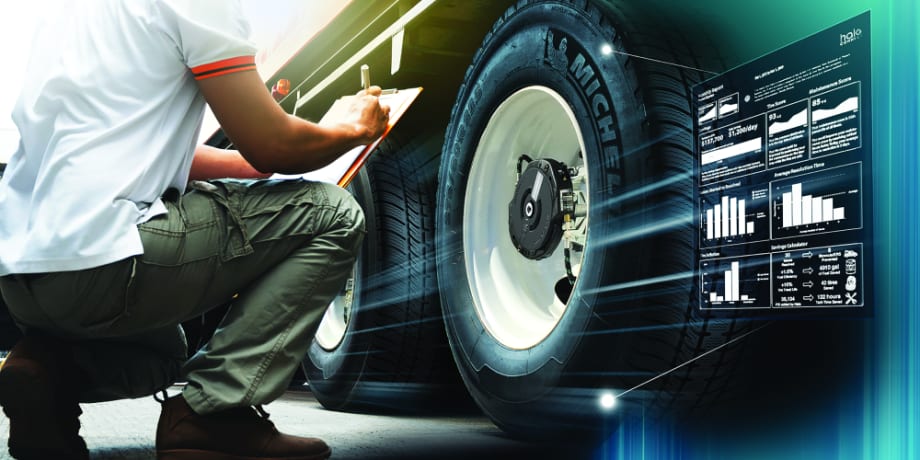
As technology evolves, fleet managers will continue to recognize the benefits and efficiency automation and analytics systems bring.
Photo: Aperia Technologies
7 min to read
Smartphones and tablets aren’t the only devices that seemingly improve on a yearly basis. With each passing moment, new developments in maintenance technologies are empowering vocational fleet managers to take even deeper looks into how they can keep their trucks at peak health.
Monitoring tires is a vital part of ensuring a vehicle is working properly and safely.
How Technology Changes the Tire Game
Facundo Tassara, head of customer success for Revvo Technologies, said one of the largest roles technology plays in the world of tires is safety.
“Hands down, a fleet with smart tires will immediately enjoy a huge boost in the safety of their tires and by extension, the safety of their drivers,” he explained.
According to Tassara, the number one reason a tire fails is a lack of proper inflation. Smart tires will connect centrally to the fleet operation, providing another layer of scrutiny beyond the driver. Tires can then be monitored between shop visits in real-time.
“If tires spend less time at sub-optimal inflation pressures, they will last longer and could lead to more retread cycles,” he said.
Judith Monte, vice president of Marketing & Customer Experience for Aperia Technologies, said when tire failures occur, they often come with significant consequences.
“Tires need to be checked and maintained more than any other component on a truck, and therefore stand to disproportionately benefit from the addition of automation paired with sensors and analytics,” she explained.
Aperia’s Halo Connect technology couples automatic tire inflation and predictive tire management. By constantly managing tire pressure and alerting when tire health is jeopardized, Halo Connect eliminates human error and simplifies processes for drivers and other employees alike. It extends the lifespan of tires by reducing wear and tear from underinflation and improves overall driving performance and fuel efficiency by ensuring optimal pressure.
Discount Tire, an independent retailer of tires and wheels, serves customers across a footprint including more than 1,100 locations in 37 states. It places a priority on safety and efficiency in tire evaluations and replacements, and is continually looking to new technologies to enhance the customer experience, according to Chris Adams, vice president of B2B/Fleet.
One example is the use of technology in capturing accurate data on tire use. Earlier this year, Discount Tire introduced a handheld tread depth reader that allows its technicians to assess and record the tread depth on fleet customers’ tires with digital accuracy.
“Additionally, the ability to collect and aggregate data at scale helps personalize and deliver the optimal tire recommendation for specific vehicles based on historical location data and an individual’s own driving habits. From development to product selection to installation to replacement, technology is critical to improving tire safety and making the customer experience easy, inviting, and safe,” Adams said.
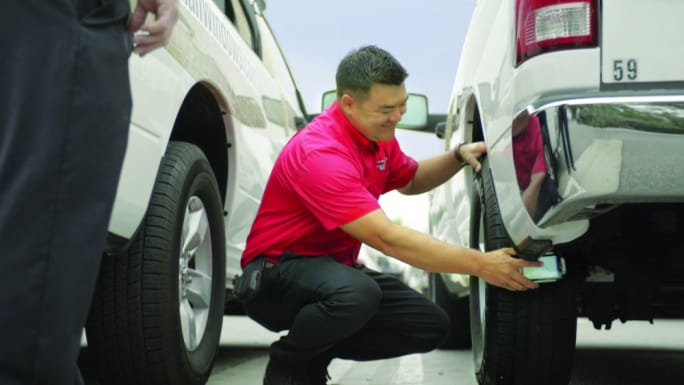
The ability to collect and aggregate data at scale helps personalize and deliver the optimal tire recommendation for specific vehicles based on historical location data and an individual’s own driving habits.
Photo: Discount Tire
Continual Tech Evolution
As technology evolves, fleet managers will continue to recognize the benefits and efficiency automation and analytics systems bring. Monte stated while automatic tire inflation systems (ATIS) were common on trailers, they are now popular on tractors too.
“Similarly, while tire pressure monitoring systems (TPMS) were the only choice for adding data to tractor tires in the past, tire technology systems can provide deeper insights and time-bound guidance to help fleets better manage maintenance,” she said.
For example, Halo Connect’s machine learning assesses variables such as geography, temperature, and pressure profile to diagnose and categorize tire issues by severity, which assists in maintenance planning. Data is continually captured by the system and compared with historical markers to spot early warning signs of potential failures and plan the right time for maintenance.
Tire technology can also help determine the best tire make and model for individual vehicles, based on duty cycles, routes, shipments, and other factors. As the capabilities of this technology advance, false warnings with incomplete information are reduced. Algorithms are able to process billions of miles of data, helping smart systems get…well, smarter.
Tassara of Revvo also echoes that in the past, tire data was only communicated by the vehicle to the driver through TPMS. They only displayed the actual tire pressure or just a warning indicator advising the driver that at least one tire was 25% underinflated. Now, in-tire smart sensors are capable of reporting pressure, tread, temperature, and more all in real-time.
Kurt Hasper, vice president of product for Discount Tire, said a specific example of the evolution of tire technology is the increased sophistication of tire sensors already built into newer vehicles.
“Real-time connected tire sensor alerts through telematics are empowering drivers with better data, and the ability for fleet managers to leverage that data at a holistic view across their operation is important in increasing safe operations and efficiency,” he said.
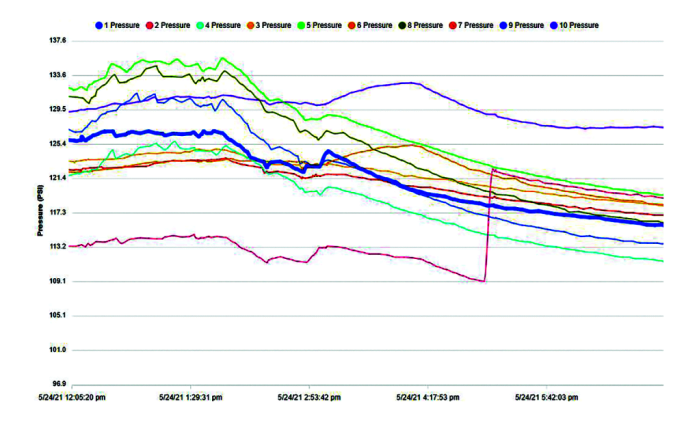
This graph from Revvo shows a tire that was below ideal pressure getting a slight bump in air.
Photo: Revvo
Preventing Unnecessary Issues
The ability to catch tire issues before they become catastrophic plays a big role in saving fleets time and money. As Mark Marrufo, vice president of Fleet Operations for Discount Tire, said every fleet carries varying weight, load, and capacity, and everyone drives differently.
“Technology allows us to account for these variances and make recommendations to fleet operators and drivers of the proper match in tires for their unique driving conditions that will ultimately help reduce total cost of ownership. That’s the key benefit of using our Treadwell tool, which is powered by years of historical driving data. Advancements in tire sensor technology also allow our technicians to quickly and efficiently diagnose and address slow leaks, low tire pressure, and other needs immediately that may help prevent costly incidents down the line,” he explained.
Revvo’s Tassara said catching tire problems early significantly reduces the amount of time a tire operated at low psi, which can damage a casing. This leads to a tire that cannot be retreaded or that will suffer premature failure.
In addition to catching tire problems early, a connected tire can help reduce the number of road calls by letting drivers and dispatch make better-informed decisions on the immediacy of needing tire service rather than suffering a preventable tire blowout. Connected tires can also help in the shop by helping technicians reduce the amount of time they spend collecting tire data through automation and integration into other fleet programs.
Most fleets now take a preventive approach to maintenance, Monte said, pulling a truck off the road for scheduled service based on a predetermined number of miles or hours in operation. If a problem is not caught in time, what started as a minor issue can rapidly snowball into a more expensive repair that forces a vehicle out of service for an extended length of time.
“Many fleets are already spending tens of thousands of dollars every year purchasing new tires and installing them on vehicles. Smart tire systems like Halo Connect eliminate the risk of human error and minimize the costly servicing of tires to when it is most convenient and economical for an organization. By coupling active inflation with machine learning, vocational clients are trimming unplanned tire-related downtime by an estimated 90%. The result is a decrease in on-road breakdowns, reduced technician diagnostic time, and increased automation of routine tasks,” she said.
Down the Road
Vocational fleets can expect to see total tire life-cycle management technology in the future that will enable them to easily manage tires from cradle to grave, according to Monte.
“We can expect to see the integration of insights such as the remaining life left on a tire and when to retread integrated into tire technology platforms. The goal is to make the tedious manual management of tires a thing of the past,” she said.
Tassara said he sees the servicing of tires continuing to evolve from being reactive to proactive.
“By the time a fleet identifies a problem, it’s often too late and a tire needs replacement. Tire technology does require some investment both in technology and a shop process, but the alternative of just replacing tires as needed has proven to be unsustainable for many fleets,” he explained.
Craig Cheatle, national head of business development for Discount Tire, said he expects fleet operators will eventually be able to remotely view key systems such as tread depth, low-pressure alerts, and temperature, and have the potential to send automated alerts to fleet managers.
Originally posted on Work Truck Online
Subscribe to Our Newsletter
More Safety

What’s Next for Fleet? Safety, AI & Industry Recognition | AF News Recap
Could your company's culture be encouraging distracted driving? This week, we're exploring how workplace expectations affect driver safety, what AI, EVs, and autonomous vehicles could mean for the future of fleet management, and how fleet professionals can strengthen their award nominations.
Read More →
Does Your Fleet's Culture Encourage Distracted Driving?
What happens when the people responsible for enforcing safety rules are the ones setting the wrong example? The answer may reveal why some of the biggest risks to fleet drivers have little to do with what's written in the employee handbook.
Read More →
Sponsored•October 1, 2026
Fleet Manager’s Ultimate Playbook: Navigating the New Standard in OEM Connectivity
Rising operating costs, driver safety concerns, and unplanned downtime are putting unprecedented pressure on modern fleets. Discover how fleet managers use embedded OEM connectivity and real-time vehicle data to cut TCO, prevent downtime, and protect drivers without aftermarket telematics hardware.
Read More →
From Driver Well-Being to EV Charging | AF News Recap
Mental health belongs in the fleet safety conversation. This week, we’re looking at five ways fleets can support employee well-being before a crisis, plus Holman’s expansion in Mexico, new one-day Fleet Forward passes, and why EV charging demand is outpacing infrastructure growth.
Read More →
Nexar-Nauto Merger Aims to Give Fleets Better Safety Intelligence Through Larger Driving Dataset
Stefan Heck tells Automotive Fleet that combining more than 10 billion miles of driving history with Nexar's AI models will give fleets deeper insights into driver risk and roadway conditions than either company could provide independently.
Read More →
Don't Wait for a Crisis: 5 Ways to Build Mental Health Into Your Fleet Safety Program
For Suicide Prevention Month, fleet and safety leaders have an opportunity to put mental health where it belongs: at the center of workplace safety.
Read More →
How Camera Data Can Strengthen a Fleet’s Insurance Renewal
Insights from a commercial insurance carrier and a broker show how fleets can turn video telematic data, driver coaching, and improved claims results into a stronger case at insurance renewal.
Read More →
The Safest Fleets Aren’t the Ones with the Most Technology
You’ve made the telematics investment. Here’s how to capture the other half of its value and build the safest fleet on the road.
Read More →
Sponsored•August 7, 2026
Hidden in Plain Sight: Fleet Compliance Risks
Fleet compliance isn't just about having policies — it's about consistently enforcing them. This practical guide reveals six hidden compliance risks common in public sector and shared fleet operations and outlines proven strategies to improve visibility, accountability, and audit readiness
Read More →
NETS Sets 2026 Fleet Safety Benchmark Conference for Indianapolis
The Sept. 15–17 program will feature fleet benchmarking data, case studies, emerging technologies, and implementation strategies while running alongside the NSC Safety Congress & Expo.
Read More →