




Hallmark Fleet Study Shows Higher Mileage Costs Less
Computer confirms fleet chief's expectations
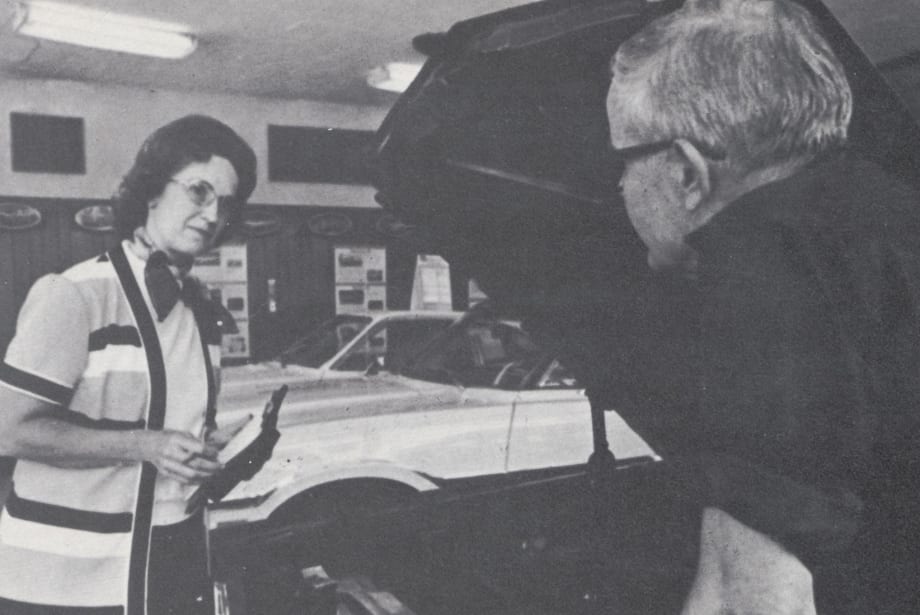
Hallmark's Helen Bland conducts an under-the-hood conference.
Since the 1973 and ‘74 energy crisis, Hallmark Fleet Manager Helen Bland has been expecting more mileage out of the 1,050 cars in the company’s sales fleet, and has been getting the extra fleet car use at less per-mile cost. According to a cost study conducted by Hallmark’s investment analysis experts, cars kept in service 65,000 to 70,000 miles cost less per mile to operate than lower mileage vehicles.
Although the impetus to get higher mileage out of the Hallmark fleet originally came from the energy crisis and a depressed used car market, Bland reports she will be more “lenient” in letting the cars go to 65,000 or 70,000 miles now that the final figures are in. Before the energy crisis, Hallmark usually replaced its cars at around 50,000 miles. Official replacement policy of the Kansas City, Missouri, greeting card company has now been pegged at 60,000 miles as a result of the fleet cost study.
Hallmark's Helen Bland conducts an under-the-hood conference.
Bland says the study was based on the sale of 300 cars retired from fleet service last year, most of which were full size Chevrolets, Fords and Plymouths. Hallmark’s investment analysis people studied all the fleet’s operational expenses, including fuel, oil, tires and maintenance costs. For the 300 cars that had been in service an average of just over 30 months, original purchase price plus costs of taxes, licenses, insurance, depreciation and interest were included in the data that was fed into Hallmark’s investment analysis computer.
The final printout showed costs of 12.55-cents per mile for cars traded at 45,000 miles, compared to 10.35-cents per mile for cars replaced at 70,000 miles (see chart). Although some drivers originally objected to the company’s plan to keep cars rolling longer, Bland says the complaints have tapered off as drivers discover the cars continue to be quite serviceable at higher mileage levels.
In fact, some 10-percent of the 300 cars studied were sold to their regular drivers at the end of their Hallmark service. Bland disposed of about 20-percent of the cars at auction, wit the remaining 70-percent taken in trade by the various dealers who handled delivery of the company’s 300 replacement units.
Although used car prices are a factor of considerable concern to managers of leased fleets, the used car market is of vital importance to an administrator looking after a multi million-dollar, company-owned fleet like Hallmark’s. Bland finds appearance and body condition generally play a bigger role in getting top dollar for her used cars than does mechanical condition, but she requires that her drivers adhere to a regular maintenance program to keep the fleet running as well as it looks.
TELLING AT A GLANCE
Because expense reports of all Hallmark drivers are processed by computer through Bland’s office, the fleet administrator can tell at a glance which Granada’s oil has been changed or which Chevelle’s engine was tuned or which Small Fury has been neglected by its driver. The computer charts information taken from the drivers’ expense reports and when a particular vehicle shows a blank space where a date and type of routine maintenance procedure should appear, Bland alerts the sales manager for that part of the country, who then has the individual driver take the car in for whatever maintenance is needed. Additionally, Bland requires that each sales manager conduct periodic checks of all Hall mark cars in his territory and send condition reports to the fleet’s Kansas City office.
Bland has logged 34 years with Hall mark, attending to fleet matters since 1963. She was named fleet manager in 1969, the same year she joined her lo cal chapter of the National Association of Fleet Administrators. Now chair man of NAFA’s Mid-America Chapter, Bland is in the final stages of downsizing the Hallmark fleet to intermediate models. When some 300 Hallmark drivers take delivery of their 1977 cars later this year, the fleet will be made up entirely of intermediate models.
As she continually keeps her eyes on the used car market, Bland says a major money-managing function of her office is to monitor the maintenance habits of her drivers so the cars Hallmark is now keeping longer will be worth more at trade-in time.
MILEAGE | PERCENT OF CARS STUDIED | COST PER MILE (CENTS) |
45,000 to 50,000 | 8 | 12.55 |
50,000 to 55,000 | 18 | 11.95 |
55,000 to 60,000 | 32 | 11.65 |
60,000 to 65,000 | 27 | 11.08 |
65,000 to 70,000 | 15 | 10.35 |
More Operations

Fleet Has a Talent Pipeline Problem. What Comes Next? | AF News Recap
Where will fleet’s next generation of leaders come from? This week, we’re looking at the industry’s talent pipeline, what certification can add to a fleet career, how to build an award-worthy track record, and the return of Automotive Fleet’s Personal Use Survey.
Read More →
Smith System Launches Driver Risk Management Program
Fleets have more driver data than ever, but identifying risky behavior doesn't necessarily correct it. Smith System's new Driver Risk Management program combines monitoring, training, and follow-up coaching to help fleets connect risk signals with driver intervention.
Read More →
Automotive Fleet Opens 2026 Personal Use Survey for Commercial Fleet Managers
Less than two weeks left! Commercial and corporate fleet managers are invited to share how their organizations handle company vehicle personal-use policies, charges, and driver eligibility.
Read More →
From AI Prompts to AI-Generated Safety Songs | AF News Recap
Can better prompts make AI more useful for fleet managers? This week, we’re breaking down smarter fleet analysis, an AI-assisted experiment that turned safety training into music, and what happened to fuel prices in August.
Read More →
How to Write Better AI Prompts for Fleet Analysis
Include these six elements in your fleet prompts to generate more relevant analysis and accurate answers.
Read More →
Fleet Meets: Eric Kilgore
This edition of the Fleet Meets series features one of the industry's best leaders driving multi-market and national operations.
Read More →
Why Reactive Fleet Management Is Becoming Too Expensive to Sustain
Research highlights a growing need for proactive management strategies to address rising costs in fleet operations effectively.
Read More →
What Your Fleet KPIs Aren’t Telling You
Tracking fleet metrics is only useful when the data leads to better decisions. This guide helps fleet leaders assess cost, utilization, and downtime more accurately, identify performance gaps, and prioritize the actions that can improve operational results.
Read More →
Hidden in Plain Sight: Fleet Compliance Risks
Fleet compliance isn't just about having policies — it's about consistently enforcing them. This practical guide reveals six hidden compliance risks common in public sector and shared fleet operations and outlines proven strategies to improve visibility, accountability, and audit readiness
Read More →
Turning Fleet Payment Data into Executive Insights
Does data alone drive results in operations?
Read More →