




Green Home Alabama
Alabama Clean Fuels Coalition has been helping fleets get the most out of their alternative-fuel options.
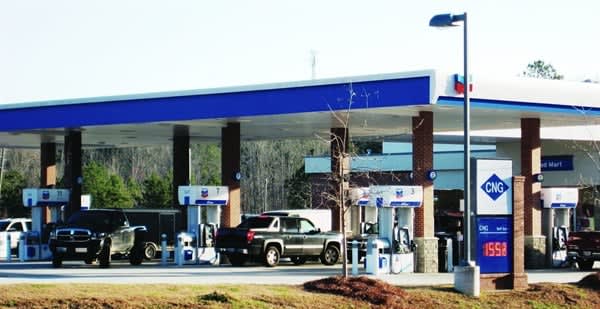
The City of Trussville, Ala., fuels its 40 CNG fleet vehicles at this Chevron station. The city-owned utility supplies natural gas to the station, which is open to the public.
Alabama Clean Fuels Coalition Executive Director Mark Bentley prides himself on being able to turn lemons into lemonade. And, when it comes to his state’s reliance on petroleum, he can’t help but start squeezing.
Bentley has spent nearly seven years at the helm of Alabama Clean Fuels Coalition (ACFC), which assists fleets and consumers in the adoption of alternative fuels, advanced vehicles, idle reduction, and fuel economy improvements. In 2011, ACFC stakeholders saved more than 2.4 million gallons of petroleum. Prior to his involvement there, Bentley crisscrossed the U.S. and Europe for 47 years as a marketing guru and entrepreneur, building business acumen that heavily informs his approach at ACFC.
“I conduct education about alternative fuels all over Alabama and beyond,” Bentley said. “Everything we do has to be a good business proposition for whoever we’re talking to. One of our roles is to bring together all the available local and national resources to provide positive economic and environmental outcomes.”
ACFC recently participated in the grand opening of a BlendStar renewable fuels terminal in Birmingham, Ala., which will significantly improve the economics of ethanol deployment in the Southeast. Prior to the terminal’s opening, a train hauling ethanol from the Midwest would take a week to unload. Now, a 96-car train can be unloaded in a single day. ACFC assisted in the early stages of the terminal’s development process, facilitating dialogue about the project with the local community.
Just northeast of Birmingham, ACFC worked with the City of Trussville, Ala., on a public-private partnership to offer publicly accessible compressed natural gas (CNG) fueling infrastructure. The city-owned utility supplies the natural gas, and a local Chevron station houses a fast-fill dispenser. The city fleet has 40 CNG vehicles that fuel at the site, with plans for more in the future.
“We have 72 independent gas utilities in the state. It’s a phenomenal business proposition for them to install a natural gas fueling infrastructure,” Bentley said.
More Green Fleet

Merchants Fleet Reports 290M EV Miles as Fleets Navigate Changing Electrification Market
From millions in operating savings to hundreds of millions of EV miles, Merchants Fleet’s latest report reveals what’s working and what’s changing in fleet electrification.
Read More →
The EV Breakdown Nobody's Talking About: Why Most Electric Vehicle Roadside Calls Aren't Mechanical Failures
Here's why EV breakdowns are widely misunderstood.
Read More →
ChargePoint Now Available in Energy Pass
ChargePoint and additional planned charging network integrations were added to GM's Energy Pass.
Read More →

First Look: Slate Auto's Electric Fleet Pickup
Could an affordable, modular EV pickup make electrification more practical for fleets?
Read More →
Slate Debuts Colorful, Unique EV Models
A recent media and client event, studded with electric vehicles dressed up on platforms, planted a new position for the manufacturer in the wider EV market. Fleets will find cost-saving advantages.
Read More →
Slate Electric SUV, Pickup Switchable Model Aims For Light-Duty Fleets
Everything about this EV is counterintuitive and understated, making it stand out from the crowd.
Read More →
Inspiration Mobility Acquires Key Electrada Assets
Inspiration Mobility Group has acquired select assets of Electrada, adding the fleet electrification provider's team, technology, and charging infrastructure development capabilities to its energy management business.
Read More →
Turning Connected Vehicle Data Into Decisions That Matter
Fleet leaders have more data than ever, but turning that data into clear, actionable decisions remains a challenge. This white paper shows how leading organizations are using connected vehicle data to improve safety, reduce costs, and optimize fleet performance. Learn how to turn insight into action across your fleet.
Read More →
Are You Tracking Your Fleet's True Total Cost of Ownership?
Bobit Business Media surveyed 190 fleet professionals and found that while most fleets are tracking costs, fragmented systems and data gaps are keeping true TCO visibility out of reach. With rising pressure to control spend in an increasingly volatile environment, the gap between what fleets think they know and what the data actually shows is wider than you might expect. See how your peers are managing costs today and where the industry still has room to improve.
Read More →