In addition, General Motors fleet sales to governmental political subdivisions were up 5% in 2017. This was the first time in 25 years that commercial and government sales for GM have been greater than daily rental deliveries.
In calendar-year 2017, total commercial and government deliveries by General Motors were more than 296,000 units, the most since 2008. Commercial and government deliveries are now the largest component of GM’s fleet deliveries, following a cumulative reduction of 170,000 rental deliveries since 2014.
Ad Loading...
In total sales — retail and fleet — General Motors delivered 3,002,241 vehicles in the U.S. in 2017, including more than 1.3 million trucks and 965,090 crossovers. In the process, GM set new annual sales records for pickup and crossover deliveries, and electric vehicles sales.
Ad Loading...
GM has capitalized on its three-truck strategy and sold more pickup trucks in the U.S. than any other automaker for the fourth year in a row — a record 948,909 units.
GM crossover deliveries were up 17% year-over-year, driven by record sales of the Chevrolet Equinox, Traverse, and Trax, as well as the Buick Envision, Buick Encore, and GMC Acadia.
Crossovers now account for more than 80% of Buick’s 2017 retail deliveries, compared with about two-thirds in 2016.
Chevrolet delivered more than 43,669 electric vehicles in 2017, including 23,297 Bolt EVs and 20,349 Volt sedans.
To learn more about GM’s fleet sales plans in calendar-year 2018, AF spoke with Ed Peper, U.S. vice president at GM Fleet. Following are excerpts from the interview.
Ad Loading...
At a Glance
In calendar-year 2017, total commercial and government deliveries for General Motors were more than 296,000 units, the most since 2008.
GM crossover deliveries were up 17% year-over-year, driven by record sales of the Chevrolet Equinox,Traverse, and Trax.
Crossovers now account for more than 80% of Buick’s 2017 retail deliveries, compared with about two-thirds in 2016.
Chevrolet delivered more than 43,669 electric vehicles in 2017, including 23,297 Bolt EV crossovers and 20,349 Volt sedans.
AF: Congratulations on a great 2017 calendar-year. What do you attribute this growth?
Peper: It was due to telling GM’s complete value story. We’ve talked for years about GM’s three pillars, which are great products, innovative business solutions, and an exceptional customer experience. I really believe that GM delivers on all of these in the fleet space better than anyone else.
Our selling proposition is if you’re successful we’re successful. It’s a different selling proposition and it’s been really successful. We’re all about making the customer successful. If we can do it better than anyone else and with the value we offer, our sales will increase. We’ve seen it in our commercial sales through November 2017, where we’ve gained in commercial 1.3 share points. In government, we’ve gained 1.9 share points.
We’re getting growth in commercial. We’re doing a nice job with Chevy cars, particularly with the Sonic and Malibu. We’re also doing a good job, as most would expect, with pickups and large vans — that’s helped us commercially.
On the government side, we’ve seen nice, steady growth in pickups, and we’ve seen an increase in Tahoe PPV (police pursuit vehicle) units being purchased. Industry-wide, the government segment is actually down by a couple of percentage points. Calendar-year 2017, GM grew its government business 5%, and grew its commercial business 11% in an overall market that was up by 2% in CY-2017.
Ad Loading...
AF: What is your assessment of today’s commercial fleet market?
Peper: I would say in 2018 that commercial and government sales combined are probably going to be stable to where it was last year. But there’s a lot of economic factors in the market that are quite good. The tax reduction for a lot of businesses is going to get companies to buy. We saw a bit of that in December 2017. We saw excellent small-business sales and excellent commercial sales. This was driven by the deadline to take advantage of the Section 179 tax deduction that offers a 50% bonus depreciation. That really helped us.
The big indicators for the fleet business, along with the optimism at small businesses, it points to the market that will continue to be strong. Will it be as strong this year as it was in 2017? Probably not, but it’s still going to be really strong.
On the whole, we think the commercial/government business will probably be flat this year.
AF: What is your forecast of the new-construction segment of the economy? This segment stimulates truck sales to itself and the ancillary contractors that work in that space, such as HVAC, plumbing, and electricians.
Ad Loading...
Peper: All of the indicators, such as building permits and home starts are up. That bodes very well, particularly for pickup sales. And, secondarily for us, at the end of the year, we will launch our new Silverado medium-duty.
AF: One of the vehicle segments growing on the retail side of the business is crossovers. There was an interesting quote from Kurt McNeil, GM’s U.S. vice president of sales
operations, who said GM is transitioning to be a crossover and truck-focused business. Is that translating into increased crossover sales in the commercial and government fleet market?
Peper: Yes. As the availability gets better for these products, we’re going to see sales be even better than they have been. We saw nice growth in our large utilities, about 5% in commercial and 16% in government.
With Equinox and Terrain, our fleet sales in the commercial market were actually down a bit, but that was simply because they are so red hot at retail. It was more of an availability issue. The product is phenomenal, and commercial and government fleets love it. I think that bodes very well for us.
AF: In calendar-year 2017, 80% of Buick retail deliveries were crossovers. It’s a sign of the brand’s resurgence in the marketplace. Is there a resurgence of Buick as a fleet vehicle?
Ad Loading...
Peper: We did grow our commercial business in 2017 with Buick by about 20%. However, when fleets compare our products, many times they will compare Chevy and Buick. In most cases, Chevy will have a lower transaction price and a lower cost of ownership and that’s what they’re looking for. I would say our fleet sales primarily continue to be Chevy and GMC, which are our two stalwart brands in the commercial and government fleet markets.
AF: With the upcoming launch of the Silverado medium-duties, does that change your three truck strategy? Will it be referred in the future as a four-truck strategy?
Peper: Whether it gets spun that way by the company, I’m not sure on that, but we will definitely talk about it as a four-truck strategy in fleet. It’s a huge advantage. We have a mid-pickup, a large pickup, a heavy-duty pickup, and we’ll have a medium-duty pickup. There’s a lot of fleets interested in the Colorado and Canyon too. That continues to be a huge opportunity.
AF: How do you think the medium-duty truck business is going to positively impact your total truck sale volume?
Peper: The medium-duty business will be solid. With the construction industry improving and all the other positive things that are going on in the economy, I think this business gets better and better. If we come out with a best-in-class product, that’s going to be very good for us.
Ad Loading...
Plus, we also see a lot of adjacent sales with medium duty. Some of our competitors realize that when they sell a medium-duty product, they also sell light-
duty trucks, either commercially to small businesses or retail. We believe there will be good adjacent sales for every medium-duty we sell.
AF: How were your van sales to commercial and government fleets in CY-2017?
Peper: Solid. Fleet sales for full-size vans in calendar-year 2017 were up 12% on large vans. The retail sales for large vans were up 11%.
I would say that GM bucked the trend in the market. If you look at our market share in large vans, we gained seven share points in fleet in 2017. We gained two share points in retail. And we gained five share points overall. Although the van segment was down a bit or flat, we gained share.
AF: Could you elaborate how the Chevrolet Malibu and your other
sedans are doing in the commercial fleet market?
Ad Loading...
Peper: In terms of the Malibu, it obviously didn’t hurt that it was voted 2017 Car of the Year by the readers of Automotive Fleet magazine. I would say Malibu’s commercial fleet sales were flat, year-over- year, but sales in the mid-sized car segment were way off. So, in order for us to be close to flat with Malibu, we gained a lot of share.
In terms of Sonic, we had really nice growth with Sonic in 2017, particularly with the Advance Auto Parts fleet, which really likes the Sonic. We saw a nice increase with Sonic.
AF: Do you find fleets transitioning more toward crossovers?
Peper: I do see some fleets transitioning into small crossovers and mid-crossovers. Our Lambda products, such as the Traverse and our small utilities like Equinox are really strong.
AF: How does GM’s EV sales divide up between fleet and retail?
Ad Loading...
Peper: Sales are primarily retail for the Bolt EV and Volt. We haven’t sold that many in fleet, but versus a year ago we’re way up. One reason is that we probably didn’t have as many Bolt EVs in the marketplace a year ago. I would say our Bolt EV fleet sales are primarily in the government space and smaller volume in commercial. Some states, such as New York, California, and Washington really like the product.
As more infrastructure gets built in and as batteries get cheaper, I think you’re going to see more and more adoption in commercial fleets.
We don’t sell a lot of Volts in fleet. We were up 1% in 2017. It’s not a huge volume. We’re going to sell a lot more Bolt EVs than Volts. But most of the electric-vehicle activity so far has been retail.
AF: What about the residual values of GM’s product portfolio? What direction are vehicle residuals trending?
Peper: In the last four years we’ve practiced more discipline in rental sales than probably anyone in the marketplace, outside of Honda, which really doesn’t sell any fleet or rental units. In these last four years, we’ve taken our rental sales down 170,000 units. We think at this level, we’ve become an industry leader in terms of rental penetration as a percent of total sales. As a result, we anticipate a lot of improvement in residual values. In the rental space you’ve seen some OEMs go crazy. The right amount of rental volume is a very good thing because you get test drives. Too much rental, with that secondary allocation of vehicles coming back into the marketplace, hurts your residuals. We’ve seen that happen.
Ad Loading...
AF: What about your dealer fleet business, how is that going?
Peper: Very good. Our dealer fleet sales for the 2017 calendar-year were up 17%. In 2017, the Business Elite dealers, who specialize more in commercial sales, were up 25% in fleet sales versus CY-2016. That’s been a big part of our commercial growth. We challenged our dealers to sell more than just pickups and vans to commercial fleet customers. They’re starting to sell small and mid-utilities and sell some mid-sized cars. They’re selling more of the full product line. Trucks and vans are always going to be a huge part of that business, but our dealers are selling other products too.
AF: You reorganized your fleet and commercial operations. What impact did this have on fleet sales?
Peper: We added two regional directors — one in the southeast part of the country and another in the west. Having five regional directors for our business has been a huge plus for us this year. Our orders are up. Our business is up. Our share is up. And it’s largely attributable to just having more focus.
It’s one of the biggest differences in our business in 2017. It’s a lot more focused on the customers and a lot more focused on the dealers when you have more leaders out there.
Ad Loading...
AF: Are there any points you want to discuss that we didn’t touch upon?
Peper: I really want to say that the rental business is extremely important to GM. I don’t want to lose focus. Our rental customers are super important to GM. We think we’re at a really good level of rental business now.
It’s also important for our rental customers, just like it is to our commercial and our government customers, to have better residual values. When car rental companies resell our products and they have more residual value in them, it’s better for everybody. I think that’s a huge point.
What happens is many times it gets lost in the translation that we’ve taken our rental sales down, so people immediately say GM doesn’t like rental. They’re cutting rental because it’s bad business. Well, it’s not bad business.
We’ve now got the right volume. We’ve managed our rental volume with discipline, and now we’re at a really good point. I think we’re working really well with the rental customers now too. It’s a much healthier relationship all the way around.
Ad Loading...
The biggest reason why we’ve grown our commercial and government business is because of our focus on the customers, and that is going to continue. We are not going to take our foot off the gas when it comes to giving the customers the products solutions and people solutions that we provide. We’re going to try to do it better than anybody else. That is not going to stop.
Economic Outlook Positive for the Balance of CY-2018
Mustafa Mohatarem, GM’s chief economist, forecasts 2018 calendar-year total vehicle sales (including medium and heavy trucks) will exceed 17 million units for the fourth year in a row. Light vehicle sales are forecasted to be in the high 16 million-unit range.
“In 2017, we had solid GDP growth and good news on employment, wages and consumer sentiment, which helped deliver very strong retail sales for the auto industry,” said Mohatarem. “This year, many consumers will see their take-home pay rise because of tax reform. That will keep the broad economy growing, and help keep sales at very healthy levels even as the Fed increases interest rates.”
According to GM, it is well positioned for market growth in CY-2018 due to its multi-year product strategy to redesign and expand its truck and crossover portfolio. On a retail basis, 78% of GM sales are now trucks and crossovers, compared with an industry average of 65%.
“We are winning customers in the fastest-growing parts of the market, and our momentum continues to grow because we have strengthened our brands, grown our commercial and government business, sharply reduced rental sales and successfully transitioned to a crossover- and truck-focused business,” said Kurt McNeil, U.S. vice president of sales operations for General Motors.
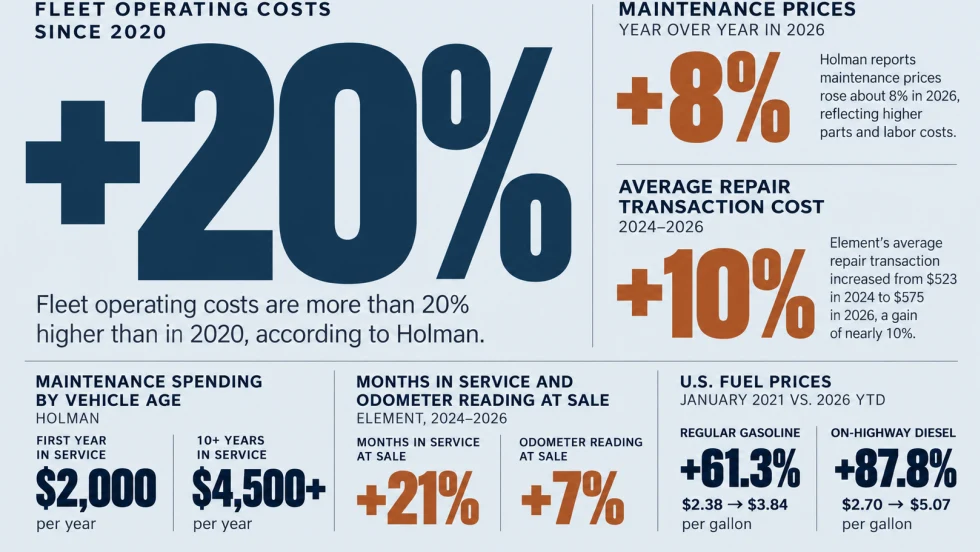
Fleet operating costs have risen more than 20% since 2020, raising a key question: When does extending a vehicle's service life stop making financial sense?
A stolen catalytic converter can cost fleets far more in downtime and lost productivity than in repairs. A total-cost-of-risk approach can help fleet managers quantify their exposure and prioritize theft prevention.
Personal-use charges are climbing, wholesale used-vehicle values are declining, and commercial fleet sales growth is slowing. This week, we're breaking down the latest fleet data, plus how Element Fleet Management is helping Waymo prepare for its first Canadian robotaxi market.
Buying fleet management software in 2027 means looking beyond features and price. As fleet operations, technology and expectations evolve, this guide explores what today’s fleet professionals should consider when choosing a system that can deliver value now and adapt to what comes next.
Neology’s neoFleet platform will manage toll transactions and toll-authority operations for vehicles across Avis, Budget, Payless, Budget Truck and Zipcar.