




George Weimer Receives 1988 Professional Fleet Manager Award
A panel of industry judges has selected George Weimer, Contel's director of transportation services, as the 1988 winner of the Professional Fleet Manager Award. Weimer's career in the fleet and leasing industry spans 31 years.

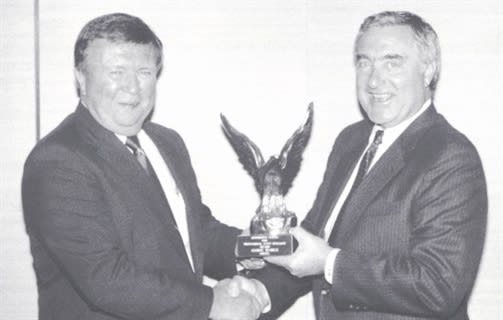
George Weimer, director of transportation services for Contel Service Corp. in Atlanta, GA has been named the Professional Fleet Manager for 1988 by Automotive Fleet magazine and a panel of industry judges. Weimer was presented a personal trophy at the Automotive Fleet & Leasing Association annual convention last April in San Francisco, CA. In addition, Weimer was also presented with a $2,000 scholarship which will be given in his name to an accredited university business school.
Weimer is the fourth recipient of the award and will have his name inscribed on a permanent trophy displayed at the magazine's headquarters. Weimer's name will join similar inscriptions honoring Jack Lamb of Exxon, the 1985 winner, E. Pierce Walsh of IC Industries, the 1986 recipient, and Richard Catino of DigitalEquipmentCorp., last year's award winner.
At the time of the award's presentation, Weimer had spent 31 years in the fleet and leasing business. He began working in the leasing business in 1957 as a salesman with Hertz Car Leasing in Chicago and ultimately rose to become the lessor's vice president of sales. In 1973, he left Hertz Car Leasing to join U. S. Fleet Leasing in New York City as vice president of sales. In 1974, Weimer joined Contel Service Corp. of Atlanta, GA, as director of transportation services, a position he has held to present. Weimer is responsible for Contel's national fleet of 7,100 cars and light trucks.

In the following article, Ed Bobit, AF's editor and publisher, interviewed Weimer on his approach to fleet management at Contel Service Corp.
AF: George, can you tell us how you entered into the picture of the Contel network and where you fit in today in its structure?
Weimer: I started with Contel in 1974 and was brought on board to operate an in-house vehicle/equipment leasing company. At the time the corporation was founded, the capital dollars were being spent primarily for telephone equipment rather than for vehicles, and the structure of the leasing company permitted the financing of the vehicles outside the normal telephone business. At that time, we were operating some 4,000 vehicles in 39 states. In 1976, we decided that Contel would no longer operate an independent leasing company, but would rely on an outside lessor to furnish the funds to operate the vehicle fleet. At that time, we examined a number of different major vehicle lessors and decided to enter into an agreement with one particular lessor; with their primary responsibility being the funding of the vehicle fleet.
It was our intent to continue to purchase all of our vehicles and dispose of our own vehicles. In addition to the funding that the lessor was to provide, we also had some ancillary services that we thought were necessary for the fleet. These included such services as national account programs to provide maintenance and repair work, tires, batteries, etc.
We continued with the leasing operation for the telephone sector until 1986. At that time, we elected to implement a program where we would simply own and operate our own vehicles. Contel had some 8,000 vehicles in service then, representing an initial cost of some $70 million which included not only the vehicles, but the considerable amount of utility-type equipment we required on our vehicles. Since 1986, we have continued to purchase our own vehicles and will continue to do so into the indefinite future, save for one exception: our non-telephone unregulated companies, where we will continue to lease from a major lessor.
AF: Where is it that you fit into the management structure of Contel and still provide this coordinating effect for all these separate companies?
Weimer: I presently report to the vice president of customer services, which is the department that is the primary user of our vehicles within the telephone operation. He, in turn, reports to the executive vice president of telephone operations for Contel, who reports directly to the president and CEO of the company. Within the structure, the parent company is a holding company of Contel and, in fact, is a service company providing service for all of the operating units of Contel, including both the regulated and unregulated segments of the company. Within the total company, the telephone operation represents some 90 percent of our activity, the remaining 10 percent being among the unregulated companies. Each of the telephone operating divisions has a vehicle manager reporting to that division, but who works in concert with the transportation services department to provide the necessary vehicles and services for their o6wn operation.
AF: Do you have any kind of vehicle policy committee?
Weimer: We do not have a formal vehicle policy committee. We do, on an annual basis, meet with the division vehicle managers to establish the type of vehicle specifications that we envision needing for the coming year. Each year, we develop approximately a hundred different vehicle specifications to handle our vehicle needs and locations - which range from International Falls, MN, with their bitter winters, to the Mojave Desert and 120-degree heat. And, on a continuing basis, we consult with our vehicle managers as new vehicles come on the scene to determine which of those have applications for our vehicle needs.
AF: In terms of budgets, who establishes and reviews your vehicle budgets?
Weimer: The actual vehicle budgets are established and approved by each of the operating units based on their anticipated needs for a calender year. Typically, we are looking at an annual vehicle purchasing budget approaching $20 million. In addition, we spend over $20 million annually for all vehicle and equipment costs and sell some $4.5 million worth of used vehicles. This varies by division, but fairly consistently, we are replacing some 1,500 to 2,000 units on an annual basis.
AF: How involved do you get with the actual suppliers, meaning the vehicle dealers, in the resale of the used units?
Weimer: Insofar as involvement with vendors for new vehicles and equipment, we actually negotiate the contracts each year with all of the vendors with the exception of some very specific construction vehicles that we need each year. Those specialty units are negotiated by our people in the field, since the servicing of the equipment on those units is handled on a local basis. In addition, we have national contracts with companies such as Adrian Steel, who furnish bodies and equipment for our vehicles. We also, have national accounts with other vendors that provide such equipment as cable plows, trenchers, trailers, and similar equipment. We also negotiate all contracts with the ordering dealers each year and, in my opinion, will continue to use the policy of courtesy delivery as the only practical way to buy new vehicles.
In addition, of course, we work very closely with Detroit to establish certain incentive programs for our particular needs. Again, using the vehicle managers we have throughout the U.S., we dispose of some 1,500 to 2,000 used vehicles each year. From my office in Atlanta, we established what we call "suggested selling" prices, which are the minimum prices we consider to be acceptable for the used vehicles we are selling. Typically, we dispose of three-year-old cars and four-year-old small trucks. We rely on the people in the field to accomplish these sales. The actual paperwork for these used sales transactions is controlled out of our office in Atlanta.
AF: What new policy developments do you feel you have helped generate or nurture that have had a significant cost savings for your company?
Weimer: In that regard, one of the first plans we implemented was a new method of marking our vehicles. While that might sound a little mundane, the methods we adopted resulted in savings of over $1 million simply in the marking of our fleet vehicles throughout the United States. Probably the most cost-effective move we've made in my years at Contel involved the replacement of some 4,000 full-sized vans with mini-pickup trucks with tops. According to the vendors in the industry, we were the first commercial fleet to use this type of vehicle. We got into this program to improve our fuel economy, as we were convinced that gasoline would soon exceed $2 per gallon. Based on our annual mileage, these vehicles were driven some 56 million miles and were getting only 10 mpg.
The switch to the downsized vehicles doubled our mpg and saves almost 3 million gallons of fuel on an annual basis. We also developed the concept of using courtesy delivery arrangements which, to date, based on our prior method of buying, have saved the company in excess of $3 million since 1981. Furthermore, rather than relying on outside sources to sell our used vehicles, we developed the program of furnishing suggested selling prices to help our people in the field dispose of their own vehicles. In a normal year, we will sell those vehicles in excess of book value by approximately $2 million. In other words, we are refunding $2 million a year to these operating companies for used vehicle sales.
AF: Do you have an opportunity to make an annual presentation to management with your plans for the following year?
Weimer: In practice, we follow a policy of providing top management with an annual summation of the previous year's activities. We present what we did, what we accomplished, and what we were able to save the company in terms of hard dollars each calendar year.
AF: Can you give us a brief background of your vehicle experience prior to joining Contel?
Weimer: I started in the leasing business in 1957 with Hertz Car Leasing in Chicago, working as a salesman. I left in 1973 as vice president of sales for Hertz Car Leasing. I then went to work for U.S. Fleet Leasing in New York City as vice president of sales for approximately one year. And in the summer of 1974, I joined Contel in Bakerskield, CA, as president of Medusa Leasing, our in-house leasing company. As of this year, I have spent 31 years in the fleet and leasing business.
AF: Have you instituted any new efficiencies internally within your own vehicle group; and what is the size of your group?
Weimer: Probably the most important addition was a software package we purchased in 1984. While the primary purpose of the software was to track our operating cost, it also provided several administrative advantages. We are now able to order our annual vehicle requirements in about six weeks. It used to require at least three months. We were also able to eliminate six months of part-time help since we no longer type purchase orders. In addition to improving ordering time, we can also control over 100 different vehicle equipment and option specifications, which we require each year.
As a by-product of our ordering system, we are able to order both fuel and national account charge cards for each of our 7,000 vehicles. While this may seem a simple matter, with over 100 separate companies and many requiring several billing locations, it's essential that we have our thirteen oil companies and other vendors properly invoice for each vehicle and Contel correctly.
As I mentioned earlier, we were looking for a means to track our operating expenses. Unlike many companies, we are not only concerned about the cost of operating our vehicles, but also the cost of equipment mounted on our vehicles. Frequently this equipment costs more to operate than the vehicle itself. This system gives us the ability to track both expenses. In addition, we wanted to determine certain costs on specific parts on the vehicle. Presently, we are monitoring about twenty items such as transmissions and brakes. This gives us the ability to see which of the manufacturer's products perform better under normal operating conditions. We are presently inputting cost data from 13 locations in the United States, as well as Atlanta.
By the end of 1988, we'll be able to have each location run their own reports for their own fleet. As you know, this business requires an enormous amount of detail, and we are constantly looking for ways to reduce or eliminate procedures to be more efficient. When I came to Contel, we were operating about 4,000 vehicles. At that time, our department consisted of seven people, including myself. At the end of 1987, our fleet consisted of some 7,000 vehicles, and we're still operating with seven people.
AF: One final question. How do you "cap" cost your vehicles, and do you take the cost of money into perspective in your operating report?
Weimer: Insofar as the "cap" cost of the vehicle is concerned, we take the true price we pay for the vehicle, less any incentives we are able to derive from Detroit or the dealers, and use that as the capitalized cost of our vehicles. We separate those dollars so, that at any given time of year, we know exactly how many dollars of incentives we've been able to obtain either from Detroit or from the dealers.
AF: George, it is well known that you are very active in many of the industry associations. There is one special one that I think our readers would be especially interested in. Could you tell us about it?
Weimer: I think you are probably referring to the Ford Fleet Advisory Council which Bill Willis and his fleet people decided to start in 1985. The purpose of the advisory panel is to meet with Ford fleet executives twice a year to review various problems that we envision the manufacturer is perhaps creating for those of us in the fleet world. That would include new products coming into the marketplace, and what those products will or will not do for our specific fleet needs. There are approximately 15 of us from around the U.S. who started with the advisory council, and we certainly feel that we have been able to contribute information and advice to all fleets through our direct dialogue with the manufacturer.
Contel's Fleet Composition
Headquartered in Atlanta, GA, Contel Service Corp. has a total fleet of 7,100 cars and trucks. The majority of the fleet, 80 percent, consists of trucks. The truck fleet segment breaks down as follows: 28 percent are mini-pickups, 27 percent are minivans, 35 percent are pickups, vans, or cab and chassis, while the remaining 10 percent are construction vehicles. The other 20 percent of the fleet consists of passenger cars. The car segment divides almost fifty-fifty between subcompacts and compacts, although there are a handful of vehicles in larger size classifications. Fleet vehicles are primarily used by the corporation's service people and technicians.
About half of Contel's fleet is leased, while the remainder is company-owned. The company's replacement schedule calls for cars to be disposed at three model years or 60,000 miles, while trucks are maintained for four model years or 70,000 miles. Replacement criteria for construction vehicles is determined unit-by-unit and is based on vehicle condition.
More Operations

90% Use Telematics. Are Fleets Getting Safer? | AF News Recap
This week, we're breaking down which industries have the highest rates, how Jamie McKay manages 2,400 vehicles, what's happening with the 2027 fleet awards, and why software-defined vehicles could introduce new costs.
Read More →
What's Best Handled by an FMC, and What's Better Done Directly?
Fleet managers continue to rely on FMCs for essential services but are taking a closer look at where working directly with suppliers can improve efficiency and responsiveness.
Read More →
Fleet Meets: Erin Gilchrist
Meet Erin Gilchrist, the inaugural Mike Antich Spirit of Fleet Award winner, as she shares insights on leadership, mentorship, the power of industry connections, and why people remain at the heart of fleet's future.
Read More →

How 2026 Fleet Visionary Jamie McKay Manages 2,400 Vehicles Across 37 States
How do you keep 2,400 vehicles running across 37 states? Fleet Visionary Award winner Jamie McKay shares how collaboration, flexibility, and a few simple strategies help her tackle fleet management challenges at Aptive Pest Control.
Read More →
Managing Fleet Costs in an Era of Permanent Volatility
Fleet operating costs have risen more than 20% since 2020, raising a key question: When does extending a vehicle's service life stop making financial sense?
Read More →
The Next Evolution of Fleet Management: Autonomous Operations
This opening keynote session at the Fleet Forward Conference highlights the future of autonomous driving for fleets.
Read More →
How to Reduce the Total Cost of Risk From Catalytic Converter Theft
A stolen catalytic converter can cost fleets far more in downtime and lost productivity than in repairs. A total-cost-of-risk approach can help fleet managers quantify their exposure and prioritize theft prevention.
Read More →
Personal-Use Charges Rise as Vehicle Values Fall | AF News Recap
Personal-use charges are climbing, wholesale used-vehicle values are declining, and commercial fleet sales growth is slowing. This week, we're breaking down the latest fleet data, plus how Element Fleet Management is helping Waymo prepare for its first Canadian robotaxi market.
Read More →
Here's When You Should Make an Exception to Fleet Policy
Fleet policies are designed to create consistency, but not every driver or situation fits neatly within standard rules.
Read More →
AI-Native or AI-Acquired: What Should Fleet Managers Look for in an AI Platform?
Six questions can help fleet managers look beyond AI marketing claims to evaluate integration, data access, and real-world operational performance.
Read More →