




General Motors has consolidated its fleet and commercial operations into a single, regionally focused organization. The new organization, now known as General Motors Fleet & Commercial Operations, will have two principal organizational elements: Sales and Service, and Brand and Support. "We've got one group now that speaks for the entire market of opportunity that is defined by the current fleet and commercial business today," said Rick Lee, who is now the fleet and commercial general manager for the Sales and Service area of General Motors Fleet & Commercial Operations. "Everything that isn't retail falls under our responsibility; but where we've had the kind of division of responsibility between the marketing divisions and NAO fleet, we've brought all that together into one single organization that speaks for the whole area of opportunity outside of the retail business. That's a huge difference from where it has been." Lee, whose title was executive ex. director, NAO Fleet Operations, now oversees fleet and commercial sales, service support, remarketing, and rental. Lee reports to Darwin Clark, vice president and general manager of Vehicle Sales, Service and Parts. Under Brand and Support, David Hansen is the new Fleet & Commercial general manager. He reports to John Middlebrook, vice president of Vehicle Brand Marketing. Hansen will oversee the departments of finance and administration, field strategy development and special products, two commercial brand managers, and GM Certified Used Vehicles. Within GM's new regional structure, one individual, a fleet and commercial regional manager, will direct resources that will cover a range from non-fleet commercial customers to the large commercial fleet accounts. Lee said the fleet and commercial regional manager will be responsible for both a dealer contact organization comprised of area sales and area service managers, and a customer contact organization of fleet account sales and service executives. GM put the new organization together with an "implementation team" represented by what Lee said was "all of GM's stakeholders in the commercial and fleet business," including representatives from Pontiac-GMC, Chevrolet, NAO Fleet, and GM's Information Systems Organization. In formulating the new organization, Lee said the group followed an eight-step process, starting with "where do you want to go as an organization?"; including "what do you want to accomplish?"; and "what are the important business processes that have to be in place to support that vision?" "It's a little bit different from how GM has gone about reorganizations in the past, as it really started with defining your future vision and then identified the major conceptual elements of that vision that needed to be in place in order to make it a reality," Lee said. "What's unique about this approach is that the first four to five steps of this eight-step process never dealt with drawing the first organization chart. We didn't really start drawing organization charts until we got to about the sixth step of the process." One of the individuals reporting to Lee will be in charge of national fleet and commercial sales. "That individual is going to have total responsibility for the fleet and commercial business outside of rental," Lee said. "So it's all the commercial fleet and commercial non-fleet business. It's all the dealer-based business as well as the direct business that we have factory reps out calling on customers for." Underneath this individual is the whole dealer contact organization and customer contact organization which are organized around the five regions, Lee said. "We consolidated the service responsibility for Pontiac-GMC, Chevrolet, and NAO Fleet into one service organization," Lee said. "The structure of the remarketing group hasn't changed much," Lee said. "We've had some personnel changes that we haven't publicly talked about yet." Rental will also be handled much the same way as it is handled currently, he said. Under brand organization, Hansen said the Chevrolet and GMC brands will be brought together differently. "Because there was not and is not a lot of need for major product differentiation in the commercial marketplace, we decided it would make a lot of sense to bring the separate nameplate brands into one organization, so we'll have one brand manager over commercial trucks," Hansen said. This brand manager will have responsibility for medium-duty trucks, some of the light-duty trucks, namely the HD3500, both GMC and Chevrolet. The other brand manager will be focused on vans, cutaways, and diesel engines. "We believe, with this new structure, we can more effectively bring a strong voice of the customer, and this allows us to speak with one strong voice for both marketing divisions," Hansen said. Hansen said Finance and Administration is a consolidation of finance and administration functions for GMC, Chevrolet, and NAO Fleet. Hansen said GM is continuing its Certified Used Vehicle Program, and some new initiatives in that area will come out sometime in 1999. In addition, Hansen said GM would continue to develop its small commercial non-fleet area. "The way we're structured, we'll develop brand marketing plans, specific field tactical plans, and the small fleet area will be given a lot of focus," Hansen said "And we've got a mechanism to take those plans and deploy them right down to the dealer level, where the small fleet business transacts. We've never had that before; there's been a complete disconnect between the various marketing divisions that were doing their own thing with their own dealer channels and our group to where now we can orchestrate that all together and bring it down to the dealership level."
General Motors Reorganizes Fleet Operations
Now known as General Motors Fleet & Commercial Operations, the company will have responsibility for General Motors total fleet and commercial business opportunity.
More Operations
BBL Fleet Acquires Velcor Leasing Corporation
BBL Fleet expanded its footprint in the fleet management industry with the acquisition of Velcor Leasing Corporation of Madison through a stock purchase agreement finalized Feb. 27, 2026.
Read More →
Lytx Introduces New AI Fleet Technologies at Protect 2026
The company introduced new AI-driven fleet safety and operations technologies during its annual user conference.
Read More →
Fleet Costs Are Rising: Here’s How Leaders Are Responding
Fleet leaders are under pressure to reduce costs, adapt to economic uncertainty, and make smarter decisions. See how peers across North America are responding with real data, proven strategies, and forward-looking insights. Download the 2026 Market Pulse Report to benchmark your strategy and uncover where you can gain an edge.
Read More →
From Waffle House to AI: Fleet Trends You Need to Know
In this AF news recap, host Faith Howell covers how Waffle House stepped up during disaster response and new AI tech on the market.
Read More →
Fleet Operations in the Age of AI: Navigating Ethical and Legal Challenges
AI is no longer a future concept for fleets—it’s already embedded in the tools, data, and decisions that operators rely on every day. In this episode of the Fleet Forward Podcast, recorded live at Fleet Forward, industry leaders take the conversation beyond hype to examine what responsible AI adoption really looks like in fleet operations.
Read More →
Factory Installed vs. Aftermarket: Choosing the Right Telematics Path & Managing the Data
As fleets rethink how they capture, manage, and act on vehicle data, telematics is at a major inflection point. In this episode of the Fleet Forward Podcast, we dive deep into one of the most pressing questions facing fleet leaders today: Should you rely on OEM factory-installed connectivity, aftermarket devices, or a hybrid of both?
Read More →
What Real-Time Data Reveals About EV Cost, Performance, and Scalability
Experts from telematics analytics, fleet-as-a-service operations, and national EV benchmarking share how real-time data is reshaping fleet strategy—dispelling assumptions, validating best practices, and exposing costly missteps.
Read More →
Planning Through Policy Shifts: What Fleets Must Track in 2026
A powerhouse panel featuring experts from the American Automotive Leasing Association, CalSTART, and municipal fleet leadership dives into the realities of navigating shifting emissions rules, regulatory waivers, federal agency actions, the future of the EPA’s endangerment finding, and the push for unified standards. They also examine the impacts of tariffs, autonomous vehicle policy, battery innovation, and the accelerating global EV market.
Read More →
Managing Market Turbulence with Strategic Fleet Insights
This episode kicks off with a deep dive into the technologies and market forces reshaping today’s fleet landscape. Host Chris Brown is joined by Laolu Adeola (Leke Services), Tyson Jomini (J.D. Power), and Richard Hall (ZappiRide) to break down real-world data, shifting incentives, and practical strategies fleet leaders can use right now.
Read More →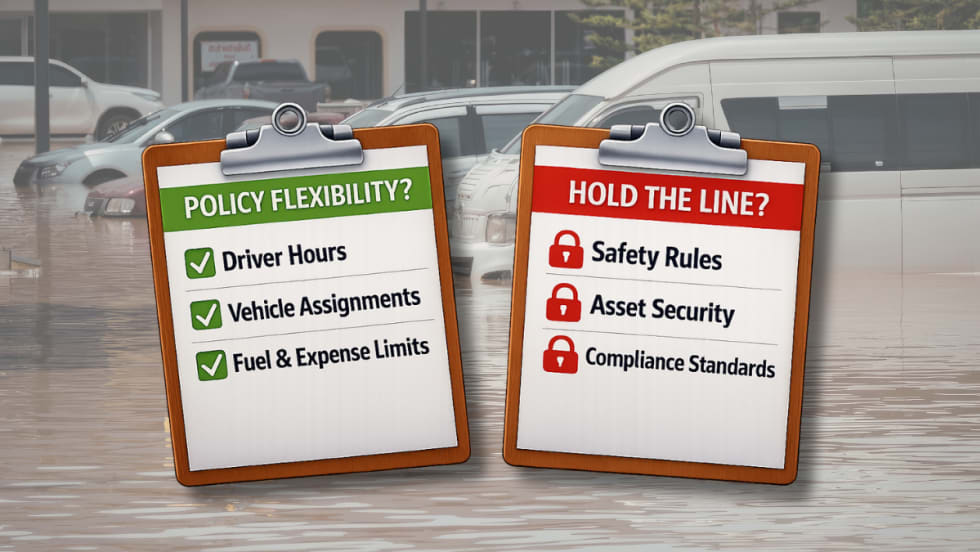
Adapting Fleet Policy When Disasters Strike
In the middle of natural disasters fleet managers must shift priorities to protect people and assets. What policy items should be loosened, and when should the line be held?
Read More →