




Freightliner M2e Hybrid Gets Down to Business
With improved fuel economy, lower emissions, extended brake wear, and reduced idle time, Freightliner’s Business Class M2e Hybrid offers fleets a “clean” way to get the job done.

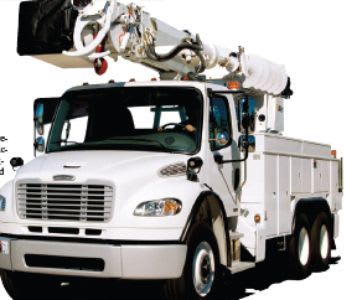
With the Freightliner Business Class M2e Hybrid, Freightliner Trucks, a division of Daimler Trucks North America, has taken a step toward Daimler’s goal of producing a zero-emissions vehicle. With fuel savings up to 1,500 gallons per vehicle, longer brake life, quiet electric power takeoff (ePTO), and idle time reduced as much as 87 percent, the M2e Hybrid skips the nonsense so fleets can get down to business.
Stop-and-Go Won’t Slow Down Productivity
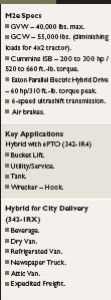
Built for stop-and-go operations, the Freightliner Business Class M2e Hybrid features the Eaton Parallel Electric Hybrid drivetrain system, tested over four years and 2 million miles. The parallel electric hybrid system allows fleets to operate with just the diesel engine or in combination with the hybrid electric motor. The diesel powertrain remains fully functional in the unlikely event the hybrid drive unit goes offline.
The hybrid motor provides additional power to launch the vehicle and improves fuel economy in high stop-and-go operations, ideal for utility, towing, pickup and delivery, and beverage applications.
Regenerative braking captures about 70 percent of the kinetic energy produced, recharging the hybrid’s battery. Energy normally lost during braking is stored in the batteries. Regenerative braking saves fuel, extends brake use, and allows for continual battery recharge in stop-and-go driving.
The truck’s hybrid drive power not only enhances fuel efficiency, but also provides an added boost for hills or rapid acceleration, helpful for vehicles that make frequent stops.
Stored energy also powers electric-only operation for ePTO and auxiliary power generation. Particularly suitable to utility applications, the M2e’s engine shuts off and the electric motor powers tools and hydraulic lifts. Fleets can save fuel, while quietly reducing emissions and idling. Electric-only ePTO operation provides significant reduction in emissions and idle time, and also offers operating flexibility.
[PAGEBREAK]
Attractive Features All Around
The M2e is equipped with a number of money-saving qualities.
Extended wear. The Freightliner Business Class M2e Hybrid’s engine and brakes now last longer. Brake life is more than doubled in urban delivery service, according to the company.
Reduced idling. In ePTO mode, idle time can be reduced by as much as 87 percent. Less idling means less fuel, exhaust, heat, noise, and vibration. In utility applications, 4-5 hours of idle time per day can be eliminated.
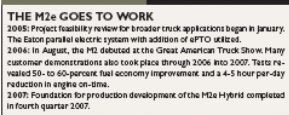
Fuel economy. With the city delivery vehicle, fuel economy is improved from 25 to 40 percent. Fuel economy in utility applications has seen a 40- to 60-percent improvement.
Overall annual savings. Considering fuel economy, extended brake life, and federal tax credits, city delivery and utility fleets can achieve an annual savings of $3,500-$6,000. Both state and local governments offer a number of incentives to offset the cost of the new technology. To learn more, visit www.environmentaldefense.org.
Other standard features on the M2e include:
Increased visibility with a broad windshield and sloped hood.
Enhanced maneuverability with up to a 55-degree wheel cut.
A roomy interior, featuring an automotive style dash.
Large doors, easy ingress and egress, with low step-in height.
Adaptable cab configurations with standard multiplex wiring, clear frame rails back of cab, and a variety of horizontally and vertically mounted exhausts.
Lightweight aluminum cab and easy maintenance. WT
More Green Fleet
EV Charging Use Is Outpacing Infrastructure Growth
ChargePoint’s 2026 Charging Forward Report points to rising charger use, higher-powered charging, commercial vehicle electrification, and energy-management technology. Here’s what fleets should know.
Read More →
Merchants Fleet Reports 290M EV Miles as Fleets Navigate Changing Electrification Market
From millions in operating savings to hundreds of millions of EV miles, Merchants Fleet’s latest report reveals what’s working and what’s changing in fleet electrification.
Read More →
The EV Breakdown Nobody's Talking About: Why Most Electric Vehicle Roadside Calls Aren't Mechanical Failures
Here's why EV breakdowns are widely misunderstood.
Read More →
ChargePoint Now Available in Energy Pass
ChargePoint and additional planned charging network integrations were added to GM's Energy Pass.
Read More →
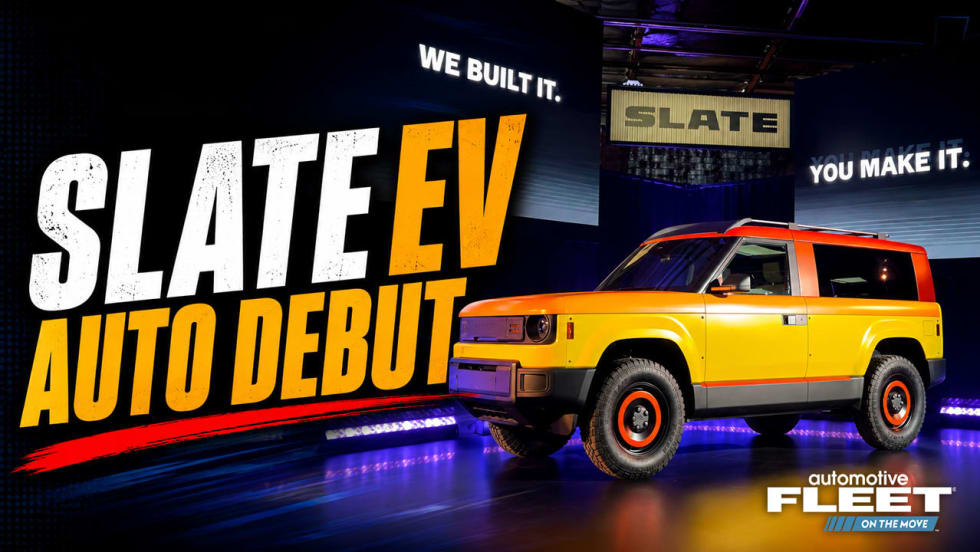
First Look: Slate Auto's Electric Fleet Pickup
Could an affordable, modular EV pickup make electrification more practical for fleets?
Read More →
Slate Debuts Colorful, Unique EV Models
A recent media and client event, studded with electric vehicles dressed up on platforms, planted a new position for the manufacturer in the wider EV market. Fleets will find cost-saving advantages.
Read More →
Slate Electric SUV, Pickup Switchable Model Aims For Light-Duty Fleets
Everything about this EV is counterintuitive and understated, making it stand out from the crowd.
Read More →
Inspiration Mobility Acquires Key Electrada Assets
Inspiration Mobility Group has acquired select assets of Electrada, adding the fleet electrification provider's team, technology, and charging infrastructure development capabilities to its energy management business.
Read More →
Turning Connected Vehicle Data Into Decisions That Matter
Fleet leaders have more data than ever, but turning that data into clear, actionable decisions remains a challenge. This white paper shows how leading organizations are using connected vehicle data to improve safety, reduce costs, and optimize fleet performance. Learn how to turn insight into action across your fleet.
Read More →