




Fleet Selectors: How They Have Changed
Just as vehicles have changed over the decades, so have the selector forms fleet managers have used. Vehicle specifications have gone through significant changes, having been impacted by the economy, products and programs offered by manufacturers, operational requirements of the vehicles themselves, and the emergence of the import vehicle.
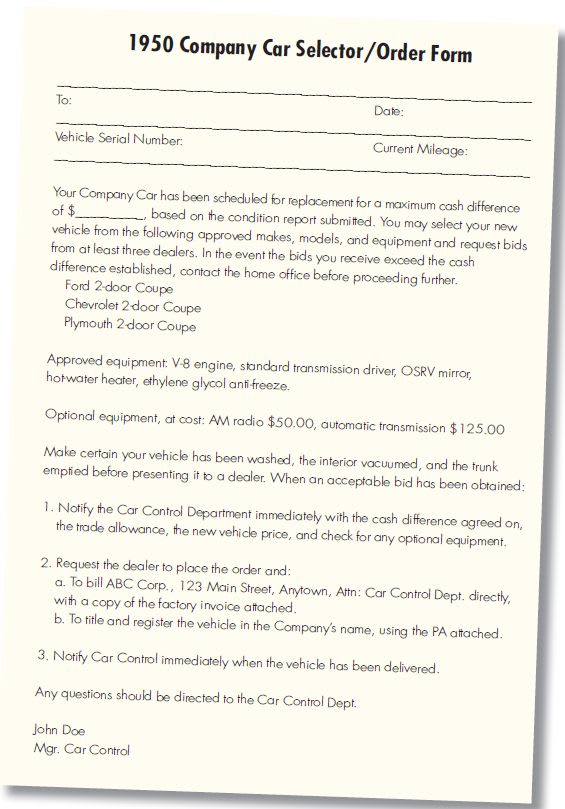
Company cars represent an integral means of seeing more people, accomplishing more in less time and less effort, resulting in greater productivity. It is perhaps the most valuable tool utilized by industry in general and represents an expense second only to salaries. As such, it demands an efficient, economical management approach not only in vehicle and equipment selection and assignment, but in the approach used to place a unit in service in the most expedient manner.
There are five separate, but related, areas that must be dealt with in developing these necessary procedures:
Establishing the approved vehicle specification.
Providing a means for the operator’s selection.
Order placement.
Delivery confirmation.
Used-vehicle disposal.
Selecting the Vehicle
Over the years, fleet vehicle specifications have gone through significant changes, having been impacted by the economy, products and programs offered by manufacturers, operational requirements of the vehicles themselves, as well as the emergence of the import vehicle.
In the early days of fleet management, domestic brands ruled the roost with GM, Ford, and Chrysler predominating in the fleet market and, to a lesser degree, second-tier brands such as Studebaker, Hudson, Nash, and later American Motors, et al. They all generally offered models in just two levels — standard and deluxe — and for the majority of fleet operators, the standard lineup were the vehicles of choice.
In selecting vehicles to place in service, consideration had to be given to a variety of operational and economic factors, such as:
Initial cost.
Resale value.
Economy of operation.
Cargo-carrying capacity.
Type of operational terrain, e.g, urban, rural, off-road.
Multiple operator levels.
Weather conditions.
Number of regular occupants.
At new-model introductions, one would see fleet managers with tape measures checking the “lifting” required to get products into the trunk as well as the trunk dimensions. Invariably, the basic model of choice was often a standard, full-size, two-door coupe, along with a four-door model usually for management-level operators (where that distinction existed). An example of an approved vehicle at the time would have been:
Two-door coupe.
V-8 or “inline” eight-cylinder engine.
Standard transmission.
Driver-side rear-view mirror.
Heater (north of the Mason-Dixon Line) and antifreeze (alcohol or ethylene glycol).
Air conditioning (only below the 100-degree temperature line).
In addition, the air conditioning unit, in its infancy at the time, would most often be an aftermarket unit that could be transferred to the replacement vehicle. Seat belts (lap only), which came along in the 1950s, were optional and also available as an aftermarket item. Radios, considered to be distracting to the driver, were not normally approved. (By today’s standards, these are practically prehistoric specifications!)
Mid-size and compact models started to enter the picture during the late 1950s and 1960s with the introduction of such models as the Plymouth Valiant and the “K” bodies, Mercury’s Comet and Montego, Ford’s Falcon and Gran Torino, etc., eventually becoming the models of choice. The new vehicle could be a replacement, an addition, or an emergency acquisition, which would most often require an out-of-stock purchase, subject to model availability and cost.
Perhaps the first major impact on fleet vehicle selection (after WWII) was precipitated by the gasoline shortages of the ’70s, which piqued interest in mid-size and compact models along with V-6 and four-cylinder engines. Some fleets at the time converted entirely to compacts, a decision regretted later when they couldn’t do the job expected and suffered in the used-car market on resale. Unfortunately, this is a situation repeated too often today.
[PAGEBREAK]
Factory Programs Emerge
Other factors that emerged affecting the vehicle selection and order placement decision were various factory programs that came into play over the years:
“Free” option packages.
Guaranteed resale values.
Early-order price guarantees.
Model cash incentives.
Volume-purchase discounts.
Single-supplier discounts.
The “drop-ship” courtesy delivery method.
Increased model levels.
All of these tended to “muddy the water,” in selecting model specifications by enticing fleet managers into selecting better models and more equipment, which have eventually become the current standard.
Creating the Vehicle Selector Form
Once the approved vehicle specifications had been established, it became necessary to devise a method to determine what vehicle to order when a choice was available, ergo the vehicle selector form.
In the early days, when ownership predominated, a method often used was to establish a “cash difference” between the vehicle being traded in and the new vehicle. It was then incumbent on the operator to “shop” the vehicle to at least three different dealers to arrive at the approved amount so that an order could be placed. Unfortunately, this occasionally led to the operator making an “under-the-table deal” with the dealer, usually for more equipment and sometimes for a better model. While somewhat cumbersome, it had the advantage of trading in the used vehicle, which eliminated the need for its separate disposal.
This method was gradually phased out over the years, replaced by the separate purchase of the new vehicle and the outright sale of the used vehicle. This approach, which required the order to be placed directly with a “cooperating” dealership, changed the replacement process by:
Eliminating operator involvement.
Requiring the establishment of a list of cooperating dealerships nationwide.
Requiring established methods of used-vehicle remarketing.
Resulting in a closer relationship with the manufacturer in selecting dealers.
A modified version practiced by a few fleets involved annual replacements, when the fleet manager would work with regional dealers to provide vehicles for a surrounding area. A cash difference would be established and sent to the dealer along with condition reports for a number of vehicles in advance of new-model introduction, with the understanding that non-compliance could result in loss of future orders.
With the advent of the drop-ship method, a number of dealers emerged nationwide for each make as “fleet specialists” who would handle orders for local delivery nationwide through a participating dealer network. The delivering dealer would receive a modest fee for the vehicle prep and delivery. This eliminated the need for fleet managers to maintain a listing of dealerships nationwide. Under a lease arrangement, orders would be sent to the lessor who would proceed in a similar manner.
Electronics Revolutionize the Industry
The advent of the electronic age, with the proliferation of computers, iPhones, iPads, BlackBerries, and the use of texting and the Internet, have revolutionized communication between operators, fleet management, lessors, dealers, and manufacturers, resulting in practically a paperless process and, unfortunately, fewer personnel. While all of the steps mentioned above must still be addressed, they can now be accomplished more quickly by transmitting the forms, approvals, directions, and even the transfer of funds electronically.
This electronic approach has also been used for the transmission of company car policy and procedure, repair approvals, etc., saving both time and effort and eliminating the need for the time-consuming and costly manual transmission and updates.
The future is difficult to predict, but could include: fleet management’s vehicle requirements, cycling and specifications embedded with the manufacturer with orders for new vehicles placed automatically for delivery by local dealers, delivery receipts, and payments transmitted electronically — only time will tell.
More Operations

Fleet Has a Talent Pipeline Problem. What Comes Next? | AF News Recap
Where will fleet’s next generation of leaders come from? This week, we’re looking at the industry’s talent pipeline, what certification can add to a fleet career, how to build an award-worthy track record, and the return of Automotive Fleet’s Personal Use Survey.
Read More →
Smith System Launches Driver Risk Management Program
Fleets have more driver data than ever, but identifying risky behavior doesn't necessarily correct it. Smith System's new Driver Risk Management program combines monitoring, training, and follow-up coaching to help fleets connect risk signals with driver intervention.
Read More →
Automotive Fleet Opens 2026 Personal Use Survey for Commercial Fleet Managers
Less than two weeks left! Commercial and corporate fleet managers are invited to share how their organizations handle company vehicle personal-use policies, charges, and driver eligibility.
Read More →
From AI Prompts to AI-Generated Safety Songs | AF News Recap
Can better prompts make AI more useful for fleet managers? This week, we’re breaking down smarter fleet analysis, an AI-assisted experiment that turned safety training into music, and what happened to fuel prices in August.
Read More →
How to Write Better AI Prompts for Fleet Analysis
Include these six elements in your fleet prompts to generate more relevant analysis and accurate answers.
Read More →
Fleet Meets: Eric Kilgore
This edition of the Fleet Meets series features one of the industry's best leaders driving multi-market and national operations.
Read More →
Why Reactive Fleet Management Is Becoming Too Expensive to Sustain
Research highlights a growing need for proactive management strategies to address rising costs in fleet operations effectively.
Read More →
What Your Fleet KPIs Aren’t Telling You
Tracking fleet metrics is only useful when the data leads to better decisions. This guide helps fleet leaders assess cost, utilization, and downtime more accurately, identify performance gaps, and prioritize the actions that can improve operational results.
Read More →
Hidden in Plain Sight: Fleet Compliance Risks
Fleet compliance isn't just about having policies — it's about consistently enforcing them. This practical guide reveals six hidden compliance risks common in public sector and shared fleet operations and outlines proven strategies to improve visibility, accountability, and audit readiness
Read More →
Turning Fleet Payment Data into Executive Insights
Does data alone drive results in operations?
Read More →