




Fleet Managers Face Truck Purchasing Issues for 2002-MY
Want a truck? Might be a problem! Fleet managers are wondering what, if any, effect the economy will have on the manufacturers' ability to meet their required vehicle specifications and scheduled delivery times.
A recent AF survey to find out what the trends in truck purchases were for the 2001-MY and their direction for 2002-MY provided some responses that are quite enlightening. Expecting an emphasis on fleets buying fewer, larger vehicles for use in a more diversified manner, we were a little surprised where fleet managers' concerns lay. Responses to the survey showed a trend in another direction, dictated at least in part by recent events, the nation's questionable economy over the past 12 months, and the economy's ability to recover.
How Will the Economy Affect Fleets' Purchasing Abilities?
The most prevalent survey concern wasn't about what type and size of truck, what powertrain or options, or even how many vehicles they were anticipating purchasing, but rather a real concern over one of the oldest of fleet manager problems, "order-to-delivery" (OTD) times. Another concern was the effect extended order-to-delivery times have on vehicle lifecycles.
Responding fleet managers also expressed a concern over manufacturers' abilities to meet stricter clean air requirements with alternative-fuel vehicles that fit their small- to mid-range work truck needs.
Wanted: The Right Vehicle, Delivered on Schedule
David Higgins, director, central fleet maintenance for the city of Boston, Central Fleet Maintenance, said, "For the 2002-MY, my concern is the ability of any manufacturer to supply the components required by the specifications."
Dennis Hogan, CAFM, manager fleet services for Alliant Energy Inc., Marion, IA, echoed Higgins' concerns when he said, "One of my biggest and most obvious concerns is the effect the economy will have on manufacturers and their ability to deliver their product. Over the past 12 months I was concerned with the timing of chassis delivery to the schedules of upfitters and final-stage manufacturers, in addition to matching the latest option packages to the current standard vehicle specification."
John Borek, fleet management officer for the state of Rhode Island DOT, Providence, RI, added, "We're told delivery times of six to eight weeks for our vehicles, but over the past year we've experienced delays as long as six months. That creates a myriad of problems with vehicle replacement schedules. Also, I'm concerned about price increases in the 2002-MY, with the economy and world situation the way it is."
Order-to-Delivery Times Affect Many Fleet Vehicle Programs
Christy Coyte, fleet manager for Johnson Controls Inc., Plymouth, MI, says, "I'm worried about lifecycle cost, acquisition costs, and upfitting costs, as well as the difficulty in getting equipment that is totally suitable to the job function. I had those concerns in 2001-MY and feel that those may still be prevalent in 2002-MY."
Many fleets have had to take another tack in trying to out-think the economy and the manufacturers, re-thought their overall need for fleet vehicles, and changed the qualification criteria to be assigned a company vehicle.
Merry Young, CAFM, fleet supervisor for WorldCam, Tulsa, OK, told AF, "Our company has revised the employee qualification for a company vehicle, so now my greatest concern is projecting our new-vehicle needs over the next 12 months. Order cancellations after the vehicle has been upfitted had posed problems in 2001-MY." Young added, "I have no concerns in ordering replacement trucks, but we have had many order cancellations in 2001-MY which have us scrambling to transfer the new vehicles to other departments."
Vehicle Lifecycle Adjustments Are Becoming a Way of Life
Patrick Grove, fleet/security manager for ACCO Air Conditioning Co. Inc. of Glendale, CA, had multiple problems in 2001-MY, and is concerned over 2002-MY prospects, "Price and delivery time from order date to delivery are two of my major concerns. The longer it takes to build and deliver the new equipment, the more money we have to spend to keep the old trucks on the road. Over the past 12 months we experienced vehicle delivery delays. We were expanding and needed our new trucks immediately, not eight to 14 weeks from the order date. In answer to the delivery and availability problems we've experienced, there has also been higher cost of operation. We've extended the lifecycle of our vehicles from five years or 150,000 miles to seven years or 200,000 miles to help offset those problems."
Pete Silva, director-fleet operations for Frito-Lay Inc. in Dallas, told AF, "I've had several concerns over the past 12 months, and two of those are the soft resale market value of trucks we are taking out of service and vehicle lifecycle costs. We have been looking at the lifecycle costs of our route trucks and have decided to convert new purchases to Cummins ISC diesel engines, which should give us better fuel mileage than our previous drivetrain, and help reduce operating cost over the life of the vehicle."
Windell Mitchell, fleet manager for King County Department of Transportation in Seattle, said "My concern over the past 12 months has been meeting requirements for ever changing environmental regulations, such as engine-emission regulations. Fuel efficiency and price are a major consideration. To achieve this balance, vehicle specifications are geared toward obtaining the most fuel-efficient vehicle for performing the job, and to meet environmental guidelines.
"To cut lifecycle cost by reducing maintenance costs and emissions, we are now including in our specifications the requirement to operate on ultra-low-sulfur diesel, new LED lighting devices, extended life brakes, and electronic controlled transmissions. These actions should help reduce maintenance cost and reduce emissions, while lowering lifecycle cost," says Mitchell.
Higgins of the city of Boston told AF, "Lifecycle parameters are basically the same for municipal purposes. Our units tend to be recycled internally prior to external disposal. Also, from a municipal perspective, given our function, fuel prices do not have a major impact on our specifications. Our focus remains relatively constant, regardless of economic circumstances.
"We spec all of our units for maximum efficiency for the state's application," said Higgins.
Hogan of Alliant Energy said, "In some cases we have adjusted our lifecycle plan based on extraordinary operating costs. In those cases we will do a lease buy-out which impacts our standardization process but does positively impact operations and maintenance costs."
How Have Fuel Prices Affected Fleet Ordering and Operation?
Gerald Cumby, fleet manager for Lockheed Martin Aeronautics Co. in Ft. Worth, TX, told AF, "We try to be practical and efficient when necessary. It has been our policy to order comfortable and safe vehicles for the employees without worrying about fuel economy issues.
"If it is impractical and does not make good business sense to insist on economical vehicle purchases, we will bow to the needs of the person, not the dictates of company economic policies.
"To sum it up, very little concern is given to fuel prices when the vehicles are being obtained for the employees who must perform their job day after day."
Grove of ACCO Air Conditioning Co. said, "We have been using more six-cylinder engine trucks when possible. When dealing with heavy haul loads, you have to use bigger engines or diesels."
Ellen Odom, director of fleet operations and DOT compliance director for Mastee Inc., told AF, "Although fuel pricing has been (and will always be) a concern, it has not been influential in our truck spec'ing at his time."
Clean Air Requirements and Product Availability Don't Mix
Fleet managers are faced with ultimatums to put certain percentages of clean (or cleaner) air vehicles in their fleets; however, alternate-fuel sources aren't always readily available to support those demands, and there are not a lot of alternative-fuel powertrain
fleet to meet increasing demands. We are replacing 15-foot route vans with 18-foot and sometimes 24-foot boxes.
"We have looked at manufacturers' recommendations and after consulting the OEMs we have adjusted the replacement cycles for our medium duty trucks," said Silva.
Silva added, "I feel the OEMs will continue to see price pressure due to competition in the marketplace. Truck purchasers may not be willing to pay for added cost associated with new truck rollouts. Engine manufacturers are going to have to figure out the 2007-MY emission issue or risk being out of business."
Hogan of Alliant Energy said, "I see the medium-duty purchase trends showing based solely on the economy and the longer-lasting chassis being developed. If manufacturers can maintain production and delivery scheduling, the light-duty truck market will remain at its current levels or increase based on the comparative price versus a medium-duty chassis."
Nelson of AT&T believes one purchasing trend that will be prevalent in 2002-MT will be a continued pressure to maximize the dollar value.
Is the Reuse of Existing Boxes and Bodies Right for You?
Cumby of Lockheed Martin said, "Lockheed Martin facilitates I represent as fleet manager do not reuse boxes or bodies because we feel that the vehicle can bring more with the box installed than one without. The labor involved in removing and reinstalling is not worth the effort. I also want the box to look as new as the truck. Image is important in that it's advertising your company/corporation, etc,"
Nelson of AT&T Corp. has a different type of equipment and operation and as such can reuse equipment with no problem. Nelson told AF, "With the slide-out inserts we use in our equipment, we feel we can expect at least three cycles. We just started this program last year."
Hogan of Alliant Energy said, "We have transferred bodies and devices from old chassis to new ones, but limit this practice to one transfer, and only if the operating hours and condition of the transferred equipment warrant transfer."
Young of WorldCom voiced the same opinion as many of the respondents regarding box or body reuse when she said, "We no longer do any box or body swapping. It is too difficult to coordinate bringing the existing vehicle back to a central location to transfer the toppers and service bodies to the new vehicles.
The existing vehicle cannot be taken out of service before the new unit is delivered."
J.R. Simplot's Howard Tauge, manger, operations support, states, "We typically try to reuse the bodies at least twice, but this of course is dependent upon the condition of the box/body and whether the design of the box/body still meets the needs of our business units."
Mitchell of King County, WA, agreed with Tauge and said, "Specialized bodies are recycled through two or more chassis, depending on their condition. Basic bodies such as dump bodies are not normally reused because of poor condition."
ACCO's Grove feels he can dispose of the old (used) equipment faster, and get more money for it if it's a complete unit. Grove said, "We tried re-cycling but didn't like the appearance of old boxes/bodies on a new chassis, plus metal fatigue and rust were another consideration. It just wasn't worth the time to fix them up."
Silva of Frito-Lay, who's always trying to find a better way to operate, told AF, that they normally use their equipment twice, but only after a thorough rebuild program.
With a total fleet of close to 8,000 vehicles, Odom of Mastee has found it beneficial to reuse the boxes/bodies on her equipment. Odom said, "Unless it substantially decreases the resale value, we will reuse bodies on new chassis at least twice."
On the other hand, municipalities that responded told AF that in their cases, by the time vehicles were ready to replace, the bodies were pretty well used up.
Fleets Adjust Their Replacement Mileages to Fit the Economy
Several of the fleets surveyed indicated they had found it necessary to extend the lifecycle and vehicle replacement schedules to offset new vehicle delivery cost and erratic delivery schedules. Most increased their parameters by one year and/or the equivalent mileage. Very few had changed any preventive maintenance scheduling guidelines.
The fleet managers' theory seems to be to run a tighter, more cost-effective fleet with what's in place, and ride out the economic roller coaster.
There always seems to be a bit of confusion over what class of vehicle equates to what GVW and vice versa. The following may help clear up any confusion.
* Class 1 ----- (0-6,000lbs.)
* Class 2 ----- (6,001-10,000 lbs.)
* Class 3 ----- (10,001-14,000 lbs.)
* Class 4 ----- (14,001-16,000 lbs.)
* Class 5 ----- (16,001-19,500 lbs.)
* Class 6 ----- (19,501-26,000 lbs.)
* Class 7 ----- (26,001-33,000 lbs.)**
* Class 8 ----- (33,001 lbs. and up)
** Over 26,000-lb. GVW requires a commercial Driver's License (CDL). A commercial vehicle starts at 10,000-lb. GVW, and is affected by many regulations. Know your restrictions before you order your replacement units.
More Operations
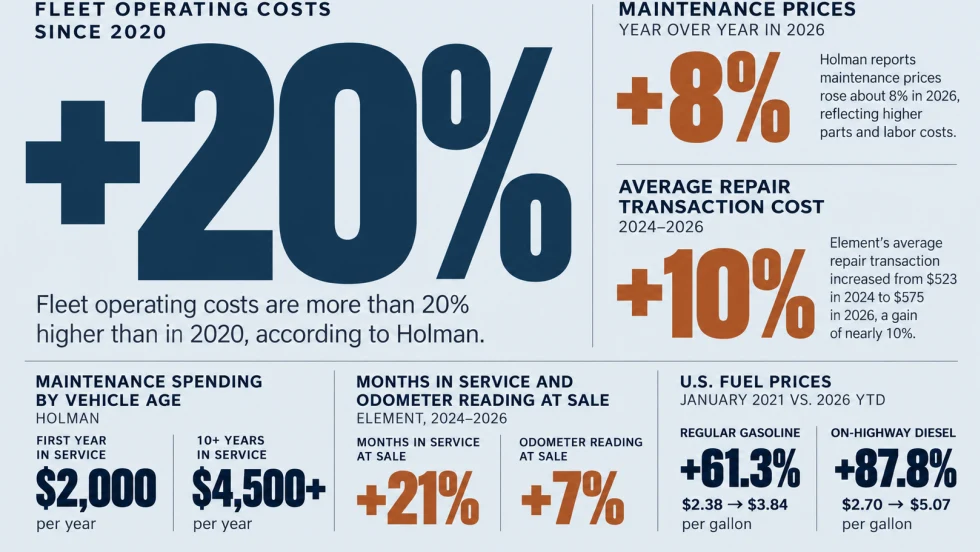
Managing Fleet Costs in an Era of Permanent Volatility
Fleet operating costs have risen more than 20% since 2020, raising a key question: When does extending a vehicle's service life stop making financial sense?
Read More →
The Next Evolution of Fleet Management: Autonomous Operations
This opening keynote session at the Fleet Forward Conference highlights the future of autonomous driving for fleets.
Read More →
How to Reduce the Total Cost of Risk From Catalytic Converter Theft
A stolen catalytic converter can cost fleets far more in downtime and lost productivity than in repairs. A total-cost-of-risk approach can help fleet managers quantify their exposure and prioritize theft prevention.
Read More →

Personal-Use Charges Rise as Vehicle Values Fall | AF News Recap
Personal-use charges are climbing, wholesale used-vehicle values are declining, and commercial fleet sales growth is slowing. This week, we're breaking down the latest fleet data, plus how Element Fleet Management is helping Waymo prepare for its first Canadian robotaxi market.
Read More →
Here's When You Should Make an Exception to Fleet Policy
Fleet policies are designed to create consistency, but not every driver or situation fits neatly within standard rules.
Read More →
AI-Native or AI-Acquired: What Should Fleet Managers Look for in an AI Platform?
Six questions can help fleet managers look beyond AI marketing claims to evaluate integration, data access, and real-world operational performance.
Read More →
A buyer's guide to fleet management software in 2027
Buying fleet management software in 2027 means looking beyond features and price. As fleet operations, technology and expectations evolve, this guide explores what today’s fleet professionals should consider when choosing a system that can deliver value now and adapt to what comes next.
Read More →
What Will Shape the Next Era of Fleet Management?
EVs, AI, and autonomous vehicles are reshaping fleet management. Discover what’s ahead—and how fleet leaders can prepare for the next era.
Read More →
How Fleets Can Recruit and Train Veterans for Technician Roles
Here's how the technician shortage has affected uptime for fleets, and what to do about it.
Read More →
Avis Budget Group Deploys Neology Toll Management Technology Across Major Brands
Neology’s neoFleet platform will manage toll transactions and toll-authority operations for vehicles across Avis, Budget, Payless, Budget Truck and Zipcar.
Read More →