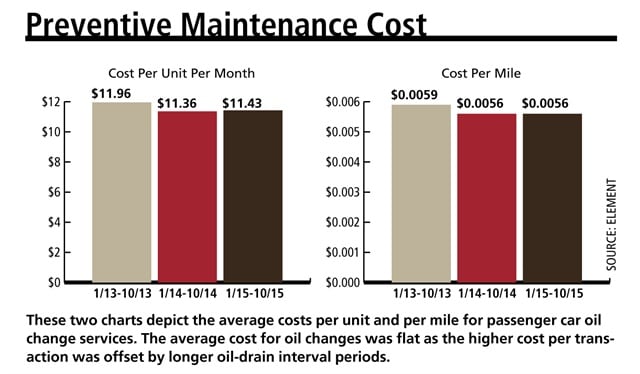
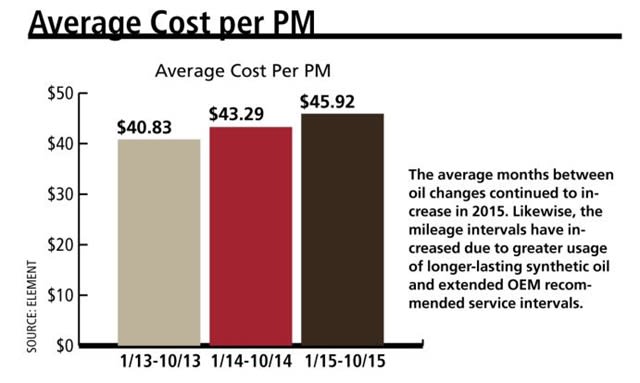
Fleet preventive maintenance (PM) expenses in calendar-year 2015 were flat compared to CY-2014, primarily due to extended oil-drain intervals.
Ad Loading...
In addition, improvements in engine design and onboard vehicle technology, along with improved oil quality, are allowing fleets to extend oil-drain intervals.
Ad Loading...
However, more stringent motor oil requirements by OEMs have put upward pressure on PM costs.
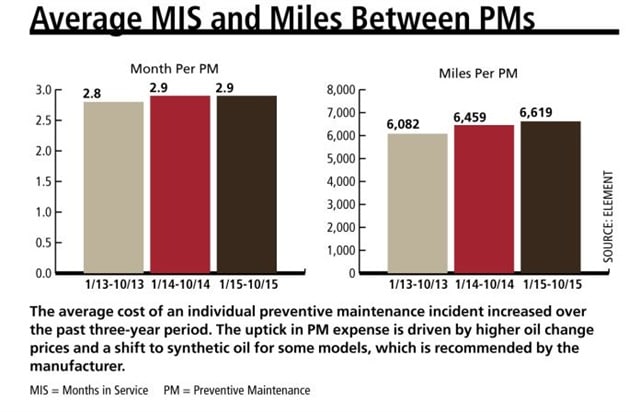
“Conventional motor oil usage has diminished in favor of synthetic oils, which have become required by some OEMs. Instances of a wide cost variation of oil changes between repair facilities has been reported. The good news is that PM expenses were flat over the past year; however, the average cost per PM has risen,” said Frank Stracke, case manager, managed maintenance for Element, a fleet management business.
At A Glance
Fleet preventive maintenance (PM) expenses in calendar-year 2015 were flat compared to CY-2014, primarily due to extended oil drain intervals.
Conventional motor oil usage has diminished in favor of synthetic oils, often required by OEMs for some models.
The proliferation of smaller displacement engines in fleet applications is putting pressure on fleet managers to use synthetic oil to maximize engine life.
While oil-drain intervals have increased, the proliferation of smaller displacement engines in many fleet applications is putting pressure on fleet managers to use synthetic oil to maximize engine life. The emergence of smaller vehicle engines with turbochargers sometimes require full-synthetic motor oil, which could increase oil change costs. Several national providers are offering “do not exceed or max pricing” on full-synthetic oil changes, which provides some level of stabilized pricing. This pricing ceiling cap provides expense assurances for fleets.
Contributing to the decrease in PM costs has been fleet adherence to OEMs’ scheduled preventive maintenance programs. This, along with improved vehicle quality, has positively impacted maintenance expenses in 2015 and promises to stabilize maintenance expenses in future years.
While there have been no significant changes in the OEMs’ recommended scheduled maintenance service intervals, improvements in engine design and onboard vehicle technology, along with improved oil quality, are allowing fleets to extend oil drain intervals. In addition, there continues to be enhancements to OEM oil-life monitoring systems, which enables extending oil-drain intervals and reduce driver downtime.
Ad Loading...
The onboard oil monitoring system of some models, which reflects actual driving patterns, often allows for longer oil change intervals.
Photo: Element
Onboard diagnostic displays are starting to change drivers’ behavior. “For example, the oil change indicator light, at first, caused alarm for some people who thought there was a problem with low oil instead of just indicating that it was time to change the oil,” said Jim Sassorossi, director, Mopar Fleet Service and Parts Operations for FCA US. “But, once the fleet driver understands its purpose, that indicator message is terrific for ensuring vehicles receive their recommended maintenance. Drivers do respond to it, very promptly usually.”
Similarly, the retail oil change industry is starting to change its mindset and is moving beyond its traditional advocacy of oil changes every 3,000 miles.
“Non-quick-lube providers are increasingly supporting OEM schedules instead of recommending traditional 3,000-mile intervals,” said Chad Christensen, strategic consultant for Element.
In prior years, there was much discussion about using recycled oil to lower PM costs. Other than some public sector fleets, this trend has failed to materialize.
Ad Loading...
“Passenger car and light-truck fleets have expressed minimal interest in recycled oils due to increased cost,” said Christensen.
One complication to fleet preventive maintenance in 2015 was the introduction of new oil filters by OEMs that are not readily available in the aftermarket.
“Newly introduced parts can be challenging for the repair process. One example was a new filter type that may not be readily available in the aftermarket. This carries risks as some shops may install an incorrect older model filter and cause subsequent damage,” said Stracke.
While extending oil-drain intervals has helped reduce PM costs, there are unintended consequences.
Photo: Element
Photo: Element
“We, along with the industry, continue to move toward synthetics and that’s resulting in oil-change intervals becoming longer. With that said, and with the importance of driver safety, we have to be cautious about going too far without having the vehicle inspected,” said Sassorossi. “We need to stress to fleet owners the importance of having brakes inspected and tires rotated. We’re already seeing tires that need to be rotated before the next oil change. So, the next frontier is properly educating drivers on the importance of those maintenance intervals.”
Ad Loading...
Other new technologies have been developed to improve customers’ automobile maintenance repair experiences, such as diagnostic equipment, remote diagnostics, dashboard alerts, dealer store repair strategies, and service department enhancements. In the case of diagnostic trouble codes (DTC), they are enhancing a dealership’s ability to improve the repair experience.
“Our wiADVISOR tool works seamlessly to diagnose DTCs. When the vehicle arrives in the service lane, we can connect to the vehicle immediately. The wiADVISOR enables us to see the DTCs on the vehicle and we can quickly identify whether it needs an onboard computer flash update, or if we need to get the proper information to the technician. The result is more uptime and the vehicle gets repaired correctly and it gets repaired faster. It’s done right the first time,” said Sassorossi.
FCA US has a network of more than 2,600 dealers in the U.S. (including FIAT and Alfa Romeo dealers) of which more than 1,000 are Mopar Express Lane dealers.
Editor's note: This article is part of a three-part package dealing with fleet maintenance costs in 2015. Read related articles covering maintenance costs and tire costs.
Rising operating costs, driver safety concerns, and unplanned downtime are putting unprecedented pressure on modern fleets. Discover how fleet managers use embedded OEM connectivity and real-time vehicle data to cut TCO, prevent downtime, and protect drivers without aftermarket telematics hardware.
Fleetio’s Brianna Perry demonstrates how Service Advisor evaluates maintenance requests, identifies pricing anomalies, and provides the context fleet managers need to focus their attention on potential problems.
Fleet compliance isn't just about having policies — it's about consistently enforcing them. This practical guide reveals six hidden compliance risks common in public sector and shared fleet operations and outlines proven strategies to improve visibility, accountability, and audit readiness
Vincentric’s three-year, 60,000-mile projections reveal wide differences for both scheduled and unscheduled maintenance among selected vehicle categories. Projected maintenance visits also play a factor.
Keeping fleet vehicles on the road has become as important as buying them. Darren Bradshaw of Mopar North America explains how connected vehicle data, AI, and proactive service strategies are helping Stellantis reduce downtime and move closer to predictive maintenance.
Merchants Fleet has expanded its relationship with Pep Boys, increasing the service provider's role within its national maintenance network. The move is intended to enhance maintenance coordination and support commercial fleets through Pep Boys' nationwide footprint.
Cesar Ayala of O’Connell Landscape Maintenance shares how he transitioned from the Marine Corps to managing a 460-vehicle fleet—and the real-world challenges of maintenance, compliance, and driver management in California.