Editors note: This article is part of a three-part package that addresses fleet maintenance costs in 2016. Read related articles covering oil service costs and tire costs.
Ad Loading...
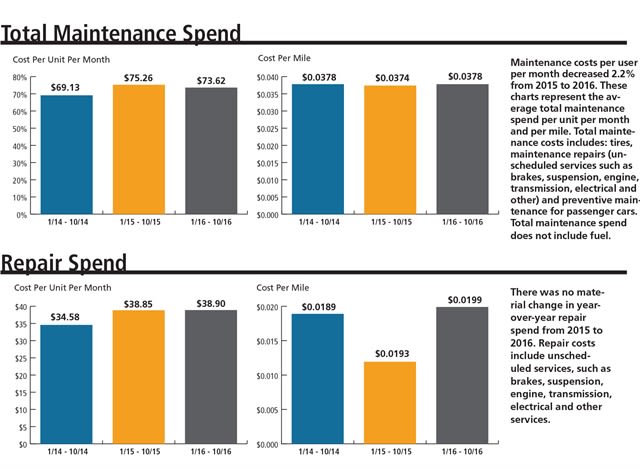
During calendar-year 2016, passenger car maintenance expenses, on average, declined 2.2% year over year compared to CY-2015.
Ad Loading...
“The decline in car maintenance expenses was primarily driven by a 7% reduction in replacement tire expenses,” said Steven Janke, a consultant in strategic consulting services for Element Fleet Management. “In 2015, many fleet owners purchased vehicles that used unique tire sizes which, unfortunately, were in limited supply. These tires have become increasingly available in 2016, reducing overall cost.”
Another factor exerting downward pressure on passenger car maintenance costs was lower rental fees for replacement vehicles while the company car was in the shop.
At A Glance
During calendar-year 2016, passenger car maintenance expenses, on average, declined 2.2% year over year compared to CY-2015.
OEMs’ move to synthetic or blended motor oils continues.
Periodic parts shortages continue.
With more technology embedded in vehicles, independent repair shops must make significant investments in diagnostic equipment to keep up with vehicle technology. Onboard diagnostic displays have changed driver behavior.
“A key reason for the decline in vehicle rental expenses was due to a highly competitive rental market, which continues to exert downward pressure on pricing,” said Bill Jones, director of product development for Element.
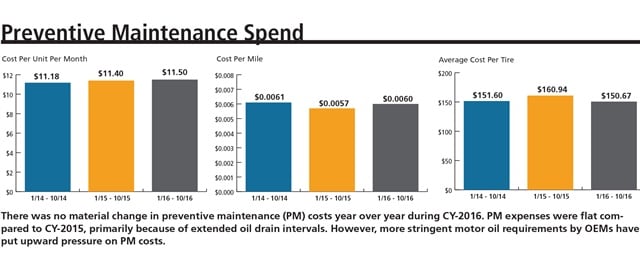
These declines, however, were partially offset by other increases in fleet maintenance costs, such as the ongoing shift by OEMs to mandate more expensive, but longer-lasting, synthetic motor oils.
“Changes in manufacturer requirements for oil specs are driving up the cost of preventive maintenance,” said Mark Lange, CAFM/technical services consultant for Element.“The frequency of oil changes may remain the same, but the cost of preventive maintenance is increasing due to changes in oil requirements.”
Ad Loading...
While longer drain intervals may decrease preventive maintenance (PM) costs, there is concern that drivers may become complacent and may not be as diligent in regularly checking motor oil levels. “This is more important than ever with extended service intervals,” added Lange.
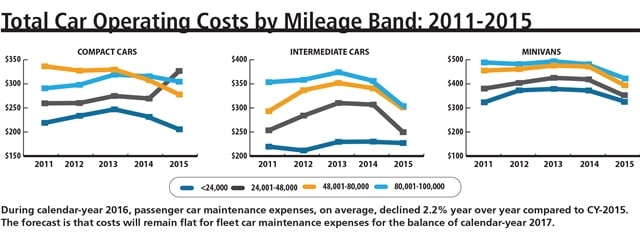
The forecast is that costs will remain flat for fleet car maintenance expenses for the balance of calendar-year 2017. “Barring unforeseen circumstances, we don’t anticipate major changes to maintenance expenses,” said Jones. “One thing to watch for is that the many technology innovations that could drive up certain repair expenses, such as specialty glass and infotainment systems, for example. At the same time, vehicles continue to become more reliable, driving costs down.”
These were some of the key findings of AF’s 22nd annual fleet passenger car maintenance survey conducted exclusively by Element Fleet Management. The study is based on actual maintenance expenses incurred by 33,818 passenger cars during calendar-year 2016.
Top Maintenance Trends
During the past 12 months, the top five trends impacting fleet car maintenance costs were:
Greater incident of rotor replacements: “Increasing brake rotor replacements: With greater use of lighter, smaller, non-vented rotors, we’re seeing an increase in brake rotor replacements when pads are replaced, versus simply resurfacing the rotors. It’s often cheaper to replace rotors over resurfacing,” said Jason Roberts, maintenance case manager for Element.
Ad Loading...
Data courtesy of Element Fleet Management.
Shops reducing stocks of conventional oil in favor of synthetics: “We expect this trend to continue in 2017,” said Lange. “Some shops no longer even stock ‘conventional’ oil.”
Periodic parts delays: “Certain OEM parts delays continue to impact vehicle downtime and associated rental costs, though this situation has improved in 2016,” said Robert Fedje, advisor, managed maintenance for Element.
While improved from 2016, certain OEM parts delays continue to impact vehicle downtime and associated rental costs. A good portion of these repairs with delayed parts deliveries occur during manufacturer’s warranty work.
“When this occurs, we recommend involving your fleet maintenance provider (either FMC, self-managed, or other) as soon as possible, so they can get in front of the situation and expedite the parts wherever possible,” said Lange.
Independent shops are investing more in diagnostic technology: “With more technology embedded in each vehicle, independent shops are making significant equipment investments in the ability to diagnose and repair using the data from in-vehicle technology,” said Lange.
Ad Loading...
Ongoing vehicle quality improvements: “Vehicle quality remains high, as evidenced by flat repair expense,” said David Germann, associate, managed maintenance for Element.
OEM Initiatives
There have been a number of vehicle enhancements by OEMs that have contributed to reduced fleet car expenses. Examples include onboard diagnostic displays that have changed driver’s behavior and the ability to remotely — and often proactively — access diagnostic trouble codes (DTC), enhancing the dealer’s ability to more quickly identify maintenance-related problems.
Data courtesy of Element Fleet Management.
“Each year, vehicles become more sophisticated in the aspect of signaling when something needs to be addressed,” said Jim Sassorossi, director, fleet service & parts operations for FCA. “When a vehicle is in for service, FCA US dealers use the latest diagnostic tools developed with our engineering teams. This allows dealers to determine exactly what needs to be addressed and service a vehicle correctly the first time, through Mopar tools such as wiTECH and wiADVISOR.”
One area that has added complexity to car maintenance has been the introduction of collision avoidance technology.
“As vehicles become more complex, so do all aspects of vehicle repair, including repairs in the collision realm. That’s why we recently introduced a new ‘Right to Request’ ad campaign informing customers they have the right to ask for Mopar O.E. parts for collision repair,” said Sassorossi.
Ad Loading...
The case for fleet customers requesting O.E. parts, according to Sassorossi, is even more critical with the complex technology and safety systems integrated into the manufacture of today’s vehicles.
“In areas such as corrosion resistance, material strength, appearance, and even packaging, O.E. Mopar collision parts provide factory performance and reliability that unknown aftermarket parts often lack,” added Sassorossi.
New Diagnostic Technology
OEMs have developed new maintenance-related technologies to improve fleet maintenance repair experiences, such as diagnostic equipment, remote diagnostics, dashboard alerts, dealer repair strategies, and service department enhancements.
“The FCA brand is in the midst of completing our rollout of wiTECH 2.0, the latest diagnostic equipment from Mopar, which interfaces with vehicles to perform diagnostics, reprogramming, and security functions,” said Sassorossi. “We also have our Mopar wiADVISOR tool, which is a tablet-based service write-up solution that enables service advisors to provide customers with an accurate, consistent, and transparent service experience. The solution provides a complementary vehicle health check, consisting of basic vehicle diagnostics, available vehicle software updates, recalls, and vehicle or mileage-specific factory-required maintenance.”
Mopar debuted wiADVISOR in 2012. “We currently have more than 50% of our dealer network leveraging this technology to enhance the customer experience,” added Sassorossi.
Ad Loading...
Data courtesy of Element Fleet Management.
Another major industry trend has been the expansion of express service lanes at dealerships. One example is FCA, which has express service lanes in close to 40% of its dealerships.
“We currently have a network of more than 2,600 FCA U.S. dealers across the country, with more than 1,000 operational Mopar Express Lane dealers and more than 1,000 dealers participating in the BusinessLink program,” said Sassorossi.
Rising operating costs, driver safety concerns, and unplanned downtime are putting unprecedented pressure on modern fleets. Discover how fleet managers use embedded OEM connectivity and real-time vehicle data to cut TCO, prevent downtime, and protect drivers without aftermarket telematics hardware.
Fleetio’s Brianna Perry demonstrates how Service Advisor evaluates maintenance requests, identifies pricing anomalies, and provides the context fleet managers need to focus their attention on potential problems.
Fleet compliance isn't just about having policies — it's about consistently enforcing them. This practical guide reveals six hidden compliance risks common in public sector and shared fleet operations and outlines proven strategies to improve visibility, accountability, and audit readiness
Vincentric’s three-year, 60,000-mile projections reveal wide differences for both scheduled and unscheduled maintenance among selected vehicle categories. Projected maintenance visits also play a factor.
Keeping fleet vehicles on the road has become as important as buying them. Darren Bradshaw of Mopar North America explains how connected vehicle data, AI, and proactive service strategies are helping Stellantis reduce downtime and move closer to predictive maintenance.
Merchants Fleet has expanded its relationship with Pep Boys, increasing the service provider's role within its national maintenance network. The move is intended to enhance maintenance coordination and support commercial fleets through Pep Boys' nationwide footprint.
Cesar Ayala of O’Connell Landscape Maintenance shares how he transitioned from the Marine Corps to managing a 460-vehicle fleet—and the real-world challenges of maintenance, compliance, and driver management in California.