




Fleet Executive Helps Streamline Uniform and Career Apparel Fleet
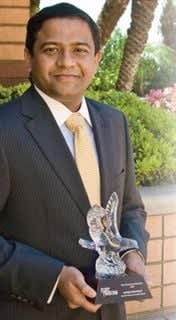
Satish Natarajan, senior director of Fleet Operations for ARAMARK Uniform and Career Apparel, is Fleet Financials’ 2009 Fleet Executive of the Year. Natarajan’s leadership helped his company better leverage people, processes, and technology.

Satish Natarajan, senior director of Fleet Operations for ARAMARK Uniform and Career Apparel (AUCA), was awarded the Fleet Financials 2009 Fleet Executive of the Year Award. Five outstanding fleet executives vied for this year’s award, presented at the NAFA Institute & Expo April 26 in New Orleans.
Sponsored by CEI, the award recognizes exceptional senior executive leadership in contributing significantly to fleet vehicle management. A panel of five industry judges evaluated candidates according to such criteria as cost-saving initiatives, policy setting, innovative programs, and cultivation of fleet manager training and management.
Investing in People, Processes & Technology
Natarajan, who holds a master’s degree in industrial engineering, began his tenure at ARAMARK as an intern in 2000. Following a stint as a management consultant, he rejoined ARAMARK in 2002, managing process improvement measures and organizational management initiatives. He joined the company’s fleet team in 2005, beginning a restructuring initiative in 2006.
The initiative’s goal was to move from a maintenance mindset to a people, processes, and technology (PPT) focus to streamline operations, enhance process consistency across the organization, and improve fleet cost efficiencies.
Natarajan spearheaded the fleet department’s reorganization efforts, which led to:
■ Organizational training and knowledge-sharing.
■ Operations streamlined through measuring, managing, and benchmarking to industry best practices.
■ Right-sized vehicle capacity.
■ A fleet management system, diagnostic and compliance tools, and a telematics pilot.
“My goal was to simplify, standardize, and automate,” Natarajan said. “We determined how to streamline and began to roll out the best processes and leverage technology.”
He realized it was vital to put systems in place so fleet would continue to automate and sustain standard processes.
[PAGEBREAK]
Sharing His Formula for Organizational Success
Natarajan doesn’t view his position as a fleet job per se, but rather as a task of leadership.
His current focus centers on general leadership, and he is surrounded with subject matter specialists who complement one another. Natarajan sees the big picture by remaining proactive and not always making the “obvious” move.
His leadership, supported by a diverse background and experience, helped AUCA’s fleet dramatically reduce operational costs. With experience in industrial systems engineering, manufacturing, consulting, and process-improvement work, he brought different perspectives to a fleet team lacking direction, and he continues to lead by looking at the big picture.
“Knowing my corporate culture and business, as well as surrounding myself with people who have fleet-specific skills, allows me to be successful,” he said. “We have a wonderful fleet team.”
Natarajan supervises a staff of fleet managers, analysts, and technicians who oversee the AUCA fleet procurement, maintenance, disposal, project management, and compliance. His team includes subject matter experts with more than 30 years experience, as well as project managers and analysts who help bridge the gap. Utilizing this experience and leveraging AUCA’s systems and culture allow the company to move at a steady pace toward ultimate operations efficiency.
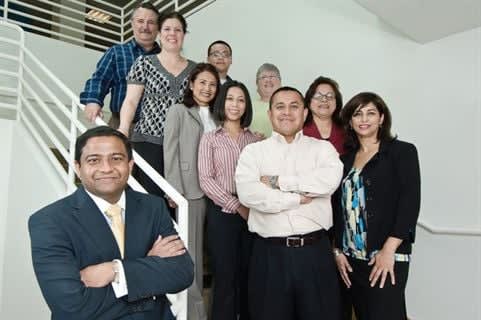
Natarajan also stressed the importance of continuous learning from peers and benchmarking policies and processes.
“I need to know what other best-in-class companies are doing and if those things are applicable to our fleet,” he said, “and how we can better leverage technology in our diversified operating environment.”
Natarajan knows he and the company don’t have all the answers, but they remain educated about all possibilities.
Size is another advantage the AUCA fleet enjoys, with more than 6,000 vehicles.
“The size and scope of our fleet allows us to create partnerships that give us a competitive advantage,” he said. “For instance, truck vendor partners allow us to test and prototype new product offerings, giving them and us an advantage.”
Natarajan collaborates regularly with senior management on AUCA’s fleet strategy and benchmarking, frequently reviewing the “what” and “why.” It’s up to Natarajan to handle the “how.”
[PAGEBREAK]
ARAMARK Culture Focuses on Customer Service
ARAMARK provides award-winning food services, facilities management, and uniform and career apparel to healthcare institutions, universities, school districts, stadiums and arenas, and businesses around the world. The company’s success stems from its mission to focus on customer service. Headquartered in Philadelphia, ARAMARK has approximately 260,000 employees serving clients in 22 countries.
“We operate in a very competitive environment,” said Natarajan of AUCA’s Burbank, Calif.-headquartered operation. “Our main objective in fleet is to provide adequate capacity at a very competitive and effective cost to field operations.”
Through its fleet, AUCA provides uniform rental and leasing services to more than 200,000 customer accounts nationwide from more than 200 service locations and distribution centers across the U.S. AUCA’s full-service employee uniform solution includes design, sourcing and manufacturing, customization, cleaning, maintenance, and delivery.
The organization’s fleet operations include four areas: field operations, support staff, compliance, and analysts & project management. The groups partner to handle everything from procurement and fleet maintenance to fleet policy and compliance. The division relies on 36 in-house garages and more than 95 fleet managers and mechanics.
Reorganization Allows Many Process Improvements
During the realignment, the fleet strategy to invest in PPT offered an opportunity to right-size the fleet while providing fleet capacity for growth. Fleet also focused on keeping as many programs in-house as possible to consolidate, centralize, and simplify its efforts.
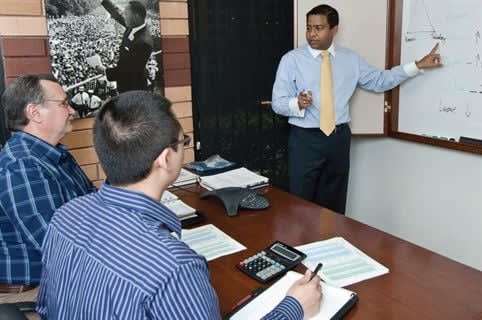
“Our process philosophy was to make our operations repeatable, reliable, and scalable,” Natarajan said. “Over the past several months, we have embarked on several initiatives aimed at standardizing and improving our internal business processes, and we have made significant progress toward this goal.”
Employing a maintenance management tool that tracks work orders, parts inventory, and vehicle maintenance improved department processes, helping it move closer to the goal of standardization.
Natarajan developed a “Competency Model” to enhance the fleet department’s “bench strength.” Goals included defining skill-set requirements for entry-level to skilled head technicians; categorizing the team of 80-plus fleet personnel into various levels based on interviews and skills assessment; and developing a training program to help workforce advance through a combination of OEM/upfitter/parts and vendor training programs.
Natarajan and his team’s fleet achievements include:
■ Implementing standardized diagnostic tools in all U.S. AUCA shops.
■ Centralizing the truck procurement process.
■ Designing a Web-based asset management tool.
■ Employing a maintenance management tool to track work orders, parts inventory, and vehicle maintenance.
■ Moving to a single, nationwide fuel vendor to keep processes more fluid.
■ Developing a green fleet strategy that includes CNG vehicles and hybrid trucks.
■ Setting continuous benchmarking standards.
■ Incorporating ongoing learning and training development tools for fleet managers.
[PAGEBREAK]
One critical move made by Natarajan’s team was simplifying and standardizing the vendor process.
“By cutting down on vendors, such as our fuel and maintenance providers, we gained more control and greater line of sight in our fleet,” Natarajan said. “It was very important to simplify a complicated network such as ours.”
Another primary goal was to optimize the AUCA fleet size and age by streamlining to a flat procurement cycle, negotiating with vendors to leverage the company’s volume, and centralizing the procurement process.
“Now, measurement and management allow us to operate a more efficient fleet,” Natarajan said. “Regularly looking at projects from both a strategic and tactical perspective is critical to our efforts.”
AUCA Moves Toward a Green Fleet
An ongoing initiative within AUCA’s fleet is a move toward alternative-fuel vehicles to become greener and better track and manage fuel costs.
“We are aggressively pursuing a move to a greener fleet,” said Natarajan. “We recently conducted an elaborate carbon footprint study and are now evaluating hybrids for our fleet.”
Natarajan plans to put some CNG trucks on the road and evaluate their effectiveness.
ARAMARK is also looking to partner with the Environmental Protection Agency’s SmartWay program. According to Natarajan, this step will allow the company to be socially responsible and reduce its carbon footprint, as well as find ways to produce operational efficiencies by reducing fuel costs, reducing operational cost per mile, and keeping vehicles in service longer.
In managing and tracking fuel use, accessing information on gallons of fuel consumed had been a complicated process of working with multiple vendors. Natarajan rolled out a single, consolidated fuel program through one vendor and converted to online invoicing and centralized controls.
“Now we can project gallons by type of fuel for a particular location, and to use for business planning purposes,” he said.
Other initiatives to help manage fuel costs include:
■ Incorporating design changes to AUCA trucks, including reducing door weight and streamlining windshield angles by studying best-in-class examples.
■ Implementing an idle-control and shut-down system.
■ Starting a telematics pilot to help improve fuel management and safety.
■ Working with upfitters and OEMs to encourage use of composite materials to reduce vehicle weight.
[PAGEBREAK]
Natarajan Plans to Continue Leveraging Key Areas
To succeed in the current economic climate requires doing more with less, and Natarajan again stresses the importance of four initiatives: cost reduction and process improvement, sustainment activities, training and development, and pilot initiatives.
“We always have cost reduction and process improvement efforts ongoing,” he said. “And we’ll continue building out our maintenance program in all garages, focusing on technology and finding ways to allow our team to be more productive. All of these things help us manage costs, stay green, and be efficient.”
To date, AUCA’s fleet reorganization has made significant progress. Natarajan credits his team and company senior management with successes already achieved.
“Much of what we’ve accomplished has been because of the support of the senior leadership team,” he said. “To scale up was important, and to do that, we needed to deploy the right assets, technology, and skill sets,” he said.
Although the AUCA fleet has come a long way in its efforts to reinvent its fleet program, it still has a way to go.
“Our quest for excellence is always ongoing,” Natarajan said. “While we’ve come a long way, we’re not yet done reinventing and transforming our fleet. As a result of our fleet team’s hard work, we are well on our way to becoming a more efficient fleet organization.”
Natarajan said he is grateful to an organization that helped him make the non-obvious move more than three years ago.
“ARAMARK has given me a lot of opportunities, and I’m extremely grateful to the company,” he said. “ARAMARK is people-centric, leadership is supportive of our efforts, and the company provides us with all the opportunities to use our skills, knowledge, and talents to succeed.”
2009 Fleet Executive of the Year Nominees
Gary Anton
VP, Strategic Sourcing
Illinois Tool Works, Inc.
Anton assisted ITW in realizing a cost
savings of more than $4 million in 2008,
including $1.25 million in operating cost savings and $500,000 in accident management program savings.
Mark Hardwick
SVP & Managing Director, N.A.
P&H Mining, a division of Joy Global
Hardwick directed the establishment and implementation of a much-needed, well-defined fleet policy and procedure manual with key performance indicators. He also has trimmed approximately $13 million in fleet costs
since 2000.
Todd Nicholson
Director of Strategic Sourcing & Supply
Burlington Northern Santa Fe (BNSF)
Railway Co.
Nicholson planned and implemented strategic initiatives that saved BNSF an estimated $4 million in 2008 and streamlined many fleet processes, efforts that included instituting an automated vehicle request and
ordering process.
Tom Vining
VP, Field Operations
Otis Elevator
Vining instituted a vehicle downsizing and reallocation program that better matched fleet field mechanics to fleet vehicles and created a cost savings of more than $1.2 million in the first year, with additional expected annual operating cost savings of $200,000.
More Operations

How 2026 Fleet Visionary Jamie McKay Manages 2,400 Vehicles Across 37 States
How do you keep 2,400 vehicles running across 37 states? Fleet Visionary Award winner Jamie McKay shares how collaboration, flexibility, and a few simple strategies help her tackle fleet management challenges at Aptive Pest Control.
Read More →
Managing Fleet Costs in an Era of Permanent Volatility
Fleet operating costs have risen more than 20% since 2020, raising a key question: When does extending a vehicle's service life stop making financial sense?
Read More →
The Next Evolution of Fleet Management: Autonomous Operations
This opening keynote session at the Fleet Forward Conference highlights the future of autonomous driving for fleets.
Read More →

How to Reduce the Total Cost of Risk From Catalytic Converter Theft
A stolen catalytic converter can cost fleets far more in downtime and lost productivity than in repairs. A total-cost-of-risk approach can help fleet managers quantify their exposure and prioritize theft prevention.
Read More →
Personal-Use Charges Rise as Vehicle Values Fall | AF News Recap
Personal-use charges are climbing, wholesale used-vehicle values are declining, and commercial fleet sales growth is slowing. This week, we're breaking down the latest fleet data, plus how Element Fleet Management is helping Waymo prepare for its first Canadian robotaxi market.
Read More →
Here's When You Should Make an Exception to Fleet Policy
Fleet policies are designed to create consistency, but not every driver or situation fits neatly within standard rules.
Read More →
AI-Native or AI-Acquired: What Should Fleet Managers Look for in an AI Platform?
Six questions can help fleet managers look beyond AI marketing claims to evaluate integration, data access, and real-world operational performance.
Read More →
A buyer's guide to fleet management software in 2027
Buying fleet management software in 2027 means looking beyond features and price. As fleet operations, technology and expectations evolve, this guide explores what today’s fleet professionals should consider when choosing a system that can deliver value now and adapt to what comes next.
Read More →
What Will Shape the Next Era of Fleet Management?
EVs, AI, and autonomous vehicles are reshaping fleet management. Discover what’s ahead—and how fleet leaders can prepare for the next era.
Read More →
How Fleets Can Recruit and Train Veterans for Technician Roles
Here's how the technician shortage has affected uptime for fleets, and what to do about it.
Read More →