




Escort Leads the Way As Ford Enters World Car Market
Mid-size Granada is totally redesigned for '81.
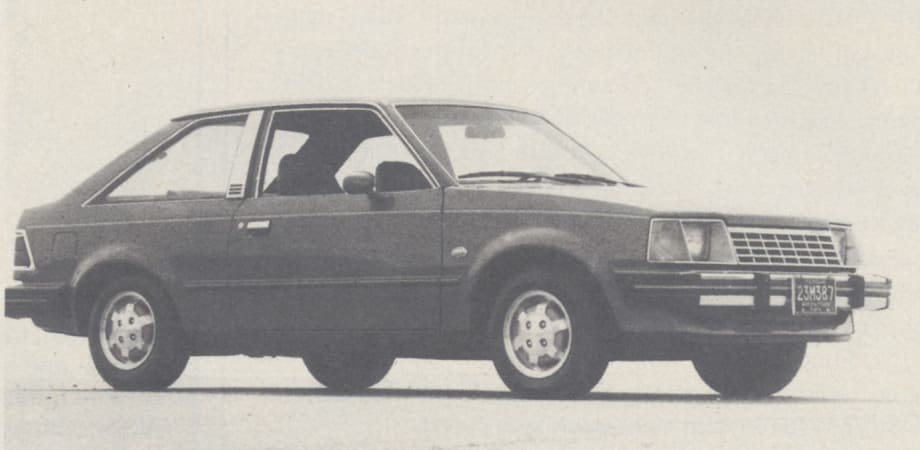
Escort is offered in a three-door hatchback (pictured) and four-door liftgate.
The Escort, Ford's first domestically produced front-wheel drive car, and the restyled Granada top the list of changes for the country's number two automaker in 1981.
The star of the 1981 line is the Escort, which promises to be as fuel efficient as it is technologically advanced. Called a "world car" by the company, it is essentially the same car that will be produced in other parts of the globe, although Ford says that 95 percent of the components for the U.S. version are sourced in this country.
Escort is offered in a three-door hatchback (pictured) and four-door liftgate.
Standing on a 94.2-inch wheelbase, the replacement for the Pinto in the Ford line will be offered in two body configurations - a three-door hatchback and a four-door "liftgate" which is essentially a station wagon. Overall length of the hatchback is 163.9 inches while the liftgate is slightly longer at 165 inches overall. Cargo volume in the hatchback with the rear seat folded down is 31 cubic feet and the liftgate, also with the rear seat down, is almost double at 61 cubic feet. Both vehicles are equipped with 10 gallon fuel tanks.
Standard equipment includes vinyl high-back front bucket seats, four-speed manual transaxle and floor-mounted gearshift lever, AM radio (subject to delete option), rack-and-pinion steering, front disc/rear drum brakes, maintenance-free 36 month battery, steel-belted radial tires, folding rear seat and load floor mat on both hatchback and liftgate models.
The Escort will be offered in five levels of trim - base, "L," "GL," "GLX," and "SS." Also offered is a "Squire Wagon" option for the liftgate.
The various trim levels incorporate some of the following optional equipment that is offered on the Escort: 1.6 liter four-cylinder engine, a three-speed automatic transaxle, air conditioning, heavy-duty battery, power brakes, electronic digital clock, console with graphic warning display module, rear window defroster, extended range fuel tank, luggage rack, tinted glass, a selection of AM/FM radios including stereo and tape decks, speed control, special suspension package, reclining front bucket seats, engine block heater, power steering, rear window wiper/washer wheel trim rings and pop-up sunroof.
The Escort features a fully-independent suspension which when combined with the front-wheel drive layout, provides for maximum interior volume. The front-wheel drive layout eliminates the hump in the passenger compartment that houses the transmission and driveline of a traditional rear-wheel drive car. The rear independent suspension eliminates a solid rear axle and permits a deeper load floor for more luggage room. Seats can also be repositioned closer to the rear for more leg room and for ease of entry and exit.
The Granada has been totally redesigned for 1981 using mechanicals from the Fairmont line and new sheet metal to give the Ford mid-size entry a contemporary look.
Offered in two- and four-door sedans, the Granada stands on a 105.5-inch wheelbase and has an overall length of 196.5 inches. Trunk capacity is 16.8 cubic feet and the fuel tank holds 16 gallons. Base engine on the Granada is a 2.3 liter four-cylinder powerplant coupled to a four-speed manual transmission. A 3.3 liter in-line six-cylinder engine and a 4.2 liter V8 are optional as is a three-speed automatic transmission.
Three levels of trim are offered on the Granada starting with the "L" level and moving up to the "GL" and "GLX" higher trim levels. The Granada is equipped with rack-and-pinion steering, AM radio, dual halogen head-lamps a microprocessor control unit to control the fuel/air mixture on all 2.3 liter-equipped cars, non-reclining front bucket seats and fronts disc/rear drum brakes.
Options include air conditioning, power door locks, console with graphic warning display, premium sound systems, vinyl roof, speed control, power windows, an intermittent windshield wiper feature, a full line of radio and tape players, TR-type low profile tires, wheels and handling components, flip-up sunroof, tilt steering, electric clock and body side moldings.
Overall, the Granada two- and four-door models are shorter and have smaller wheelbases and a narrower front tread than 1980 models, however, interior room on the 1981 is larger with six passenger seating and more hip room, shoulder room and leg room than its predecessor.
Returning to the line with few styling changes, but several engineering improvements are the LTD, Thunderbird Fairmont and Mustang. The LTD has received several changes that will improve the full-size model's fuel economy as well as upgrade the level of luxury.
To improve fuel economy, the 4.2 liter V8 with AOD will be standard on LTD wagons. New options include a right-hand remote-control mirror and puncture-resistant self-sealing tires. LTD will continue to be available in four series, LTD S (fleet only), LTD, LTD Crown Victoria and LTD Country Squire.
The fleet version LTD S is available in a four-door sedan or four-door wagon only. The LTD is equipped with a full bench seat with knit cloth-and-vinyl seat trim and adjustable head restraints. Trunk capacity on the LTS S with a mini-spare tire is 22.4 cubic feet. The LTD S is equipped with AM radio, 60-amp alternator and a 36-amp/hour maintenance free battery.
All LTD models stand on a 114.3-inch wheelbase and have a fuel tank capacity of 20 gallons.
For 1981, Thunderbird will return with a smaller engine as standard equipment. A 3.3 liter in-line six replaces the 4.2 liter V8 as standard equipment on the series while the AOD transmission will be offered with the 4.2 and 5.0 liter V8 engine options. Inside, there is a new designated seating plan with rear-seat center divider and front-seat fixed armrest or center coin tray making the Thunderbird a four-passenger vehicle. A three-speed automatic transmission is standard on all models.
Thunderbird stands on a 108.4-inch wheelbase and is 200.4 inches in overall length. Luggage capacity on the base Thunderbird and Town Landau is 17.7 cubic feet while on the special Heritage package it is 16.3 cubic feet due to luxury luggage compartment trim. Fuel capacity is 18 gallons.
Fairmont, beginning its third year, retains the basic appearance and underskin engineering features that have made it one of the most popular cars in the division. Fairmont is available in two series - Fairmont and Fairmont Futura. Fairmont is available in two- and four-door sedans and four-door wagon. Futura is available as a two-door coupe, a four-door sedan and for the first time, a four-door wagon.
New standard features include power front disc/rear drum brakes, deluxe sound insulation package and a dual-note horn.
The Fairmont powertrain lineup has been changed with the deletion of the 2.3 liter turbocharged engine and the four-speed manual gearbox on the 3.3 liter six. A 2.3 liter four-cylinder engine is standard and is coupled to a four-speed manual transmission. A three-speed automatic transmission is optional. The automatic transmission is required with the optional 3.3 six or 4.2 liter V8.
All Fairmonts stand on a 105.5-inch wheelbase and trunk capacity is 16.8 cubic feet on sedans and 16.1 on coupes. Cargo area on the wagon models is 70.5 cubic feet with the rear seat folded down. Fairmonts ordered with the 2.3 liter engine are equipped with 14.7 gallon fuel tanks, while Fairmonts with larger engines have 16 gallon tanks. Wagon models have a 14 gallon capacity.
With turbocharged engines deleted from the Fairmont line, Mustang returns with a turbo option on its 2.3 liter powerplant. A normally aspirated version of the engine is standard equipment. Also available are the 3.3 liter six and the 4.2 liter V8. A T-hatch roof option will be offered for the first time on Mustang. Mustang is available in a two-door notchback or three-door hatchback body style. Four transmissions are offered including a four-speed manual, four-speed manual overdrive and three-speed automatic.
The Mustang stands on a 100.4 inch wheelbase and is 179.1 inches overall. The notchback has luggage capacity of 10 cubic feet while the hatchback has a load space of 32.7 cubic feet with the rear seat down. The fuel tank holds 12.5 gallons.
More Operations

How to Manage Conflict for Your Fleet Operations
Conflict management is becoming a core leadership skill. Here are five strategies fleet leaders should know.
Read More →
Turning Connected Vehicle Data Into Decisions That Matter
Fleet leaders have more data than ever, but turning that data into clear, actionable decisions remains a challenge. This white paper shows how leading organizations are using connected vehicle data to improve safety, reduce costs, and optimize fleet performance. Learn how to turn insight into action across your fleet.
Read More →
Cameras, Safety and Insurance: From Reactive Claims to Real-time Prevention
Commercial auto remains one of the most challenging and costly lines of coverage for fleet operators and insurers alike. Learn more about how to effectively address these issues from Onur Aksan, Enterprise Business Development Executive, Geotab.
Read More →

Are You Tracking Your Fleet's True Total Cost of Ownership?
Bobit Business Media surveyed 190 fleet professionals and found that while most fleets are tracking costs, fragmented systems and data gaps are keeping true TCO visibility out of reach. With rising pressure to control spend in an increasingly volatile environment, the gap between what fleets think they know and what the data actually shows is wider than you might expect. See how your peers are managing costs today and where the industry still has room to improve.
Read More →
Turn Fleet Data Into Smarter Decisions
Fleet leaders have access to more operational data than ever, but disconnected systems and unclear metrics often slow decision-making instead of improving it. This article outlines five practical steps fleets can take to transform fragmented data into actionable insights that improve planning, safety, utilization, and long-term performance.
Read More →
Hybrids: Electrification Without the Challenges
For fleet managers, fuel is one of the biggest line items in the budget — and it's one hybrids can shrink without changing how your people work. Download the eBook to see the numbers, understand the technology, and get a step-by-step guide to making the switch.
Read More →
How NOV Uses Telematics to Improve Fleet Safety Across 160 Locations
James Victory of NOV discusses how the company manages fleet safety, maintenance, and telematics across more than 150 locations supporting oilfield operations throughout the U.S.
Read More →
Fleet Meets: Steven Santostasi
This edition of the Fleet Meets series features Steven Santostasi, the current TSP channel manager for Ford Pro.
Read More →
Why Fleet Managers Are Replacing Departmental Vehicles with Shared Motor Pools
Departmentally assigned vehicles often create hidden costs through underutilization, poor visibility, and increased administrative burden. This white paper explores how shared motor pool strategies help fleets reduce costs, improve accountability, and optimize vehicle utilization.
Read More →
Soap Box Derby Challenge: Assembling the Crew
Meet Gabriel, Matthew, and Angel — the team helping bring this soap box derby build to life.
Read More →