




Editor's Page
The classic of interference in a successful enterprise must be the obstacles thrown between Elizabeth Barrett and her lover, Robert Browning, by Elizabeth’s father. The long distance romance never did fare well, but it did stimulate Elizabeth to write the beautiful lines: “How do I love thee? Let me count the ways:” The parallel here is in the interference from government by obstacles which frustrate and attempt to thwart this industry’s operation in a “free enterprise” society. For a nation whi
The classic of interference in a successful enterprise must be the obstacles thrown between Elizabeth Barrett and her lover, Robert Browning, by Elizabeth’s father. The long distance romance never did fare well, but it did stimulate Elizabeth to write the beautiful lines: “How do I love thee? Let me count the ways:” The parallel here is in the interference from government by obstacles which frustrate and attempt to thwart this industry’s operation in a “free enterprise” society. For a nation which is the most prosperous country on earth, we certainly do have a lot of elected leaders who, in our “automotive economy,” try every devious way imaginable to throw obstacles in the way of industry progress.
Here are some examples of obstacles which have hindered our industry recently:
1. Most outrageous was the uproar in Congress at the new car price announcements. This was scandalous behavior toward an important industry in our national economy, particularly in light of the fact that the increases were on a Federal edict for a so-called safety group of accessories. And more particularly because the real offender in not holding the line is not those who would make an honest and fair profit, it is the Federal Government, playing the roll of the “squeaking wheel” in sounding off the loudest at an inflationary situation caused by price increases resulting from soft money created by the “Eat, drink and be merry” attitude of the deficit spenders: borrowed money that costs the taxpayers over eleven billion dollars annually in interest alone, or one dollar in every eight from taxes. (One dollar in every three goes to government’s payroll.) So the threat of a Congressional investigation because the price of a $3,000 product goes up 30 or 40 bucks, just doesn’t ring true. One might think higher prices are certainly in keeping with current Federal thinking, or lack thereof. Never mind the tax increases to finance the orgy into debt. Stop inflation by cutting profits. Some attitude from those in a position of trust to preserve our free enterprise system and our Republic!
2. Safety package was what Congress said about the new accessories, “Arm twisting” made it compulsory for the purchaser to shell out for these additional expenses in the name of “safety.” Yet money is being diverted from funds earmarked to maintain safe highways, to non-highway use with no concern for safety.
3. Somebody said it was all those cars in Los Angeles that made smog. This makes it a fact as far as the federal people are concerned. Now we are all to pay from $30 to $50 more for cars of the future so that we can have a device to eliminate this contaminate which has never been proven to be the primary cause of the irritants in Hollywood’s Bowl. There are even those people, scientists by profession, that feel that during combustion is not the best time to eliminate the potential cause.
4. The Highway Beautification act offers such a potential “pork barrel” situation it staggers the imagination. More deficit spending to pay for being elected. (Or haven’t you noticed the southerly migration of Federal projects lately?)
5. Tire standards are the latest regulatory concern of Congress. Harry C. McCreary, chairman of McCreary Tire & Rubber has a point when he seeks a Federal standard rather than 50 different state laws. Others feel it is best for the industry to police itself. In any event, the Federal Government is flirting with taking over safety activities of the states in areas other than tires. Twenty Senators and eighteen Congressmen have proposed traffic legislation which would necessitate a one per cent tax on car prices to pay for the program.
6. Most recent addition to the obstacle course our industry runs was the removal of the six and a half per cent duty on cars, and the eight and a half per cent duty on parts imported from Canada. ASIA President Allan L. Levine said: “It will export U.S. jobs to Canada and will result in the loss of jobs and contracts in our industry and will eventually increase the price of replacement parts to the U.S. customer.” The UAW of Canada reportedly will “do our utmost to influence Canadian public opinion against the tariff reduction.” Neither side seems happy, and apparently the U.S. taxpayer will again get an increase in costs and probably in taxes to make up for the lost revenue.
“How do I thwart thee? Let me count the ways:” No thanks—you might find one you missed!
More Operations
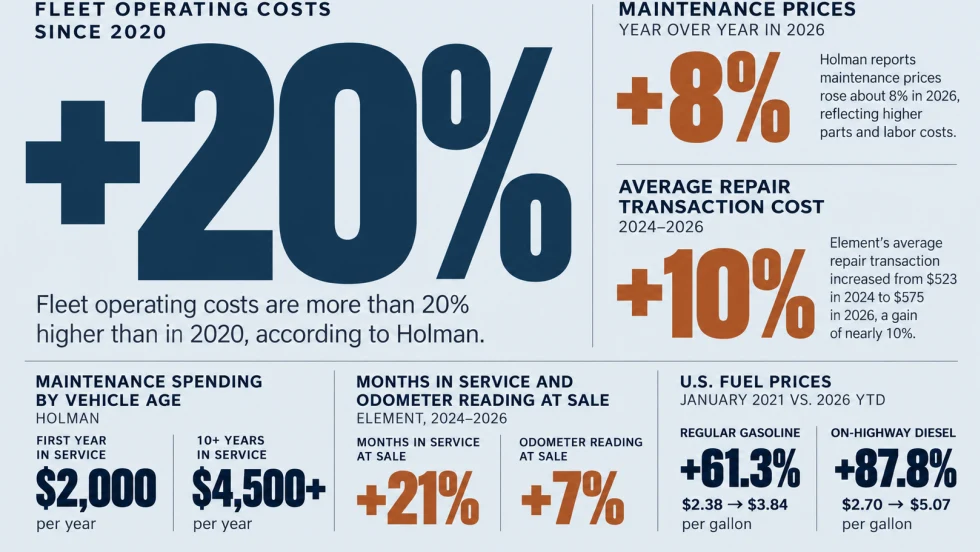
Managing Fleet Costs in an Era of Permanent Volatility
Fleet operating costs have risen more than 20% since 2020, raising a key question: When does extending a vehicle's service life stop making financial sense?
Read More →
The Next Evolution of Fleet Management: Autonomous Operations
This opening keynote session at the Fleet Forward Conference highlights the future of autonomous driving for fleets.
Read More →
How to Reduce the Total Cost of Risk From Catalytic Converter Theft
A stolen catalytic converter can cost fleets far more in downtime and lost productivity than in repairs. A total-cost-of-risk approach can help fleet managers quantify their exposure and prioritize theft prevention.
Read More →

Personal-Use Charges Rise as Vehicle Values Fall | AF News Recap
Personal-use charges are climbing, wholesale used-vehicle values are declining, and commercial fleet sales growth is slowing. This week, we're breaking down the latest fleet data, plus how Element Fleet Management is helping Waymo prepare for its first Canadian robotaxi market.
Read More →
Here's When You Should Make an Exception to Fleet Policy
Fleet policies are designed to create consistency, but not every driver or situation fits neatly within standard rules.
Read More →
AI-Native or AI-Acquired: What Should Fleet Managers Look for in an AI Platform?
Six questions can help fleet managers look beyond AI marketing claims to evaluate integration, data access, and real-world operational performance.
Read More →
A buyer's guide to fleet management software in 2027
Buying fleet management software in 2027 means looking beyond features and price. As fleet operations, technology and expectations evolve, this guide explores what today’s fleet professionals should consider when choosing a system that can deliver value now and adapt to what comes next.
Read More →
What Will Shape the Next Era of Fleet Management?
EVs, AI, and autonomous vehicles are reshaping fleet management. Discover what’s ahead—and how fleet leaders can prepare for the next era.
Read More →
How Fleets Can Recruit and Train Veterans for Technician Roles
Here's how the technician shortage has affected uptime for fleets, and what to do about it.
Read More →
Avis Budget Group Deploys Neology Toll Management Technology Across Major Brands
Neology’s neoFleet platform will manage toll transactions and toll-authority operations for vehicles across Avis, Budget, Payless, Budget Truck and Zipcar.
Read More →