




Ed Bobit's Publishers Page
I can only share with you that it is very possible history may mark the 1990 NADA Convention as a turning point in the manner that fleets purchase their vehicles.

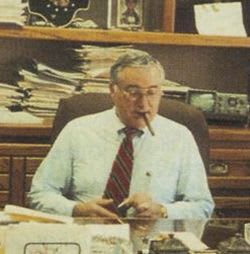
Ed Bobit at his desk, 1990
Because of their overcapacity problems, some of them (imports) are making fleet deals the domestic manufacturers wouldn't touch with a 10-foot pole.-Ben Bid well, chairman. Chrysler Motors (January. 1900)
Rumor has it that the domestic manufacturers have privately acknowledged that they would like to get out of this (rental buy back programs) least profitable end of the business.-Ed Mullane, president. Ford Dealers Alliance
Having just returned from the National Automobile Dealers Association (NADA) convention in Las Vegas, I can only share with you that it is very possible history may mark this event as a turning point in the manner that fleets purchase their vehicles.
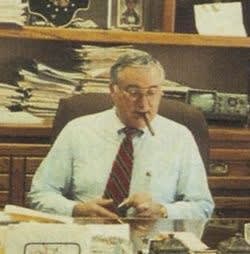
Ed Bobit at his desk, 1990
An excerpt from the moving farewell address by Ron Tonkin, NADA's out-going president, may not properly describe the emphasis and response from a packed arena of dealers and factory management, but it may illustrate why his speech drew a standing ovation.
Of the fleet allowance programs. Tonkin said:
"Well, dealers are mad. They are rightfully mad about fleet subsidies, or more correctly, daily rental company subsidies, and they are saying, 'That's enough.'
"Dealers have their whole lives invested in their dealerships. Everything in support of the supposed exclusivity of the franchise. But our suppliers, the automakers, gluttonously invested in daily rental companies, and thus began their secondary distribution system to the public, undermining their own loyal dealers by subsidizing new partners to the tune of - in some cases - thousands of dollars a unit, requiring little investment compared to their dealers.
"Need proof? Listen to this commercial recently from Indianapolis. (Here Tonkin plays a rental company tape depicting the economical price availability of almost-new, used cars with low mileage, etc.)
"Listen to us, automakers. Hear us, automakers. Your dealers' combined voices are telling you... 'Sell to no one for less than your loyal, franchised dealers.'"
Tonkin seemed almost prophetic, when, a short period later, he introduced Chrysler Corporation Chairman Lee Iacocca to this crowd which he had left emotionally-stimulated. To Iacocca's credit, he met the issues head-on, and with candor. Said Iacocca in response:
"The rebate game is getting a little absurd. Fleet giveaways are getting out of hand. As for Ron's (Tonkin's) 'love' of fleet discounts...Well, I want to be careful what I say. The fleets have been good to us at Chrysler; they helped save us when we almost went down for the count.
"And they're very important to our future ability to utilize capacity and if you don't utilize capacity, you're dead.
"But now, I'll admit, it's gotten a little crazy. Too many buybacks, pouring too many low-mileage current model cars through the distribution system at prices that undercut new cars and destroy resale values. Now, that's bad.
"At Chrysler, we try hard to ensure that all cars go back through the auction system to our own dealers...So, that they, at least, can book the retail profit. But it's still too many. And the short-term deals are too short and too sweet. And it's time to blow the whistle.
"So, if you're mad at the fleet business in general - and Fm not with you - but if you're mad at what's happening in short-term, buy-back deals...I am with you. But don't yell at me, okay? Start yelling at your own manufacturers - domestic and import."
What makes all of this discussion historic is that as Tonkin was finishing his farewell remarks, he departed from his text to announce that three of his dealerships (Chevrolet, Lincoln-Mercury, and Dodge) had just filed a lawsuit in Oregon. The defendants - all of whom the lawsuit accuses of price discrimination - are automakers GM, Ford, and Chrysler, plus the following auto rental companies: Hertz, Avis, National, Alamo, Budget, and Dollar. The eventual outcome could very possibly affect every fleet buyer.
More Operations

Fleet Has a Talent Pipeline Problem. What Comes Next? | AF News Recap
Where will fleet’s next generation of leaders come from? This week, we’re looking at the industry’s talent pipeline, what certification can add to a fleet career, how to build an award-worthy track record, and the return of Automotive Fleet’s Personal Use Survey.
Read More →
Smith System Launches Driver Risk Management Program
Fleets have more driver data than ever, but identifying risky behavior doesn't necessarily correct it. Smith System's new Driver Risk Management program combines monitoring, training, and follow-up coaching to help fleets connect risk signals with driver intervention.
Read More →
Automotive Fleet Opens 2026 Personal Use Survey for Commercial Fleet Managers
Less than two weeks left! Commercial and corporate fleet managers are invited to share how their organizations handle company vehicle personal-use policies, charges, and driver eligibility.
Read More →
From AI Prompts to AI-Generated Safety Songs | AF News Recap
Can better prompts make AI more useful for fleet managers? This week, we’re breaking down smarter fleet analysis, an AI-assisted experiment that turned safety training into music, and what happened to fuel prices in August.
Read More →
How to Write Better AI Prompts for Fleet Analysis
Include these six elements in your fleet prompts to generate more relevant analysis and accurate answers.
Read More →
Fleet Meets: Eric Kilgore
This edition of the Fleet Meets series features one of the industry's best leaders driving multi-market and national operations.
Read More →
Why Reactive Fleet Management Is Becoming Too Expensive to Sustain
Research highlights a growing need for proactive management strategies to address rising costs in fleet operations effectively.
Read More →
What Your Fleet KPIs Aren’t Telling You
Tracking fleet metrics is only useful when the data leads to better decisions. This guide helps fleet leaders assess cost, utilization, and downtime more accurately, identify performance gaps, and prioritize the actions that can improve operational results.
Read More →
Hidden in Plain Sight: Fleet Compliance Risks
Fleet compliance isn't just about having policies — it's about consistently enforcing them. This practical guide reveals six hidden compliance risks common in public sector and shared fleet operations and outlines proven strategies to improve visibility, accountability, and audit readiness
Read More →
Turning Fleet Payment Data into Executive Insights
Does data alone drive results in operations?
Read More →