




Ed Bobit's Publisher's Page
My name is Barbara (Bobit) Logue. I'm 27 now, still happily married, living in Scottsdale, and proud to have brought Pops his first grandchild, a colleen lass named Katie Lynn Logue.

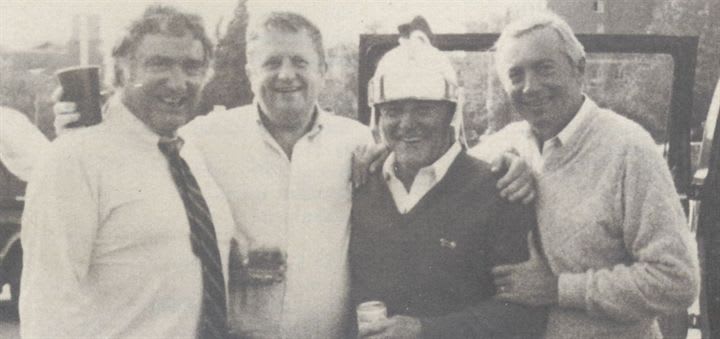
After an Oldsmobile "plant tour" Pops met with industry men (from left) George Lillis (Dresser Leasing), Earl Gray (AF's Chicago manager), Pierce Walsh (IC Industries) for a Michigan State-Notre Dame game.
Chrysler Chairman Lee Iacocca met with UAW honchos before contract talks reopened recently and started grumbling about health-care costs. "We did a survey and found out that, on the average every Chrysler employee, hourly and salaried, had four blood tests last year," Iacocca told the union bigwigs. "G—damn it, I didn't have any blood tests last year, so that means some SOB had eight of them." We wish they'd stop needling Lee. . .
Said Canadian multimillionaire Nelson Skalbanie in 1979, explaining the secret of his success: "Three groups I never use for advice are lawyers, accountants, and, hank managers."
Skalbanie currently is $30 million in debt and, facing bankruptcy, according to a chartered accountant for the company that will act as his trustee. -Two recent newspaper items.
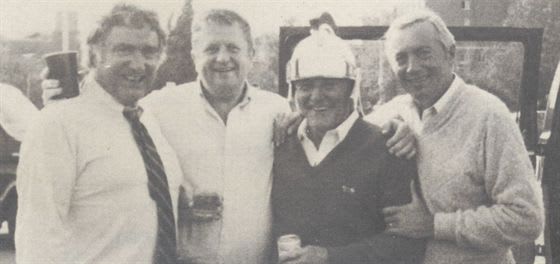
My name is Barbara (Bobit) Logue. I'm 27 now, still happily married, living in Scottsdale, and proud to have brought Pops his first grandchild, a colleen lass named Katie Lynn Logue. Pop was really happy until my brother, Ty, produced the insurance of another generation of Bobits with Blake Edward; now Pop (grandpa) is ecstatic. He's also scheduling his very selective "business" trips: the AALA meeting here in Arizona, NADA in Vegas, studying the daily rental business in Martinique, Antigua,
and St. Thomas via a cruise, and taking a special Oldsmobile plant tour (see photo above) where he met with industry men for serious discussion on fleet sales. Pictured with Pop are George Lillis from Dresser Leasing; Earl Gray, AF's Chicago manager; and Pierce Walsh from IC Industries. (The four Irishmen took in the Michigan State-Notre Dame football game in East Lansing after the "plant tour.") Naturally, I'm stuck with writing this page again during his most demanding season.
Automobile manufacturers (including GM this year) certainly made every one of us believers that they are competitive with their "free air" offers available to virtually all fleets on orders before the first of the year. Some tell me that it may not have sold many cars, but it surely built up the order bank into Detroit computers before the first of the year. I just want to meet that unbeatable genius who has to translate all those orders into production schedules. And if it should be that there really weren't that many more extra cars ordered, couldn't that equate to some 500,000 cars (half the year's fleet orders) times $400 (air conditioning allowance) or (if my arithmetic is correct) $200,000,000. Wow!
Between the IRS and fleet incentives, we do know that we're making one heck of a year for accountants, lawyers, tax counsels, computer programmers and schedulers, and those people who make air conditioners.
It's crazy. No wonder Pop gave up on the Beefeaters a year and a half ago. Somehow, we've got to pull together to strengthen the economy, improve buyer confidence in the future, and bring some sanity to the professional buying and selling process. Pop says that fleet business is good business with good people, and he knows they'll emerge wiser and better than ever. And I believe what he says.
More Operations

Fleet Has a Talent Pipeline Problem. What Comes Next? | AF News Recap
Where will fleet’s next generation of leaders come from? This week, we’re looking at the industry’s talent pipeline, what certification can add to a fleet career, how to build an award-worthy track record, and the return of Automotive Fleet’s Personal Use Survey.
Read More →
Smith System Launches Driver Risk Management Program
Fleets have more driver data than ever, but identifying risky behavior doesn't necessarily correct it. Smith System's new Driver Risk Management program combines monitoring, training, and follow-up coaching to help fleets connect risk signals with driver intervention.
Read More →
Automotive Fleet Opens 2026 Personal Use Survey for Commercial Fleet Managers
Less than two weeks left! Commercial and corporate fleet managers are invited to share how their organizations handle company vehicle personal-use policies, charges, and driver eligibility.
Read More →
From AI Prompts to AI-Generated Safety Songs | AF News Recap
Can better prompts make AI more useful for fleet managers? This week, we’re breaking down smarter fleet analysis, an AI-assisted experiment that turned safety training into music, and what happened to fuel prices in August.
Read More →
How to Write Better AI Prompts for Fleet Analysis
Include these six elements in your fleet prompts to generate more relevant analysis and accurate answers.
Read More →
Fleet Meets: Eric Kilgore
This edition of the Fleet Meets series features one of the industry's best leaders driving multi-market and national operations.
Read More →
Why Reactive Fleet Management Is Becoming Too Expensive to Sustain
Research highlights a growing need for proactive management strategies to address rising costs in fleet operations effectively.
Read More →
What Your Fleet KPIs Aren’t Telling You
Tracking fleet metrics is only useful when the data leads to better decisions. This guide helps fleet leaders assess cost, utilization, and downtime more accurately, identify performance gaps, and prioritize the actions that can improve operational results.
Read More →
Hidden in Plain Sight: Fleet Compliance Risks
Fleet compliance isn't just about having policies — it's about consistently enforcing them. This practical guide reveals six hidden compliance risks common in public sector and shared fleet operations and outlines proven strategies to improve visibility, accountability, and audit readiness
Read More →
Turning Fleet Payment Data into Executive Insights
Does data alone drive results in operations?
Read More →