




Donlen Pioneers Computer-Based Fleet-Leasing Seminars
Launched last December, the seminars are a way for Donlen, which is based in Skokie, IL, to inform fleet mangers about new developments in the field. "You can read or hear about these developments, but that doesn't have the same impact as actually seeing them for yourself," says Paul Hilder.
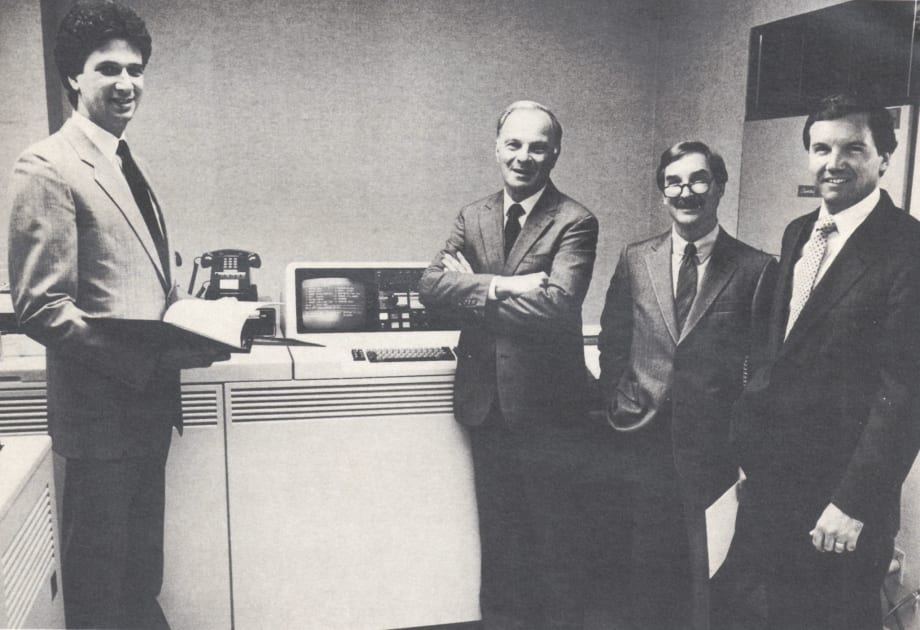
(L-R) Steve Dudley, Don Rappeport, Ben Bilski, and Bob Piot pose with Donlen's new vehicle-management computer.
(L-R) Steve Dudley, Don Rappeport, Ben Bilski, and Bob Piot pose with Donlen's new vehicle-management computer.
In a darkened room, 25 pairs of eyes are riveted on a 10-foot screen. A video projector connected to a portable computer brings "menu" into focus. The menu demands choices -choices that are critical for fleet mangers. Pushing the right button can mean thousands of dollars saved -or lost. A buzz of excitement runs through the room as vehicles are chosen and options are picked. Seconds after the choices are entered, they are relayed by a modem over telephone lines. Weeks are chopped from the ordering process in a matter of minutes. After the fleet has been ordered, people look searchingly around the room, like a magician's audience looking for hidden strings.
No strings are attached to this simulated demonstration of computerized fleet ordering. It is the focal point of Donlen Corporation's innovative fleet-leasing seminars. Launched last December, the seminars are a way for Donlen, which is based in Skokie, IL, to inform fleet mangers about new developments in the field.
"You can read or hear about these developments, but that doesn't have the same impact as actually seeing them for yourself," says Paul Hilder, Donlen's director of maintenance and a seminar leader.
Hilder explains that Donlen, a leading vehicle-management firm, has created the software that allows companies to take advantage of a computer's time- and cost-saving capabilities.
"Yet many people in our field are naturally uncertain about something they have never used before," he says. "The seminars help eliminate that uncertainty."
The first series of seminars concentrate on fleet ordering and maintenance. The seminars, which are free and open to anyone in the vehicle-management business, have been held in such major cities as Chicago, Atlanta, Houston, New York, and New Jersey. They feature demonstrations, brief talks by seminar leasers, and question and answer sessions. Seminar attendees have included fleet administrators, directors of purchasing, vice presidents of finance, and data processing specialists.
Don Rappeport, Donlen's president, originated the seminars in response to the changing nature of the business.
"Vehicle manufacturers have given us the opportunity to act as dealers, to communicate directly with the factory," he says. "To ignore this opportunity is a serious mistake. With computer technology, we can capitalize on it, saving customers significant time from the day they order to the time they receive their vehicles. I believe the seminars are stimulating discussion, allowing companies to weigh their computer options."
According to Bob Piot, Donlen's vice president of sales and a seminar leader, computer technology helps remedy a major problem facing the industry today. Piot explains that last year many customers became new car buyers. As those consumers returned to the market, fleet customers were forced to wait 12 to 14 weeks longer than the normal waiting period. "Time has become an even more critical factor than ever before," he says. "In our seminars, we show people how they can get factory order numbers the day after ordering, as status reports and daily updates."
Bob Piot adds that although response to the ordering portion of the seminar has been positive, attendees seem to be even more interested in computer maintenance applications. He attributes that interest to the changing economy. "In boom times, companies tended to order in bulk," he says. "Then, their primary concern was obtaining vehicles as quickly as possible to keep up with demand. Now, fleets have been trimmed, and there is a greater emphasis on cost-efficiency."
Piot notes that people's eyes light up when they see how the computer can access data and provide important cost information. "It really hits home when we start demonstrating the actual cost savings by controlling the variable expenses," he says. "We take a company with 250 vehicles and an average of 30,000 annual miles per vehicle. By using our National Account Service Program, operating more efficient vehicles, and relying on our Telenetwork System to track maintenance expenditures, we can save a company one to three cents per mile. Translated into dollars, that's potential savings of $150,000 a year."
Paul Hilder, Donlen's director of maintenance, explains that variable expenses, such as gas, oil, tires, and maintenance, are tangible items that can be directly controlled, unlike new car prices and interest rates. Donlen offers a wide spectrum of maintenance cost control programs, and he adds that those programs are designed to offer the necessary tools for the fleet administrator to manage all or any portion of his variable expenditures.
Rappeport is extremely pleased with the response to his company's seminars, and more are planned in the coming months. He sees the seminars evolving with the industry, focusing upon new trends, technologies, and events that are of paramount importance to vehicle management.
"It is important that people in our business have a forum to exchange information, to ask questions, and have them answered. Computers are the topic today. Tomorrow, who knows?"
Rappeport insists the seminars-no matter what their topics-be flexible. He explains that the present seminars do not promote a rigid point of view, that one computer ordering or maintenance approach is right for everyone. He says it is necessary to view these new tools as adaptable to a company's specific vehicle-management needs. "A company with 500 vehicles will use it differently than one with only 50," he says.
According to Rappeport, one philosophical perspective of Donlen in communicated in the seminars: The importance of the human factor. Despite the emphasis on computer technology, the seminars also stress the human component-the people with the knowledge to interpret the data and respond to it.
"I like to think we practice what we preach," he says "We do not just input data. We have an 800 number for our customers to call. They can talk to people in our in house maintenance department who help them interpret data. We have found that the value of a computer is directly tied to the value on the people using it. In our vehicle management seminars, we put both of them to work."
More Operations

Fleet Has a Talent Pipeline Problem. What Comes Next? | AF News Recap
Where will fleet’s next generation of leaders come from? This week, we’re looking at the industry’s talent pipeline, what certification can add to a fleet career, how to build an award-worthy track record, and the return of Automotive Fleet’s Personal Use Survey.
Read More →
Smith System Launches Driver Risk Management Program
Fleets have more driver data than ever, but identifying risky behavior doesn't necessarily correct it. Smith System's new Driver Risk Management program combines monitoring, training, and follow-up coaching to help fleets connect risk signals with driver intervention.
Read More →
Automotive Fleet Opens 2026 Personal Use Survey for Commercial Fleet Managers
Less than two weeks left! Commercial and corporate fleet managers are invited to share how their organizations handle company vehicle personal-use policies, charges, and driver eligibility.
Read More →
From AI Prompts to AI-Generated Safety Songs | AF News Recap
Can better prompts make AI more useful for fleet managers? This week, we’re breaking down smarter fleet analysis, an AI-assisted experiment that turned safety training into music, and what happened to fuel prices in August.
Read More →
How to Write Better AI Prompts for Fleet Analysis
Include these six elements in your fleet prompts to generate more relevant analysis and accurate answers.
Read More →
Fleet Meets: Eric Kilgore
This edition of the Fleet Meets series features one of the industry's best leaders driving multi-market and national operations.
Read More →
Why Reactive Fleet Management Is Becoming Too Expensive to Sustain
Research highlights a growing need for proactive management strategies to address rising costs in fleet operations effectively.
Read More →
What Your Fleet KPIs Aren’t Telling You
Tracking fleet metrics is only useful when the data leads to better decisions. This guide helps fleet leaders assess cost, utilization, and downtime more accurately, identify performance gaps, and prioritize the actions that can improve operational results.
Read More →
Hidden in Plain Sight: Fleet Compliance Risks
Fleet compliance isn't just about having policies — it's about consistently enforcing them. This practical guide reveals six hidden compliance risks common in public sector and shared fleet operations and outlines proven strategies to improve visibility, accountability, and audit readiness
Read More →
Turning Fleet Payment Data into Executive Insights
Does data alone drive results in operations?
Read More →