Does the Future Hold a P&L for Every Fleet Vehicle?
Technology has made available to fleet managers today a wider variety of data than ever before, more quickly, more accurately, and more completely. Can that data be used to create a “P&L” for each vehicle?
by Staff
September 1, 2008
4 min to read
The information age rolls on. In today's business environment, data is king, securing its throne more and more every day.
Few functions involve data in more volume than fleet management. Each day, drivers going about the company's business conducting transactions for fuel, tolls, parking, maintenance and repair, and other fleet expense. Add the "automatic" creation of fixed cost data and the complete picture of vehicle holding costs is available in nearly real time.
Ad Loading...
Fleet management is data management; managing a far-flung company asset is impossible without easy access to data. But that's only the cost side. Is there an income side? There can be. Drivers of company vehicles create income, and that's the only element missing to create a profit and loss statement (P&L) for each vehicle.
But is there value in developing P&L figures for individual company vehicles? Is this activity merely a matter of toying with interesting, but useless, information? Since developing vehicle-specific P&Ls hasn't been done on any widespread basis, the question is a good one.
Begin with Fleet Expense
It is important to begin at the beginning, with data most familiar to fleet managers. There are two primary categories of fleet expense: fixed and variable. Incurred in the acquisition and ownership (or lease) of vehicles, fixed costs include the following:
Depreciation – during the vehicle's time in service, the depreciation reserve; after it is sold, actual depreciation or the difference between the original cost and proceeds from its sale.
Insurance– includes accruals for physical damage as well as a corporate charge for liability coverage.
License/Title/Tax – including personal property tax when applicable, registration renewals, and inspection costs and retitling when vehicles are moved.
Variable costs are those incurred in the operation of the vehicle:
Ad Loading...
Fuel.
Maintenance/Repair.
Tires.
Oil.
Fleet expense data is captured in various forms, some tied to an outsourced fleet program, others via expense report.
Technology has enabled the electronic capture and manipulation of most fleet data. Traditionally, fleet managers have used the data in a cost/use ratio format, in cents per mile or dollars per month. A fleet vehicle's efficiency is measured against either internal or external benchmarks, and vehicle selection decisions are made using these methods.
Creating a Fleet Income Line
While fleet expense is familiar to a fleet manager, the factor of income is less so. A P&L cannot be established without an income line. However, such accounting can be accomplished in a number of ways.
The simplest and easiest "income" line to use for a vehicle P&L is sales, when applicable. Sales vehicles generate income as the driver goes about the job, selling company products and services.
Ad Loading...
Another possible method applies a company's EBIT (earnings before income tax) percentage to sales, then using the resulting number. Still a third method is using the net-after-tax income rate to create the revenue line.
The net income numbers described might not be entirely accurate. In the company's income statement, vehicle expense is already accounted for and thus, the percentages are moot. The gross sales number might be more accurate. However, the purpose of a fleet P&L is simply for comparative purposes, not financial accuracy. Thus, using EBIT or net profit percentages, applied to the sales number, will make the numbers more manageable.
Vehicle P&L Covers Cost Efficiency
Traditional financial P&L statements incorporate several items:
Revenue.
Expense.
EBIT.
Taxes.
Net income.
The vehicle P&L, as simply a means to measure cost efficiency, doesn't have an established format. The important step is creating a new means to measure the cost efficiency of a particular vehicle; the format isn't as critical.
Ad Loading...
Let's say, for example, a salesman creates $100,000 in sales each year. Vehicle expense is:
Monthly Lease Cost:..$400
Insurance:................ $100
License/Title/Tax:....... $25
Fuel:......................... $400
Ad Loading...
Maintenance/Repair:.. $50
Tires/Oil:.................. $150
Total Monthly Cost: $1,125
Total Annual Cost: $13,500
The simple vehicle P&L for this scenario is :
Ad Loading...
Annual Income:. $100,000
Annual Expense:. $13,500
Net Income: $86,500
How is this information valuable? Rather than judging the efficiency of a fleet vehicle simply on how low its overall expenses stack up, a P&L view provides a true picture of a vehicle's value to the company, and further, might be applicable to express a driver's productivity. The individual vehicle P&L is a concept that has been used in the trucking industry for some time, and the concept may be ready for application in the light-vehicle fleet industry as well.
BBL Fleet expanded its footprint in the fleet management industry with the acquisition of Velcor Leasing Corporation of Madison through a stock purchase agreement finalized Feb. 27, 2026.
Fleet leaders are under pressure to reduce costs, adapt to economic uncertainty, and make smarter decisions. See how peers across North America are responding with real data, proven strategies, and forward-looking insights. Download the 2026 Market Pulse Report to benchmark your strategy and uncover where you can gain an edge.
AI is no longer a future concept for fleets—it’s already embedded in the tools, data, and decisions that operators rely on every day. In this episode of the Fleet Forward Podcast, recorded live at Fleet Forward, industry leaders take the conversation beyond hype to examine what responsible AI adoption really looks like in fleet operations.
As fleets rethink how they capture, manage, and act on vehicle data, telematics is at a major inflection point. In this episode of the Fleet Forward Podcast, we dive deep into one of the most pressing questions facing fleet leaders today: Should you rely on OEM factory-installed connectivity, aftermarket devices, or a hybrid of both?
Experts from telematics analytics, fleet-as-a-service operations, and national EV benchmarking share how real-time data is reshaping fleet strategy—dispelling assumptions, validating best practices, and exposing costly missteps.
A powerhouse panel featuring experts from the American Automotive Leasing Association, CalSTART, and municipal fleet leadership dives into the realities of navigating shifting emissions rules, regulatory waivers, federal agency actions, the future of the EPA’s endangerment finding, and the push for unified standards. They also examine the impacts of tariffs, autonomous vehicle policy, battery innovation, and the accelerating global EV market.
This episode kicks off with a deep dive into the technologies and market forces reshaping today’s fleet landscape. Host Chris Brown is joined by Laolu Adeola (Leke Services), Tyson Jomini (J.D. Power), and Richard Hall (ZappiRide) to break down real-world data, shifting incentives, and practical strategies fleet leaders can use right now.
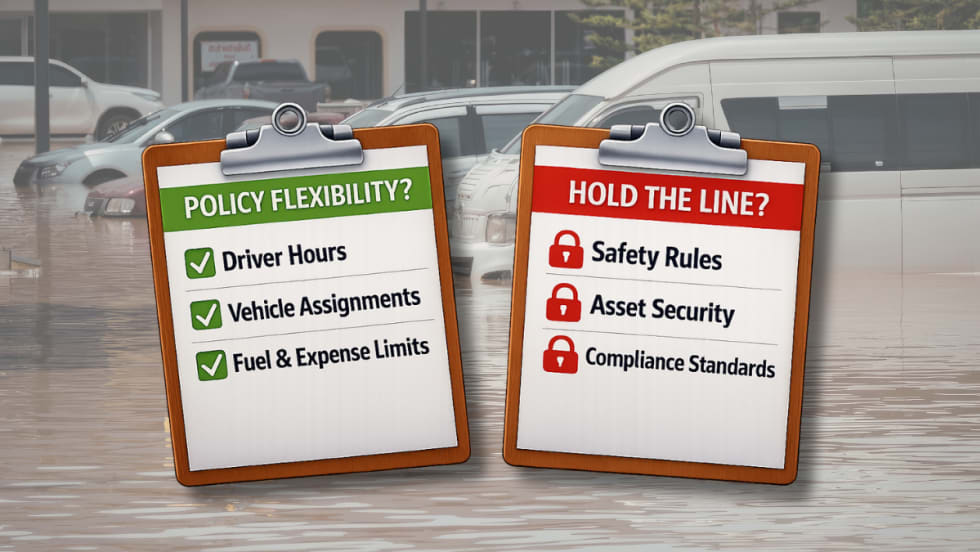
In the middle of natural disasters fleet managers must shift priorities to protect people and assets. What policy items should be loosened, and when should the line be held?