




Did you Know? How to Balance Truck Application Against Resale
Determining the Optimal Lifecycle for Truck Fleets
Waiting too long can result in unnecessary wear-and-tear, expense, and lost productivity. Making the decision too soon can result in higher capital expenses and depreciation costs. The key is finding the perfect balance.
by Staff
November 18, 2014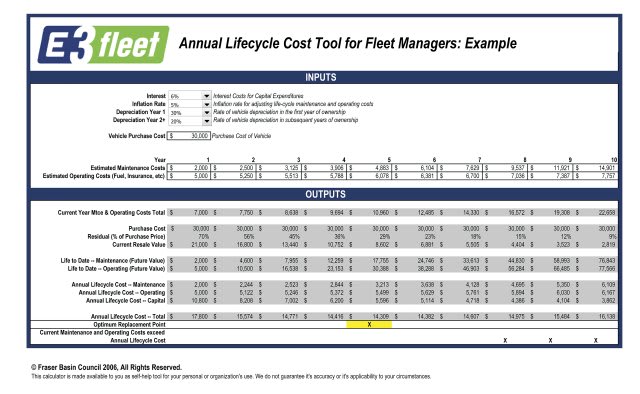
Lifecycle cost tools, such as the one illustrated here by E3 fleet, can help fleet managers determine the optimal replacement time frame for trucks, based on important factors. (SOURCE: FRASER BASIN COUNCIL 2006)
9 min to read
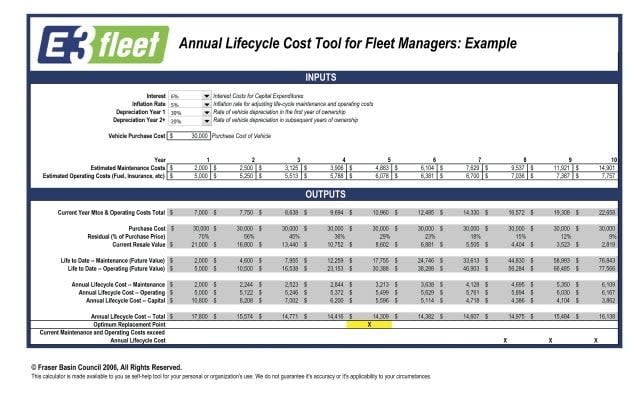
Lifecycle cost tools, such as the one illustrated here by E3 fleet, can help fleet managers determine the optimal replacement time frame for trucks, based on important factors. (SOURCE: FRASER BASIN COUNCIL 2006)
You may start to notice drivers complaining about the worn condition and diminished performance of their trucks. Suddenly, roadside emergencies occur more often, resulting in lost productivity and revenues. Also, truck maintenance costs start to surge, as engines and transmissions need overhauls or replacements.
These are just a few signs that a fleet has kept its trucks too long and needs to address truck fleet lifecycle and vehicle replacement to decrease the risk of disruptions that could cripple the business.
Yet, if a fleet were to replace trucks too soon, it would pay higher capital and depreciation costs because the vehicle loses the highest percentage of its value during the first few years.
“It doesn’t usually make sense to replace vehicles after one year because there would be a high monthly depreciation rate. The earlier in the lifecycle, the steeper the depreciation curve. It begins to level out at around four or five years,” said Collin Reid, truck strategic consultant at GE Capital Fleet Services. “You’re going to have to balance falling fixed costs such as lease and finance payments and rising variable costs including maintenance, repairs, and downtime. If you replace too soon or too much, you burn your fixed costs; if you replace too slow, you burn your variable costs.”
Perform a Lifecycle Cost Analysis
How can fleet managers strike the right balance to determine the best replacement interval?
“The optimal replacement time frame is when you reach the lowest cost portion of the truck’s lifecycle, while also still maximizing the truck’s productivity,” Reid said.
A lifecycle spreadsheet, such as the “E3 Annual Lifecycle Cost Tool for Fleet Managers: Example,” developed by E3 fleet, can help determine the optimal time replacement frame.
Numbers to plug into the spreadsheet include:
Interest costs for capital expenditures.
Inflation rate for adjusting lifecycle maintenance and operating costs.
Vehicle depreciation rate in the first year and the rate in subsequent years of ownership.
Purchase cost of vehicle.
Estimated maintenance and operating costs.
Notice in the provided example how the first year is the most expensive at $17,800. Then, annual costs trend lower until the fifth year, when the annual lifecycle cost is estimated at $14,309 — the lowest cost point in the truck’s lifecycle. The annual lifecycle costs begin to tick upward from year six and later.
In this example the best time to replace the vehicle is around its fifth year in service.
More Art than Science
But, keep in mind, this is a simplified example to provide context and illustrate what it means to say a vehicle is at its lowest annual lifecycle cost. Real-world lifecycle cost analysis is not an exact science. The process requires being able to accurately predict depreciation rates, maintenance costs, operational expenses, etc., which isn’t easy to do. And, the calculations are only as good as the data input.
A fleet management company or fleet consultant can help fleet managers walk through the calculations specific to their vehicles and offer a wealth of vehicle lifecycle data across industries and applications to help determine optimal lifecycle benchmarks for specific trucks.
Fleets can also leverage their own maintenance data to uncover trends where costs spike at particular mileage points to factor into their replacement cycle analysis.
When determining the optimal replacement interval, make sure to account for these six factors:
1. Duty Cycle: Truck Hours vs. Miles
There are some applications where vehicles operate at low annual mileage, but the engine is in use throughout the day, making engine hours a more accurate indicator for lifecycle purposes.
“We’ve seen utility fleets with bucket trucks that only travel 5,000 to 10,000 miles per year, but their engines are operating a whole lot more. So you have to take that into account,” said Reid of GE Capital Fleet Services.
In these high idle-duty cycles, Reid recommended developing a cost-per-hour metric vs. cost per mile.
“Sometimes, the trucks that drive the fewest miles have some of the highest maintenance costs,” Reid said. “That’s because those units are being driven relatively few miles per day but the engines are running 40, 60, or even 100 hours per week.”
2. Work Truck Resale Market
The steepest decline in vehicle value (depreciation) usually occurs during the first two to three years. Then, the rate slows as the vehicle ages.
But, the resale market is not set in stone. What may be a soft market at one point when estimating lifecycle costs could be robust six months later, making a significant impact on the rate of depreciation.
For example, not long after the recent recession in 2008-2009, there was a trend where fleets held onto medium-duty trucks longer, putting off new truck purchases to save on capital expense. This resulted in fewer trucks being released into the used-vehicle market, limiting supply and driving higher resale values.
In these instances, where the secondary market is strong for a particular vehicle, it may make sense to shorten its lifecycle to take advantage of the higher resale value.
In other cases, when the resale market is soft, it would likely make more financial sense to keep the vehicle longer.
3. Impact of Truck Specs
Take, for example, the gasoline vs. diesel question, and how the answer can impact replacement timeframe and annual lifecycle costs.
In medium-duty (Class 4 throig Class 7) trucks, diesel engines are typically rated with a usable life above 300,000 miles, and gasoline engines are built for up to around 200,000.
“We examine client historical data or industry benchmarks and determine that, if we spec a diesel engine, we might expect to see some accelerated maintenance costs after 150,000 miles. Or, if it’s a gasoline engine, we should start seeing accelerated maintenance cost at 100,000 miles,” Reid said.
But, the longer lifecycle offered by diesel comes with a steep price tag, about $7,000 to $10,000 more than gasoline. So, make sure the truck’s application is a good fit (high annual miles, for example) to create sufficient operating cost savings to justify the higher initial capital investment.
4. New-Vehicle Technologies
Newer, fuel-sipping engines and more aerodynamic body designs could cause fleets to replace vehicles sooner than they originally intended because of the prospect of substantial fuel cost savings.
Consider how much of a difference only five years can make on fuel efficiency by comparing the U.S. Environmental Protection Agency (EPA) fuel economy ratings of a 2009 pickup two-wheel drive and a comparable 2014 model.
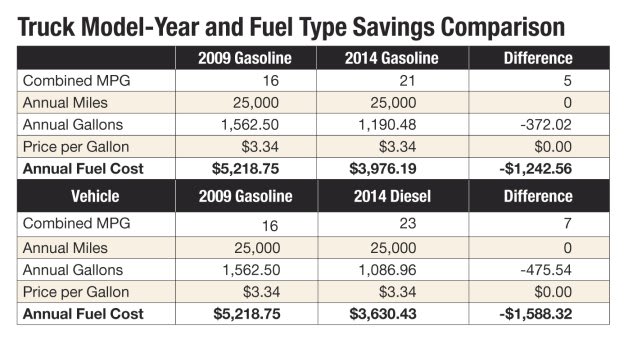
Comparing two of the same model gasoline-powered trucks in 2009 and 2014, the newer model truck burns 372 fewer gallons than its predecessor model. Comparing a 2009 gasoline engine to a 2014 diesel engine finds a savings of 475 gallons of fuel.
According to www.fueleconomy.gov, the 2009 truck, powered by a 3.7L, six-cylinder gasoline engine, is rated at 14 mpg city/20 mpg highway and 16 mpg combined; the 2014 model comes in at 18 mpg city/25 mpg highway and 21 mpg combined.
So, with enhanced technology and body design over a span of five model years, the 2014 model truck offers a 5-mpg (31%) improvement in combined fuel economy.
How does this translate into fuel cost savings? As of August 2014, the national average for gasoline is $3.34, according to AAA’s fuel gauge report. Therefore, at 25,000 annual miles, the 2014 truck burns about 372 gallons fewer than the 2009 model, saving $1,242 per year.
And, these numbers don’t account for any drop in fuel economy as the older vehicle ages. According to Reid at GE Capital Fleet Services, fleet managers should expect about 1% to 2% fuel economy degradation per year. Over a five-year span, that’s as much as a 10% drop. If you apply that percentage to the 2009 truck at 16 mpg combined, that truck is likely performing at 14.4 mpg, further expanding the fuel efficiency gap with the 2014 model.
The 2014 truck also offers a new diesel option (unavailable in 2009) with a combined fuel economy rating of 23 mpg, a 43.75% improvement over the 16 mpg combined rating for the 2009 model with the V-6 gasoline engine.
As government fuel economy standards become more stringent over the next decade, not only on light-duty but also with medium- and heavy-duty trucks, this trend is sure to continue.
“One of the highest operational costs is fuel, which directly impacts your lifecycle analysis calculations,” said Joe Brightwell, manager of truck engineering for Wheels Inc. “If you try to hold onto the truck over 10 years, you might not be getting the benefits of the technology from the new vehicle.”
5. Driving Location & Regions
Harry Samp, truck engineer at Wheels Inc., recommended tailoring the lifecycle cost model based on the vehicle’s work environment.
“You could have two trucks doing the same job, such as pickup and delivery, but the location could impact vehicle lifecycle, depending on type of usage, terrain, climate and other factors,” Samp said.
For example, a vehicle that travels on mountainous terrain puts more strain on the brakes and powertrain, accelerating the wear and maintenance cycles, compared to a truck performing the same job on flat roads.
Or, an urban delivery truck that has several stops per day will wear out brakes faster than a vehicle that’s used for over-the-road delivery with fewer stops per day.
“I might have to put my New York City delivery vehicles on a shorter lifecycle because of the high frequency of stops than I would my vehicles that operate in more rural areas that operate more frequently at highway speeds,” Samp said.
6. Fleet Risk Tolerance
Samp advised a fleet assess how much risk of vehicle downtime it can tolerate. The more risk tolerance, the longer a fleet might be willing to keep the vehicle.
“If a fleet is risk averse about downtime, they might want to plan on a shorter lifecycle to optimize the resale value of the vehicle and completely eliminating downtime or maintenance costs. That’s probably around 60,000 miles or four years. Or, you may take it out to six- to eight-year period, maybe up to 100,000 miles,” said Samp of Wheels.
Some fleets can tolerate risk of taking their trucks to the brink of breakdown, depending on the truck’s application. “If the truck build is not too complex, they might be able to afford to be a bit more risky because they can quickly find a replacement vehicle out of dealer stock or as a short-term rental to minimize downtime,” Samp said. “If it’s a very complex and unique build, where it’s hard to replace with a rental truck, or the fleet doesn’t have spare vehicles, then you would be in a situation where you might not want to replace the vehicle sooner to reduce downtime risk.”
When assessing risk tolerance, fleet managers should include cost of downtime in their analysis.
“Fleet managers need to know, what is the cost of downtime? Every business is different. If this is a truck that is used in the oil fields and it breaks down, it could cost the company hundreds or even thousands of dollars per hour in lost productivity, depending on the role of the truck,” said Reid of GE Capital Fleet Services.
If a truck stays in service too long, the impact of downtime could cripple a business. “Fleets get a truck to do a job, and if the trucks aren’t productive, that affects the entire organization. So the organization as a whole will react to having older trucks,” Reid said.
The key is to determine at which point the risk of unplanned vehicle maintenance outweighs the “reward” of lower capital expense. Or, as Brightwell of Wheels puts it: “Any time your total cost of operations starts to exceed the remarketing value to resell the truck, then it’s time to consider that the lifecycle might be over for that truck.”
According to Reid, “If you keep your vehicles too long, your company becomes more focused on solving maintenance issues while your drivers and operations spend less time with your customers.”
Topics:Spec'ingLifecycle CostsTruck LifecycleTruck ResaleMedium-Duty TrucksLight-Duty TrucksVehicle ResearchOperations
Originally posted on Work Truck Online
Subscribe to Our Newsletter
More Operations

Fleet Has a Talent Pipeline Problem. What Comes Next? | AF News Recap
Where will fleet’s next generation of leaders come from? This week, we’re looking at the industry’s talent pipeline, what certification can add to a fleet career, how to build an award-worthy track record, and the return of Automotive Fleet’s Personal Use Survey.
Read More →
Smith System Launches Driver Risk Management Program
Fleets have more driver data than ever, but identifying risky behavior doesn't necessarily correct it. Smith System's new Driver Risk Management program combines monitoring, training, and follow-up coaching to help fleets connect risk signals with driver intervention.
Read More →
Automotive Fleet Opens 2026 Personal Use Survey for Commercial Fleet Managers
Less than two weeks left! Commercial and corporate fleet managers are invited to share how their organizations handle company vehicle personal-use policies, charges, and driver eligibility.
Read More →
From AI Prompts to AI-Generated Safety Songs | AF News Recap
Can better prompts make AI more useful for fleet managers? This week, we’re breaking down smarter fleet analysis, an AI-assisted experiment that turned safety training into music, and what happened to fuel prices in August.
Read More →
How to Write Better AI Prompts for Fleet Analysis
Include these six elements in your fleet prompts to generate more relevant analysis and accurate answers.
Read More →
Fleet Meets: Eric Kilgore
This edition of the Fleet Meets series features one of the industry's best leaders driving multi-market and national operations.
Read More →
Why Reactive Fleet Management Is Becoming Too Expensive to Sustain
Research highlights a growing need for proactive management strategies to address rising costs in fleet operations effectively.
Read More →
Sponsored•August 12, 2026
What Your Fleet KPIs Aren’t Telling You
Tracking fleet metrics is only useful when the data leads to better decisions. This guide helps fleet leaders assess cost, utilization, and downtime more accurately, identify performance gaps, and prioritize the actions that can improve operational results.
Read More →
Sponsored•August 7, 2026
Hidden in Plain Sight: Fleet Compliance Risks
Fleet compliance isn't just about having policies — it's about consistently enforcing them. This practical guide reveals six hidden compliance risks common in public sector and shared fleet operations and outlines proven strategies to improve visibility, accountability, and audit readiness
Read More →
Turning Fleet Payment Data into Executive Insights
Does data alone drive results in operations?
Read More →