




Want More? Teach Your Drivers How to Maintain Tires
Deciding to Repair or Replace Run-Flat Tires
What should a fleet professional know when utilizing assets with run-flat tire versus a non-run-flat tire? According to mounting and balancing equipment manufacturers and tire manufacturers the consensus is a run-flat’s unique construction makes them more difficult to mount and demount.
by Bob Ulrich
December 18, 2018
Run-flat tire repair procedures recommended by the U.S. Tire Manufacturers Association (USTMA) are the same for both run-flat and non-run-flat tires.
Photo: Goodyear Tire and Rubber Co.
6 min to read
What should a fleet professional know when utilizing assets with a run-flat tire versus a non-run-flat tire? According to mounting and balancing equipment manufacturers and tire manufacturers, the consensus is that a run-flat’s unique construction makes it more difficult to mount and demount.
However, there is no consensus on whether run-flat tires can be repaired. Tire manufacturers often defer to the vehicle manufacturer’s replacement tire restrictions and recommendations.
Michelin North America Inc., for example, allows its run-flat tires (Zero Pressure) to be repaired under certain guidelines. However, repairing the original equipment run-flat tires on a BMW isn’t an option, per its owner’s manual.
Run-flat tire repair procedures recommended by the U.S. Tire Manufacturers Association (USTMA) are the same for both run-flat and non-run-flat tires. USTMA prefaces this by advising vehicle owners to consult the tire manufacturer for its repair policy and, if applicable, recommended repair procedures.
Can You Patch a Run-Flat Tire?
Most run-flat tires offer safety, weight savings, and more stability than conventional tires because they can support a vehicle and aid in control after a complete air loss situation. However, what do tire manufacturers say about repairing the structural integrity of run-flat tires?
Pirelli Tire LLC
When asked if there are any instances where a run-flat tire can be repaired, a Pirelli Tire LLC spokesperson said no, a run-flat should never be repaired.
According to Pirelli’s Run-Flat Hazzard Policy, “damaged run-flat tires or run-flat tires that have experienced a loss of tire pressure should immediately be replaced with another run-flat tire of identical size and service description (load index and speed symbol).”
Yokohama Tire Corp.
A technical services bulletin from Yokohama Tire Corp. clarifies that Yokohama ZPS run-flat tires should not be repaired following a puncture, severe loss of air pressure, “or other tire disablement.”
“ZPS run-flat tires are covered by the Yokohama standard limited warranty that provides for tire replacement under specified conditions,” the bulletin reads. “Your ZPS tire will be replaced on a prorated basis based on remaining tread depth when the tire has been damaged due to a tread area puncture within the repairable area and limits defined by (USTMA).”
Continental Tire the Americas, LLC
Continental Tire the Americas, LLC, does not recommend repairing Continental SSR (Self Supporting Runflat) tires. The company’s explanation is as follows:
“Even a trained tire specialist may be unable to recognize internal structural damage to a Self Supporting Runflat (SSR) tire resulting from having been driven in an underinflated or zero pressure condition. Such damage may not be visible on the surface of the inner liner or sidewall, making it impossible to determine the tire's suitability for repair. Continental does not recommend any repair to Continental SSR tires. Note: Continental advises if a tire is returned under complaint and the reason for the product’s disablement is in any way associated with a repair or the reason for repair, the manufacturer’s warranty is invalidated.”
“Repairs of run-flats are a major concern,” Chris Davis, Continental’s technical product service manager, said. “Always refer to the tire manufacturer’s recommendations on repairs as it can vary by manufacturer. Some allow a repair, some don’t, and some allow multiple repairs, noting that each repair lowers the speed rating of the tire. Consider your dealership’s liability as the ‘tire expert’ agreeing the tire is not damaged, should you repair the tire without knowing damage between the layers."
“Run-flat tires, by design, have a very thick, stiff compound in the sidewall,” Davis said. "It is typically not the same material that you can visualize on the inside or outside of the tire. If there is a separation between those layers, the dealer and the customer may not know about the condition until the tire has a second incident of low pressure causing the run-flat tire not to work as designed, leaving the customer stranded on the highway or worse, having a rapid air loss and instability of control."
“Use your best judgment based on the tire manufacturer’s suggestions (and) customer safety, and if in doubt, contact the tire manufacturer’s customer service for recommendations,” Davis said.
Some Tire Manufacturers Permit Repair
Although the consensus seems to favor replacement over repair, other vehicle and tire manufacturers say drivers can repair run-flat tires.
Bridgestone Americas Tire Operations, LLC
“Under certain circumstances, run-flat tires can be repairable,” Robert Saul, Bridgestone Americas Tire Operations, LLC's director of consumer product strategy, said.
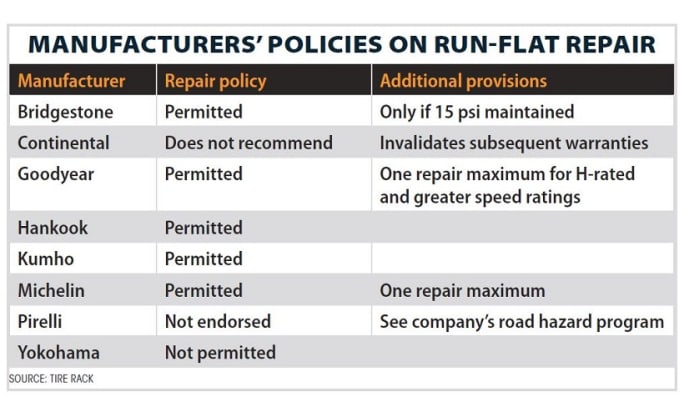
There is no consensus on whether run-flat tires can be repaired. Tire manufacturers often defer to the OEM's replacement tire recommendations.
Source: Tire Rack
“Guidelines vary by vehicle manufacturer, so it’s important for dealers to always abide by the vehicle manufacturer’s recommendations. Many tire manufacturers also publish their repair and service guidelines in the form of technical bulletins, so dealers can check to see if the manufacturer of the tire they are servicing has a technical bulletin that they can refer to as well," Saul said.
“In certain instances, a run-flat tire can be repaired, provided it meets specific guidelines,” Saul said. “These guidelines are contingent upon how far the run-flat tire was driven at low inflation conditions, the amount of air loss experienced, and the overall condition of the tire. A run-flat tire that has experienced a puncture or loss of pressure must be thoroughly inspected for any resulting damage to determine if it can be put back in service.”
Hankook Tire America Corp.
Juan Britos, senior technical services specialist for Hankook Tire America Corp., says Hankook’s run-flat models “can be repaired in the same manner as our standard versions. We design our tires to be repaired as simply as possible."
Use of Run-Flat Tires in Europe
Pete Liebetreu, vice president of marketing for Hunter Engineering Co., said run-flat tires from European and Asian OEM manufacturers are very often mounted to a special wheel with an EH2 (for “extended hump”) bead seat. Nokian “Flat Run” tires are one of many examples.
“We see these wheels every day in the U.S. on BMW, Lexus, Mercedes, Infinity, Toyota, Audi, and other vehicles,” Liebetreu said.
“The EH2 wheel actually creates much of the difficulty in servicing these wheels, more than tire stiffness does. EH2 means the wheel has an extended safety hump, which helps the deflated run-flat stay on the wheel properly in the event of a puncture,” he said.
“For the tire changer, though, that extended hump makes it even harder to service. That’s because the already stiff tire needs to be pushed even further down to be in the drop center for demounting or mounting. Many technicians miss this and end up struggling with the tire that they could easily service if they pressed a little more on the key points with one of the press arms I mentioned earlier.”
A spokesperson from Bridgestone Americas Inc. said EH2 (and EH2+) wheels provide bead retention characteristics desired by car companies; in many cases, they help extend run-flat operating distances and tire suitability, particularly at reduced loads.
“While EH2/EH2+ wheels are considered components of an extended mobility system, they are not explicitly restricted from use without other system components. In other words, EH2/EH2+ wheels may be able to be used with conventional tires or with conventional valves (without TPMS sensors).”
According to Bridgestone’s warranty manual, Bridgestone and Firestone RFT tires should never be replaced or mixed with conventional tires unless on an emergency or temporary basis.
Subscribe to Our Newsletter
More Operations

Here's When You Should Make an Exception to Fleet Policy
Fleet policies are designed to create consistency, but not every driver or situation fits neatly within standard rules.
Read More →
AI-Native or AI-Acquired: What Should Fleet Managers Look for in an AI Platform?
Six questions can help fleet managers look beyond AI marketing claims to evaluate integration, data access, and real-world operational performance.
Read More →
Sponsored•October 14, 2026
A buyer's guide to fleet management software in 2027
Buying fleet management software in 2027 means looking beyond features and price. As fleet operations, technology and expectations evolve, this guide explores what today’s fleet professionals should consider when choosing a system that can deliver value now and adapt to what comes next.
Read More →

What Will Shape the Next Era of Fleet Management?
EVs, AI, and autonomous vehicles are reshaping fleet management. Discover what’s ahead—and how fleet leaders can prepare for the next era.
Read More →
How Fleets Can Recruit and Train Veterans for Technician Roles
Here's how the technician shortage has affected uptime for fleets, and what to do about it.
Read More →
Avis Budget Group Deploys Neology Toll Management Technology Across Major Brands
Neology’s neoFleet platform will manage toll transactions and toll-authority operations for vehicles across Avis, Budget, Payless, Budget Truck and Zipcar.
Read More →
Fleet Personal-Use Charges Edge Higher in 2026
Nearly eight in 10 surveyed fleets allow personal use of company vehicles, while just over half of respondents report charging employees for the privilege.
Read More →
The Future of Fleet + What’s Changing Right Now | AF News Recap
Could developments overseas offer a preview of what’s coming for U.S. fleets? This week, we’re looking at the future of AI, autonomy, and electrification, plus Ford Pro’s new certified pre-owned program, smarter vehicle offboarding, and a new way for fleets to manage toll expenses.
Read More →
How to Handle Vehicle Offboarding
What do fleet managers need to do when a driver leaves?
Read More →
Sponsored•October 1, 2026
Fleet Manager’s Ultimate Playbook: Navigating the New Standard in OEM Connectivity
Rising operating costs, driver safety concerns, and unplanned downtime are putting unprecedented pressure on modern fleets. Discover how fleet managers use embedded OEM connectivity and real-time vehicle data to cut TCO, prevent downtime, and protect drivers without aftermarket telematics hardware.
Read More →